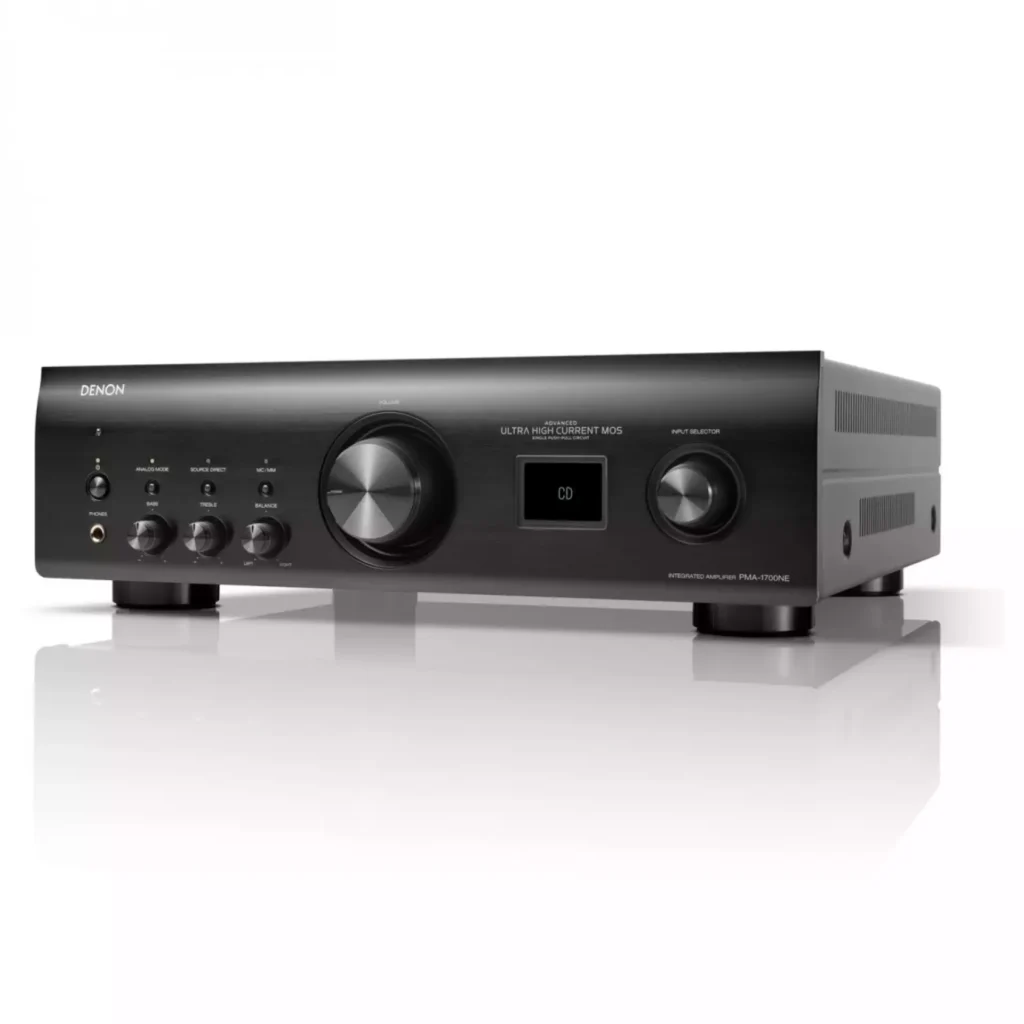
Denon PMA-1700NE is a substantial conventional integrated amplifier with computer USB conversion and a phono stage for suitable moving-magnet or moving-coil cartridges. It does not contain a network streamer, Bluetooth receiver or HDMI ARC interface. This research-based review considers the refined, dynamic presentation described in original European evaluation and the source arrangements that make it useful. It also distinguishes the fixed recorder output from a variable pre-out and explains why TV Auto Play is a narrower facility than full HDMI television integration.
Research-based review. This assessment draws on manufacturer documentation and the original published evaluations linked below. Audio Review has not performed a hands-on test of this model.
Refined clarity and dynamics are supported by original evidence
HIFI.DE’s original evaluation describes a balanced, finely resolved presentation with strong dynamics and useful performance through both digital and phono sources. It also identifies the absent variable pre-out and non-switchable dual speaker terminals as practical limitations. Those observations belong to the tested system rather than an Audio Review hands-on assessment.
Listen with the intended speakers and sources, comparing a natural acoustic recording with more demanding rhythm-led material. Match levels and pay attention to both quiet expression and stronger transients. A refined amplifier should remain involving without making every recording sound artificially smooth. The documented source flexibility is particularly relevant when records and a computer are both important. Room behaviour and loudspeaker balance still influence the result, so use sensible placement before deciding whether a tonal difference comes from amplification. The evidence makes the PMA-1700NE a serious conventional-system candidate. It does not mean the model is automatically a better purchase than a more integrated network product for a different daily routine.
Computer USB audio has a clear role and format limit
The official manual documents USB-DAC playback of supported PCM up to thirty-two-bit, 384 kHz and DSD up to 11.2 MHz. Optical and coaxial inputs have a different supported PCM limit. Those are source-format capabilities, not a promise that higher-resolution files always sound better.
Demonstrate the actual computer and software, using the correct official driver where required. Check device selection, application switching and recovery from sleep. Keep the ordinary collection in the audition instead of judging the system from one unusually large test file. A direct computer connection can reduce the need for another converter, but the computer still manages playback and may be less convenient for another household member than a separate network player. Compare that operating arrangement honestly. Avoid transferring the USB format list to optical or coaxial connections. The amplifier’s useful digital section is strongest when it handles the buyer’s existing sources reliably, rather than becoming a reason to purchase different music or unnecessary accessories.
MM and MC support still require cartridge matching
The phono stage supports both moving-magnet and moving-coil operation with documented input conditions. The original evaluation provides positive evidence for its quality, but that does not make every cartridge equally suitable or remove the need for correct turntable setup.
Check output level and loading requirements before choosing the phono setting. A turntable already supplying line level belongs on a line input unless its stage is deliberately bypassed. Assess hum with sensible separation from the amplifier’s power supply and with a quiet passage of a familiar record. Keep cartridge alignment and record condition consistent when comparing another phono route. The built-in provision may save another box for an appropriate cartridge, which is a meaningful part of the amplifier’s value. A specialist external stage remains reasonable when it solves a specific compatibility or preference issue. It should not be assumed necessary simply because the amplifier performs several functions, nor assumed redundant solely because an MC label is present.
TV Auto Play is useful but remains distinct from HDMI
The manual includes automatic playback behaviour for compatible digital sources. It does not turn the optical connection into HDMI ARC or provide native television volume communication through an HDMI cable.
Test the actual television’s stereo PCM output and check internal applications and external sources separately. Verify wake-up, source selection, lip synchronisation and the remote used for volume. An automatic source change can reduce friction, but the household still needs an understandable way to return to music. Network playback also remains external, and an analogue socket labelled for a network source does not contain a service player. Bluetooth is not built in on this model. Price a suitable streamer or other source if the daily routine needs it. The PMA-1700NE is a coherent conventional amplifier when those choices are intentional. It becomes less convenient if the buyer expects one-box streaming and HDMI control merely because the product includes a modern DAC.
Output and bypass connections should not be confused
The recorder output is fixed level, while EXT.PRE IN is an input for a separately controlled preamplifier. There is no ordinary variable pre-out for feeding another power stage or active system. The dual speaker terminals also do not provide independently selected sources or switched zones.
Plan expansion before purchase. A fixed recording feed needs suitable downstream volume control and should not be treated as a direct substitute for a variable output. Use the documented external-preamp mode deliberately, understanding where volume is controlled. Check permitted speaker loads if both terminal sets are used rather than assuming two pairs are automatically safe together. Try the headphones separately for noise and useful adjustment. Leave ventilation and cable clearance around the substantial enclosure, with appropriate furniture for its weight. These details are manageable in a stable conventional system, but can become limitations for a buyer expecting flexible preamplifier routing. The connector names describe different jobs and should remain distinct in both the review and the actual installation.
Complete-system pricing determines its current value
The manufacturer’s seventy-watt eight-ohm and one-hundred-and-forty-watt four-ohm figures use different bandwidth and distortion conditions. Compare them consistently with a rival’s claims, then assess the intended speaker load and listening requirement rather than ranking products by a single large number.
Include passive speakers, a network source if needed and any specialist phono requirement in the current complete price. Check regional mains suitability, remote, condition and support for a used or demonstration unit. A buyer with a computer and records may use more of the PMA-1700NE’s capability than someone who relies solely on a phone service and television. A separate network source can preserve future flexibility, but adds a control interface and cost. Compare the rack and daily sequence as well as musical preference. Its strongest case combines documented conventional competence with source roles that are already useful. A higher model number alone is not a reason to accept missing facilities central to the household.
Alternatives to consider
Cambridge Audio CXA81 Mk II: Compare computer audio and analogue needs with the actual speakers. Include an appropriate phono stage wherever the alternative does not cover the cartridge directly.
Denon PMA-900HNE: Consider a different Denon platform when HEOS network convenience is more valuable than the PMA-1700NE’s conventional computer and phono arrangement. Compare exact source roles rather than model numbers.
Denon PMA-1700NE key specifications
- Role
- Conventional integrated stereo amplifier-DAC
- Manufacturer output, 8 ohms
- 70 W/channel, two channels, 20 Hz–20 kHz, 0.07% THD
- Manufacturer output, 4 ohms
- 140 W/channel, two channels, 1 kHz, 0.7% THD
- Analogue sources
- RCA line; MM / MC phono; external-preamp input
- Digital sources
- PC-USB; two optical; one coaxial
- USB formats
- Supported PCM up to 32-bit/384 kHz and DSD up to 11.2 MHz
- Optical / coaxial
- Supported stereo PCM up to 24-bit/192 kHz
- Outputs
- Speaker A/B terminals; headphones; fixed recorder output
- Expansion caveat
- No variable pre-out; EXT.PRE IN is an input
- TV feature
- Digital-source Auto Play; not HDMI ARC
- Wireless / network
- No built-in Bluetooth or service streamer
- Dimensions (W × H × D)
- 434 × 135 × 410 mm
- Net weight
- 17.6 kg
Verdict
PMA-1700NE is a strong research-based choice for conventional computer and vinyl stereo, with positive evidence for refined, dynamic music. Plan network and television sources separately, distinguish fixed output from bypass input and check the complete speaker installation. It is most convincing when its actual source arrangement fits the listening routine rather than an assumed feature hierarchy.
Documentation and original reviews
Denon official PMA-1700NE EU owner manual · Denon official PMA-1700NE output specification · Denon official PMA-1700NE supported digital formats · HIFI.DE original PMA-1700NE evaluation
Editorial record
Sources and updates
Product specifications and factual claims were checked against Official Denon PMA-1700NE product page ↗. Scores and buying advice follow our category-specific editorial methodology.
- Published
- November 17, 2026
- Last updated
- November 17, 2026