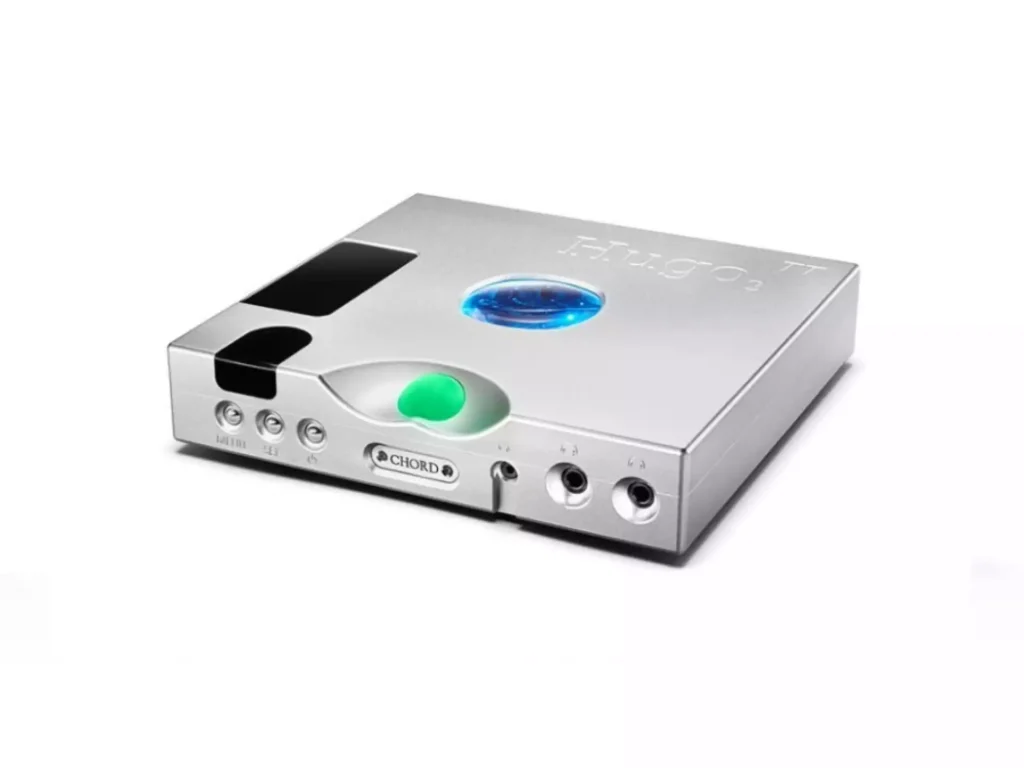
Chord Hugo TT 2 is a premium desktop DAC, headphone amplifier and digital preamplifier with a more substantial role than the transportable Hugo 2. Strong original review evidence supports its musical performance, but its price and menu system demand a deliberate purchase. This research-based review examines how it fits headphones and a stereo system while following current manufacturer connection guidance. Older reviews and enthusiast discussions should not override the present manual when configuring outputs or considering a loudspeaker connection.
Research-based review. This assessment draws on manufacturer documentation and the original published evaluations linked below. Audio Review has not performed a hands-on test of this model.
Resolution and dynamics are the strongest original-review themes
What Hi-Fi’s original TT2 evaluation praises clarity, finesse and dynamic expression, while criticising the menu-driven ergonomics. It finds a meaningful step beyond the smaller Hugo 2 in its reference system. Those are the original reviewer’s findings, not Audio Review listening or measurement results.
Audition with the headphones or stereo system that will actually be used, at carefully matched volume. A more expensive source should demonstrate a useful improvement rather than rely on architecture or reputation to justify itself. Listen to quiet instrumental detail, natural voices and larger dynamic changes across ordinary music. Consider whether the rest of the chain and listening environment reveal the qualities being sought. A premium desktop component can be deeply satisfying without being the sensible first upgrade in every system. The available evidence gives the TT 2 a strong case for a serious audition. Its recommendation remains conditional on a suitable chain, a practical control routine and a price that makes sense beside alternatives.
The desktop power arrangement changes the ownership role
Unlike a transportable battery device, TT 2 uses an external supply and a desktop-oriented power arrangement. Its case, cables and ventilation requirements make it a fixed system component rather than a pocket accessory.
Plan a stable shelf or desk with accessible controls and enough space around the unit. Do not hide it in a poorly ventilated enclosure simply to reduce visible cables. The remote needs a workable line of sight, and the display should be readable from the normal listening position. A matching stack can look attractive, but the manufacturer’s placement guidance matters more than aligning front panels. Check the supplied power unit and relevant regional requirements when buying used. A high-quality component still needs a practical place in the room. If it spends most of its life behind other equipment or the remote is unreliable from the seat, a simpler source may be more enjoyable to own despite a less ambitious technical specification.
Output modes must match the downstream volume control
The current manual distinguishes headphone, variable amplification and fixed DAC modes. Fixed DAC operation bypasses ordinary listening-volume adjustment, so downstream equipment must provide suitable attenuation. Headphone insertion also changes the operating role.
Read the relevant mode instructions before connecting another component. Disconnect and configure as directed rather than cycling through modes while an amplifier is playing music. Begin at low level after a change and verify the active volume-control path. Do not interpret AMP mode as permission to treat every output as a conventional speaker terminal. A power amplifier or active speakers need a supported line connection and a clear gain arrangement. A preset level can also be too high for a particular downstream input even when it is described as line level. Predictable operation matters more than maximum available output. The TT 2 offers useful flexibility, but a buyer should be comfortable establishing one coherent routine for headphones and another documented route for the stereo system.
Current connection restrictions take priority over older demonstrations
Chord’s current manual warns against connecting both RCA and XLR outputs to amplifiers simultaneously, advises against XLR-to-RCA converter cables and says the TT 2 must not be connected directly to loudspeakers. Those instructions should take priority over older descriptions of direct speaker experiments.
Choose one supported line-output route and check the receiving equipment’s manual as well. Passive loudspeakers require appropriate separate amplification. Do not infer a safe connection from a power figure quoted in a forum or a review published under earlier guidance. If an intended system falls outside the documented arrangement, obtain a model-specific answer from the manufacturer or dealer before connecting it. This is especially relevant with a used component, where a previous owner’s adapter may not reflect current advice. The TT 2 can serve a conventional stereo system successfully without improvising its role. The professional installation is the one that uses correct cables and predictable level control, rather than the one that attempts to exploit every possible output at the same time.
Digital flexibility does not include analogue source switching
USB, optical and BNC coaxial inputs cover several wired digital sources, with Bluetooth available for convenience. Special dual-BNC operation belongs to compatible partnering equipment rather than an arbitrary pair of digital cables. There is no analogue input or native network player.
Map the required sources before spending on accessories. A turntable needs an analogue route elsewhere, while a network music service needs a suitable external source. A television can use a supported digital output but does not gain HDMI ARC control through an optical cable. Actual Bluetooth mode depends on the transmitter, and wireless convenience should not be confused with autonomous streaming. Use the relevant driver and supported format for a computer, then check stable everyday playback. The highest rate in a specification does not apply identically to all inputs. An optional upscaler is a separate purchase and should not be treated as mandatory for useful listening. The standard system should meet its core requirement before another costly component is considered.
Menus, filters and package cost deserve equal attention
The TT 2 provides filter and crossfeed options, with a supplied remote that can simplify source selection. These are useful controls, but the original review’s ergonomics reservation is relevant to daily ownership.
Try the actual input-switching and volume routine in a demonstration rather than only listening to one prepared track. Begin without unnecessary processing and compare options individually at sensible level. Crossfeed changes the headphone presentation and remains a preference, not an automatic accuracy upgrade. Check all required inputs, remote operation and output modes on a used example. Include the correct supply and missing accessories in the total price, and compare current local support rather than relying on an old review’s market position. The TT 2 has a strong musical case, but its premium is easiest to defend in a system that can use its performance and flexibility. Simpler controls or a less expensive complete chain may be the better purchase when those advantages are not central to the listening routine.
Alternatives to consider
iFi NEO iDSD 2: Compare a more affordable desktop system if its controls and source connections cover the need. Audition the complete headphone chain before assigning a large budget to conversion.
Topping D90 III Discrete: Consider a separate-DAC approach when an appropriate amplifier is already owned. Include amplification and output-control requirements when comparing the final installed price.
Chord Hugo TT 2 key specifications
- Role
- Desktop DAC, headphone amplifier and digital preamplifier
- Conversion
- Chord custom FPGA; 98,304-tap WTA implementation
- Wired digital inputs
- USB Type-B, two optical and two BNC coaxial
- Wireless convenience
- Bluetooth source selection; actual codec depends on source
- Headphone outputs
- Two 6.35 mm and one 3.5 mm single-ended
- Analogue line outputs
- Stereo RCA or XLR, subject to manual connection restrictions
- USB ceiling
- Supported PCM up to 32-bit/768 kHz; native DSD512 in appropriate mode
- Operating roles
- Headphone, variable AMP and fixed DAC modes
- Control
- Remote, volume ball, filters and crossfeed
- Power / weight
- External supply; approximately 2.53 kg
- Not provided
- Analogue input or native network playback
Verdict
Hugo TT 2 is a compelling research-based high-end desktop DAC/amp with strong original musical evidence. Confirm the control routine, volume modes and current connection restrictions before installation. Its best value lies in a capable digital headphone or stereo system that genuinely benefits from the component, with no need to improvise unsupported speaker connections or add optional equipment by default.
Documentation and original reviews
Chord official Hugo TT 2 product · Chord current TT 2 manual V2.1 · What Hi-Fi original TT 2 evaluation
Editorial record
Sources and updates
Product specifications and factual claims were checked against Official Chord Hugo TT 2 product page ↗. Scores and buying advice follow our category-specific editorial methodology.
- Published
- November 17, 2026
- Last updated
- November 17, 2026