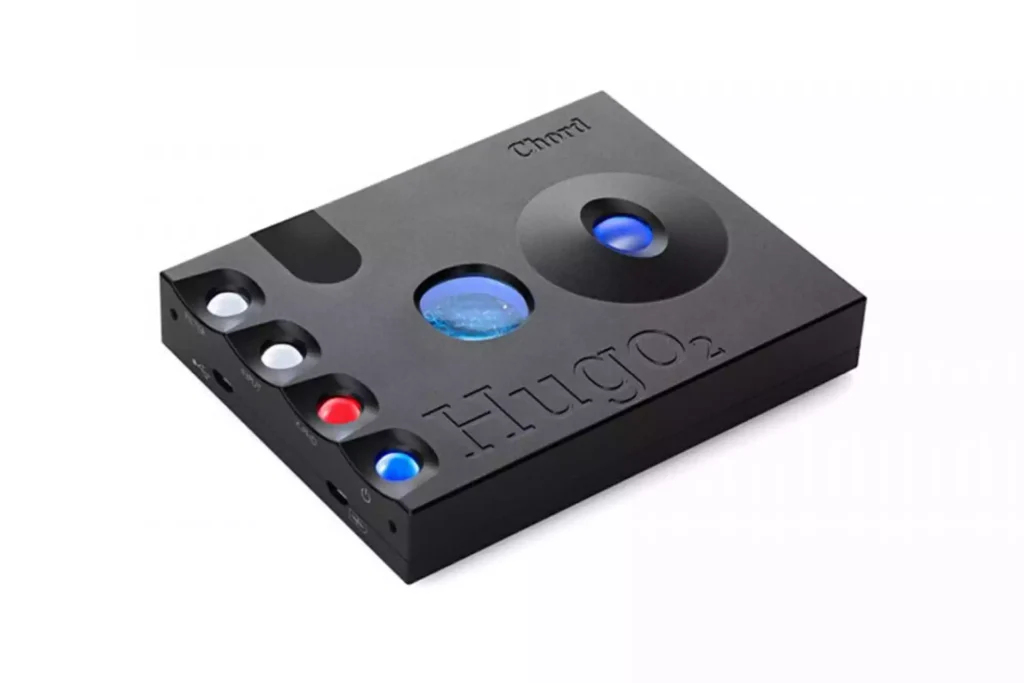
Chord Hugo 2 is a premium transportable DAC and headphone amplifier that can also feed a stereo system through RCA output. Its custom conversion design and colourful controls make it distinctive, while strong original review evidence gives it a serious musical reputation. This research-based review considers that evidence without treating price or architecture as proof of universal superiority. Practical ownership still depends on the headphone, battery, source cables and a clear understanding of the line-level setting.
Research-based review. This assessment draws on manufacturer documentation and the original published evaluations linked below. Audio Review has not performed a hands-on test of this model.
Detailed and coherent in the original musical evaluation
What Hi-Fi’s original Hugo 2 evaluation praises detail, dynamic expression and the coherence of ensemble music. It also identifies the controls and the limits of its claimed portability as practical reservations. These are the source reviewer’s observations, not Audio Review listening findings.
Audition with the transducers and source that will actually be used. Match volume carefully before comparing it with another DAC/amp, and listen to natural voices, small instrumental details and larger musical peaks. A premium converter should be assessed across a normal session rather than only a short impressive excerpt. If a less expensive device already produces quiet and satisfying playback, identify what useful improvement justifies the change. Strong evidence supports the Hugo 2 as a serious candidate, but not a promise that every headphone or speaker system reveals the same difference. The final recommendation depends on the whole chain and on whether the control and connection arrangement remains convenient after the novelty of the design has passed.
Transportable is a more useful description than pocket-sized
The internal battery allows listening away from a power outlet, while the solid case can move between a desk and another location. It remains a substantial component compared with a dongle or very small wireless receiver.
Try carrying the actual phone, DAC and headphone cable arrangement before planning regular walking use. A bag, seat or desk can suit a transportable component better than a tight pocket. Confirm the cable lengths and avoid putting strain on the sockets. A remote is useful in a stationary system, but it does not reduce the bulk of the equipment being carried. The original evaluation’s portability reservation is therefore practical rather than a criticism of battery operation itself. If most listening happens at one desk, compare a dedicated desktop alternative. If the main priority is moving freely with a phone, a smaller receiver may be more convenient. The Hugo 2 makes the clearest sense when its combination of headphone and stereo-source roles is genuinely used across a few locations.
Colour-coded controls need a short learning period
The illuminated buttons and volume wheel identify functions through colour. Filter and crossfeed options add choice, while the supplied remote can make some operations more direct. This is different from a conventional large display with plain-text menus.
Check readability and comfort in the intended room, including low light. Keep the relevant manual available while learning which indication belongs to input, volume or another function. Do not assume that a bright colour means a universally better setting. Start with a simple baseline and adjust one listening option at a time. Crossfeed changes the stereo presentation and may be useful with some recordings, but preference varies. Filters should not be used as a substitute for selecting a comfortable headphone or correcting a source configuration problem. The strongest interface is one the owner can use confidently without interrupting every album. A distinctive control style can be enjoyable, but it should also work for anyone else who may use the system.
Line-level mode needs deliberate use
The Hugo 2 has a preset 3 V line-level setting for connection to suitable equipment. It affects the output arrangement and must not be approached as an ordinary headphone listening level. RCA output is a line connection, not a passive-speaker amplifier.
Reduce level, disconnect inappropriate loads and follow the matching manual before selecting that mode. Confirm that the downstream amplifier provides suitable attenuation. Do not assume a front control behaves identically in every operating state or that a prior headphone setting will protect a different connection. When using an integrated amplifier, establish one clear listening-volume routine. A power amplifier or active speaker system requires particular attention to the source level. Test at low volume after changing the system. The Hugo 2 can be a flexible stereo source, but that flexibility is valuable only when it remains predictable. An owner who frequently changes between headphones and RCA equipment should verify the full sequence rather than rely on a remembered colour or a familiar wheel position.
Digital source support has distinct input requirements
Micro-USB audio, optical, coaxial and Bluetooth provide several source routes. A separate Micro-USB connection handles charging. The coaxial mini-jack is a digital input rather than an analogue input, and special dual-data operation needs the appropriate supported arrangement.
Check cable type and source format for the exact input being used. The highest advertised USB ceiling is not a promise that every connection accepts the same rate. Bluetooth codec use depends on the transmitter and does not create native Wi-Fi service playback. A separately purchased network accessory should not be assumed to be included with a used Hugo 2. Follow official driver guidance for the intended computer mode and test ordinary application switching and return from sleep. Expensive specialist formats are not required to enjoy a normal music library. Stable source selection, appropriate cables and the actual listening result are more useful than forcing a high sample rate to appear in the indicator. The source arrangement should remain simple enough for regular use.
Battery and complete system cost decide long-term value
The manufacturer quotes around six hours of playback depending on headphones and use. That is a claim for a particular design and conditions, not an Audio Review endurance measurement or a guarantee for an older used battery.
Check charging behaviour and a realistic session before relying on the unit for travel. Use the documented charging connection and suitable supply, and assess socket condition on a used example. Battery service is a reason to consult the appropriate support route rather than attempt an improvised replacement. Include the remote, cables and any required network or transport accessory when comparing offers. A premium DAC can remain satisfying for years, but its price should be weighed against the headphones and everyday routine rather than brand reputation alone. The Hugo 2 has strong musical evidence and useful versatility. Its best value appears when those benefits remain audible and practical in the finished system, with battery care and control habits that the owner is comfortable maintaining.
Alternatives to consider
iFi NEO iDSD 2: Compare a different desktop-oriented arrangement if most listening happens in one place. Assess the actual source connections, headphone control and current total price.
iFi iDSD Diablo 2: Consider another premium portable approach with the actual headphone. Available power, control range, bulk and battery routine all matter alongside musical preference.
Chord Hugo 2 key specifications
- Role
- Battery-powered transportable DAC, headphone amplifier and digital preamplifier
- Conversion
- Chord custom FPGA and Pulse Array implementation
- Inputs
- Micro-USB audio, optical, 3.5 mm coaxial and Bluetooth
- Headphone outputs
- 3.5 mm and 6.35 mm single-ended
- Line output
- Stereo RCA
- USB ceiling
- Supported PCM up to 32-bit/768 kHz and DSD512
- Controls
- Colour-coded buttons, volume wheel and remote
- Processing choices
- Four filters and three crossfeed levels plus off
- Line-level preset
- 3 V setting; understand all output consequences before use
- Battery claim
- Around six hours depending on headphones and use
- Not provided
- Analogue input or native Wi-Fi/network playback
- Dimensions (W × H × D)
- 100 × 21 × 130 mm
- Weight
- 365 g
Verdict
Hugo 2 is a compelling research-based premium DAC/amp for a deliberately matched headphone or stereo system. Confirm transportable size, battery condition and output-mode behaviour. Its strong original evidence supports a serious audition, with the purchase justified by a useful complete listening arrangement rather than the assumption that every source needs an expensive converter.
Documentation and original reviews
Chord official Hugo 2 product and current specifications · Chord official Hugo 2 operating manual · What Hi-Fi original Hugo 2 evaluation
Editorial record
Sources and updates
Product specifications and factual claims were checked against Official Chord Hugo 2 product page ↗. Scores and buying advice follow our category-specific editorial methodology.
- Published
- November 17, 2026
- Last updated
- November 17, 2026