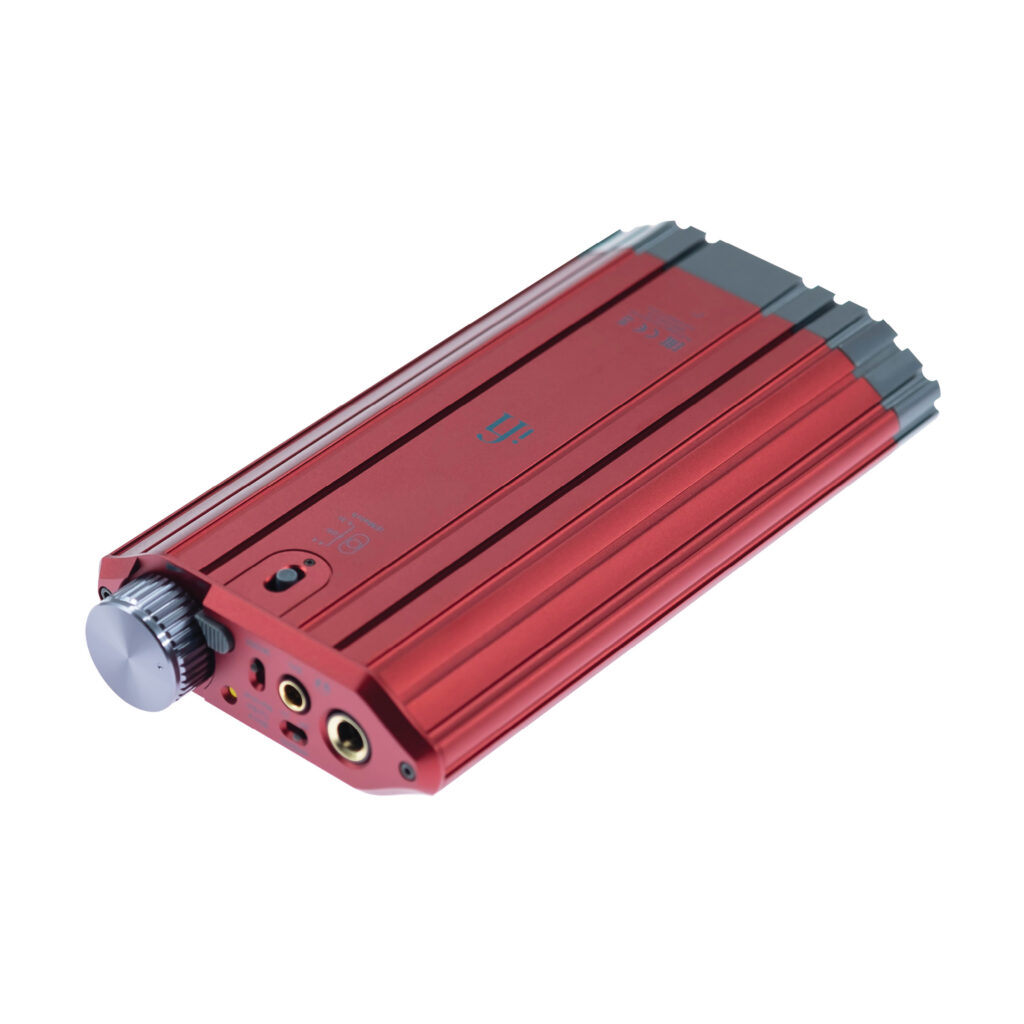
The iFi iDSD Diablo 2 is a transportable DAC and headphone amplifier for listeners who want a substantial headphone system away from a permanent shelf. It combines battery operation, digital inputs and Bluetooth with a distinctive red enclosure. Its strengths are easier to understand as a movable full-size headphone rig than as a minimal phone accessory.
iFi iDSD Diablo 2 — Transportable rather than a tiny pocket adaptor
The Diablo 2 asks a different question from a USB dongle: how much of a serious listening setup can you take to another desk, room or destination? A battery and substantial amplifier stage make that possible, but the whole arrangement includes the source, headphones and cables. Assess the complete carrying system rather than assuming that any battery-powered component is equally convenient on a daily walk.
The enclosure includes a volume lock and supports several physical placement arrangements. Those are useful details for equipment that may move between uses. Protect the volume control and connectors during transport, and give the amplifier a stable, ventilated place when listening. A bag that carries it safely is not necessarily the right place to run it at high output. Someone who mainly uses easy-to-drive earphones on public transport should weigh the added size and cost against a smaller receiver or dongle.
Inputs, charging and a crucial rear-socket distinction
The Diablo 2 accepts USB-C audio, S/PDIF and Bluetooth. A separate USB-C port handles charging. These two ports serve different purposes, so identify them before troubleshooting a silent connection. The source still supplies the music and interface: the Diablo does not independently browse a streaming library. Its Bluetooth capability is receiving, with codec compatibility determined by the transmitting source as well as the receiver.
The current manual describes the rear 4.4 mm connection as a balanced fixed line output, or a single-ended analogue line input under the specified conditions. That is an important correction to assumptions based on connector shape. It is not a second front-panel headphone output, and in line-output operation the volume dial does not control its level. Use it only with appropriate downstream volume control. For analogue input, follow the manual’s wiring and source requirements instead of assuming a balanced input simply because the socket is 4.4 mm.
This flexibility can help a movable system, but it rewards an orderly setup. Label or separate the cables used for each role and avoid changing sources casually while leaving an analogue device attached to a socket whose direction changes. Clear signal routing is more valuable here than having every input occupied.
Power ratings and headphone matching
iFi distinguishes maximum output from RMS specifications. Its product table lists balanced RMS output above 1.71 W at 32 ohms, separately from a maximum headline above 5 W at that load. Repeating the larger number as though it were the continuous RMS figure would misrepresent the documentation. Our assessment uses the distinction rather than treating the marketing headline as a universal drive guarantee.
There are Normal, Turbo and Nitro power modes. Start conservatively and choose the least demanding setting that gives the headphone sufficient range. A sensitive earphone and a difficult full-size planar have very different requirements, and the available iEMatch attenuation is useful only in the modes documented for it. The manual says iEMatch is unavailable in Nitro or xMEMS mode. More gain is not an improvement when it reduces the useful travel of the volume control.
Hi-Fi News’ original lab report also noted clipping with full-scale digital peaks as the control was advanced in higher-gain modes. That is a specific published finding, not our measurement, but it reinforces the value of sensible gain and level settings. A large output specification does not mean every combination of source level, gain and headphone load is equally suitable. Check the chosen headphone’s sensitivity and your actual listening needs.
Sound quality and the evidence
Headfonics described the Diablo 2 as vivid and forward, with strong detail and good results from several full-size headphones. The reviewer also favoured it more as a desktop-oriented system than a small portable accessory. That supports its intended audience without establishing that it is the best tonal match for every headphone. In particular, a listener already sensitive to a headphone’s forward presentation should compare carefully rather than assume the amplifier will soften it.
The most useful comparison keeps playback level consistent and uses familiar passages. A louder setting can sound more immediate and detailed even before considering the component itself. Give attention to sustained listening comfort, not only a short demonstration. If a headphone is fundamentally unsuitable in fit or tonal balance, a costly transportable amplifier may be the wrong way to address the problem.
The Diablo 2 is a focused product. It does not offer the same bass and spatial controls found on some other iFi models. That can appeal to someone who wants a direct signal path and chooses headphones accordingly, but buyers expecting those familiar adjustment buttons should check the actual feature set. Do not infer functions from the brand or from an earlier device with a similar shape.
xMEMS and wireless compatibility
The dedicated xMEMS mode is intended for compatible xMEMS earphones, not as a general enhancement setting for ordinary dynamic or planar headphones. The manual explicitly separates those uses. Leave the mode off for conventional headphones and follow the specified connection for compatible xMEMS models. Its presence is a specialist capability, not a reason that every buyer should pay more.
The Bluetooth list includes aptX Lossless, but that requires an appropriately compatible source and connection. A phone with a different codec set will use a mutually supported alternative. The amplifier does not add aptX Lossless to an iPhone simply by pairing with it. USB can remain the straightforward choice when the source is already close by. Likewise, the advertised PCM 768 kHz and DSD512 figures describe input compatibility, not a guarantee that every internal stage operates at those rates or that upsampling ordinary recordings improves them.
Battery life, value and the right owner
Battery duration depends on the mode, headphone and listening conditions, so a single maximum figure is a poor guide to every trip. Plan charging around the actual use rather than assuming the most demanding mode lasts as long as the least demanding one. A movable rig is convenient only if the charging and source arrangement fit the day. For permanent desk use, compare whether a mains-powered amplifier would be simpler and better value.
The Diablo 2 makes the strongest case for someone with full-size headphones who moves between locations and wants one self-contained amplifier. It is harder to justify for a basic earphone system or for a fixed desk where the battery adds little benefit. Compare current European offers with suitable alternatives, including the complete cable arrangement and local support. Its technical reach is impressive, but value comes from needing that particular combination of mobility, input flexibility and headphone capability.
Alternatives to consider
Chord Mojo 2: A relevant transportable alternative when a smaller physical package and its different adjustment approach suit the chosen headphones.
FiiO K17: Compare this for a system that will remain at a desk. A fixed desktop role can make battery-powered portability unnecessary.
iFi iDSD Diablo 2 key specifications
- Role
- Transportable DAC and headphone amplifier
- Digital inputs
- USB-C, S/PDIF and Bluetooth
- Front outputs
- 6.35 mm and balanced 4.4 mm headphones
- Rear 4.4 mm
- Fixed balanced line output; single-ended line input as documented
- Balanced RMS rating
- Manufacturer: above 1.71 W at 32 ohms
- Modes
- Normal, Turbo, Nitro; separate xMEMS mode
- Weight
- Manufacturer: 455 g
Verdict
An ambitious transportable amplifier best suited to a planned full-size headphone system. Its flexible inputs and specialist xMEMS capability are useful, but careful gain selection, the distinction between maximum and RMS power, and its substantial carrying arrangement matter to the buying decision.
Primary documentation and independent reviews
iFi official iDSD Diablo 2 specifications · iFi current Diablo 2 manual · Headfonics original Diablo 2 listening review · Hi-Fi News original Diablo 2 lab report
Editorial record
Sources and updates
Product specifications and factual claims were checked against Official iFi iDSD Diablo 2 product page ↗. Scores and buying advice follow our category-specific editorial methodology.
- Published
- November 8, 2026
- Last updated
- November 8, 2026