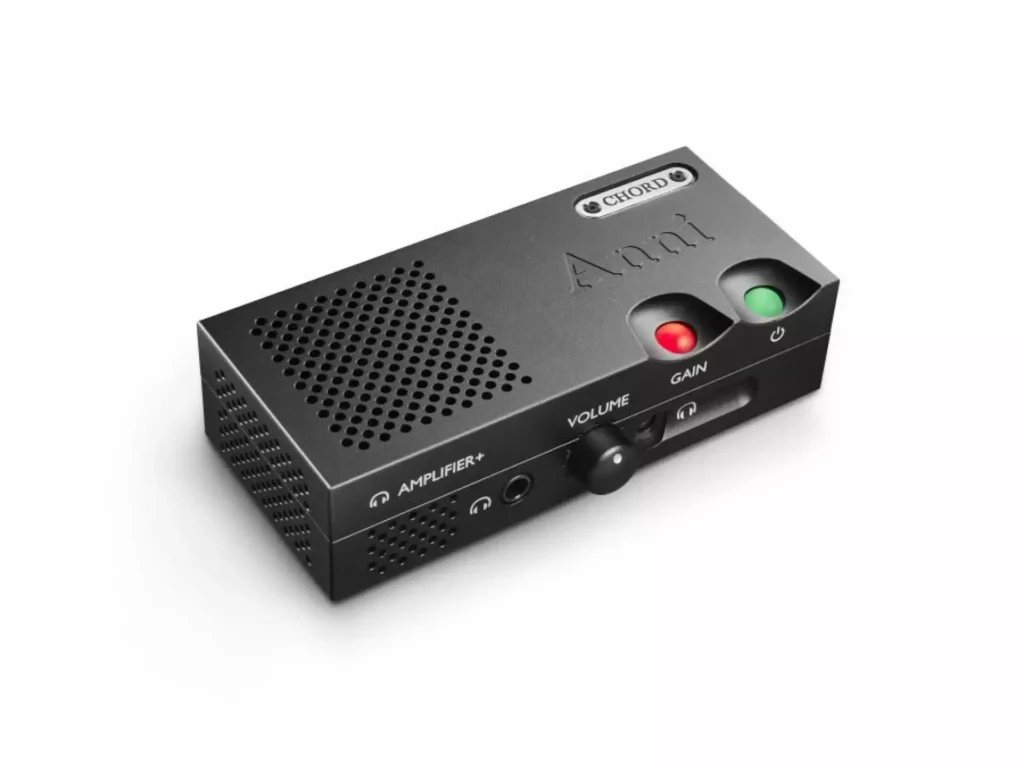
Chord Anni is a compact analogue amplifier that can serve headphones and appropriately matched passive speakers. It brings a distinctive case and ULTIMA-derived circuitry to a small desktop system, but does not contain a DAC, phono stage or wireless source. This research-based review considers its positive original musical evidence alongside the practical limits of speaker power, headphone gain and cooling. A neat appearance is only part of the attraction: the right source level and transducer match determine whether it works comfortably every day.
Research-based review. This assessment draws on manufacturer documentation and the original published evaluations linked below. Audio Review has not performed a hands-on test of this model.
Bold and enjoyable in the original listening evidence
Headfonics’ original Anni evaluation describes a substantial, energetic and smooth presentation, using external DACs and several full-size headphones. It also flags the fixed headphone gain arrangement and sensitivity concerns with some earphones. These are third-party observations, not Audio Review listening findings.
Try the actual headphones with a suitable source and match playback level when comparing amplifiers. A fuller or more energetic impression should not simply reflect a louder setting. Listen quietly as well as at the usual level, checking background noise, balance and comfortable adjustment. A lively musical presentation can be appealing without being the best choice for every transducer or taste. The original evidence makes the Anni a serious shortlist candidate for a compact desktop system, with the recommendation tied to real pairing rather than a universal power claim. An owner who primarily uses very sensitive earphones may find a different control arrangement easier, even if the Anni is more capable with other headphones in the same collection.
The gain button is a loudspeaker function
The manual specifies two gain settings for the loudspeaker outputs. When headphones are connected, the amplifier uses its automatic low-gain arrangement. The button therefore should not be described as an independently selectable high-gain headphone feature.
Check the actual listening range with the intended source and headphone. Begin low and assess whether quiet adjustment is convenient before making any decision from a maximum output number. Sensitivity matters alongside impedance, so one transducer’s satisfactory result does not settle another pairing. Do not increase listening level merely to reach a familiar clock position on the knob. Reduce level before changing inputs or transducers, especially if the sources have different nominal outputs. The source can also influence how much useful rotation is available. A suitable amplifier is one that gives comfortable everyday control and enough headroom, rather than one that simply becomes loud. Understanding the gain behaviour early avoids buying a compact component for a function that its front-panel button does not actually provide.
Two analogue inputs require an appropriate source level
Anni accepts two stereo RCA line sources. There is no internal digital converter or phono stage. The manufacturer’s manual specifically says that a partnering Qutest should be set no higher than 2 V output.
Follow source-level guidance rather than selecting the largest available DAC voltage by default. Check the labels at the rear when connecting left and right channels, and verify input selection at low level. A turntable requires a suitable phono stage first; a USB computer connection requires conversion elsewhere. Do not assume the amplifier accepts Bluetooth or network playback because another compact component can provide those functions. A source with volume control may help establish a practical chain, but the arrangement should be deliberate and repeatable. If additional boxes and cables are necessary, include them in the price and space comparison. The Anni is most coherent when the source requirements are already understood and its analogue role complements an existing system rather than creating a collection of improvised adapters.
Compact-speaker ability is useful within realistic limits
Chord rates the speaker output at 10 W into 8 ohms and provides banana-type connections. That gives the Anni a role beyond headphones, but it does not establish unrestricted capability with every loudspeaker, room or listening level.
Choose an appropriate speaker load and assess sensitivity, distance and expected musical peaks. A near-field desk can demand less than a large listening room, but low impedance or difficult electrical behaviour still deserves attention. Start conservatively and stop if the result becomes strained rather than assuming protection circuitry makes any pairing suitable. Use the documented speaker connection and prevent loose conductors from shorting. An active speaker already contains amplification and needs a suitable line source rather than a speaker-level feed. The extra role is valuable when the actual passive speakers work comfortably within the amplifier’s available headroom. If louder room-filling playback is central to the plan, a more appropriate integrated amplifier can be a better purchase even when it takes more shelf space.
Small casework still needs cooling space
The manual describes extensive ventilation and a cooling fan, and advises against placing other units directly on the Anni outside an appropriate supported arrangement. Compact dimensions do not make thermal requirements disappear.
Give it a stable, ventilated position with room around the case. Do not bury it beneath another component simply to make a tidy stack. If a modular rack is used, check that the actual installation follows the intended spacing and support. Listen for any fan-related distraction from the normal seat in a quiet room rather than assuming a small amplifier is silent under every condition. Keep the supplied power arrangement accessible and use the specified equipment rather than an improvised replacement. Mechanical layout also affects convenience: the volume control and headphone cable should remain easy to reach without pulling the amplifier across the desk. The professional installation is a practical one that respects heat and cable clearance, not merely one that matches the shape of adjacent Chord components.
A premium analogue package needs a clear purpose
Anni combines two roles in a distinctive desktop footprint, but omits the source functions and remote convenience available in some larger integrated products. Its appeal depends on whether the owner genuinely uses that particular combination.
Compare current local offers with the correct supply, source conversion and required cables included. For used equipment, test both inputs, headphone sockets, speaker operation and normal cooling behaviour with appropriate loads. Verify the exact model and matching manual rather than borrowing settings from a Hugo or another Chord component. A headphone-only system may have less expensive alternatives with more suitable gain control, while a speaker-focused setup may need greater power or additional inputs. Conversely, an existing high-quality analogue source and suitable desk speakers can make the Anni’s restrained scope entirely sensible. The strongest reason to buy is a demonstrated match between its musical presentation, physical controls and real transducer requirements. Brand identity and visual consistency should support that decision rather than replace it.
Alternatives to consider
Schiit Asgard 3: Compare a dedicated headphone-amplifier route if passive speakers are not required. The useful volume range and actual headphone pairing matter more than a matching visual stack.
Topping A90 Discrete: Consider another analogue desktop approach for a headphone-focused system. Compare gain, switching and source requirements with the actual transducers and total budget.
Chord Anni key specifications
- Role
- Analogue desktop headphone and speaker amplifier
- Topology
- Class AB with Chord ULTIMA-derived circuitry
- Inputs
- Two stereo RCA line inputs
- Headphone outputs
- 3.5 mm and 6.35 mm single-ended
- Speaker connection
- 4 mm banana-type outputs
- Manufacturer speaker rating
- 10 W into 8 ohms; not a universal room-filling recommendation
- Gain switch
- Loudspeaker output function; headphones use automatic low-gain arrangement
- Power
- Specified external supply; no internal battery
- Cooling
- Ventilated case with fan; allow appropriate free space
- Size / weight
- Approximately 160 × 42.5 × 96.6 mm; 625 g
- Not provided
- Digital input, phono stage, Bluetooth or remote control
Verdict
Anni is a credible research-based premium analogue amplifier for a carefully matched desktop headphone and passive-speaker system. Confirm source level, quiet headphone control, speaker headroom and ventilation. Its positive original musical evidence is persuasive when the two output roles are useful, with clear limits around digital sources, remote operation and selectable headphone gain.
Documentation and original reviews
Chord official Anni product and specification · Chord official Anni manual and source-level guidance · Headfonics original Anni evaluation · Headfonics original Anni listening and pairing assessment
Editorial record
Sources and updates
Product specifications and factual claims were checked against Official Chord Anni product page ↗. Scores and buying advice follow our category-specific editorial methodology.
- Published
- November 17, 2026
- Last updated
- November 17, 2026