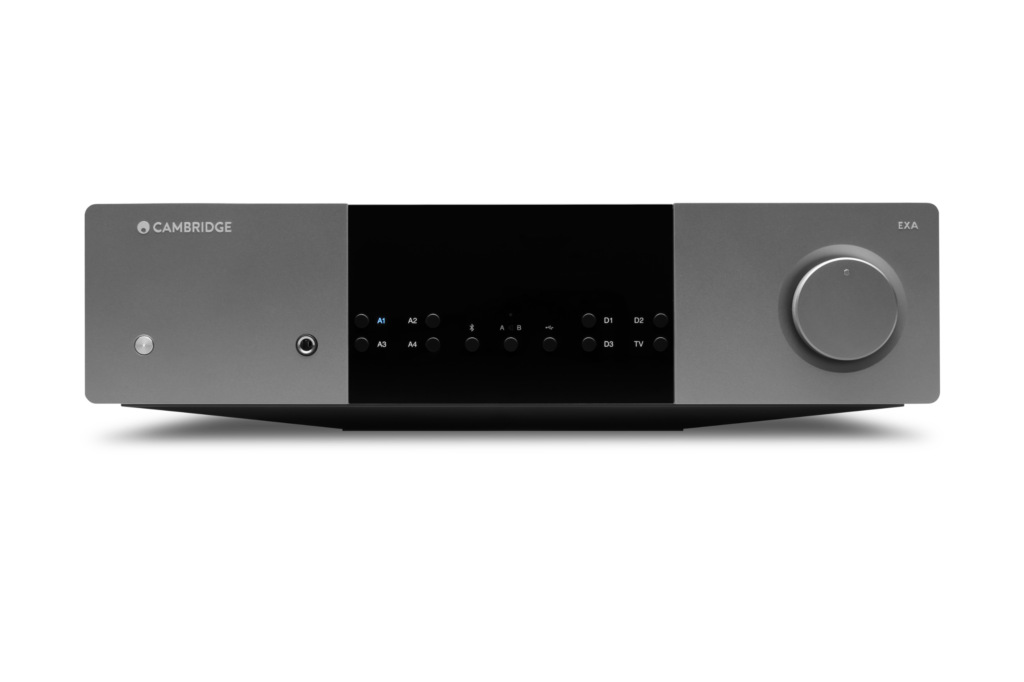
Cambridge Audio EXA100 brings a conventional integrated stereo amplifier into a system that may also include a computer and television. Its broad input selection and HDMI eARC are more important to that role than a single power figure. It can become the centre of a substantial passive-speaker system, but it is not a network streamer in its own right. Buyers should plan the complete source chain rather than assuming every modern connection also includes every modern service.
Research-based review. This assessment draws on manufacturer documentation and the original independent evaluations linked below. Audio Review has not performed a hands-on test of this model.
Amplification and speaker matching
Cambridge specifies Class AB amplification with continuous output ratings stated for 8-ohm and 4-ohm loads. Those conditions matter when comparing the EXA100 with another amplifier’s headline figure. A number measured at a different impedance or under a different distortion condition is not a direct like-for-like comparison.
Start with the speakers, room and distance at which you listen. Sensitivity, impedance behaviour and the desired level all influence how demanding the system is. A substantial amplifier is useful when it provides clean headroom, but more power is not an invitation to ignore loudspeaker limits. Give the cabinet adequate ventilation and follow the manual when connecting more than one speaker pair. Two terminal sets do not turn the unit into an independently powered multiroom receiver with unrelated sources in each room.
Sound quality and the independent assessment
What Hi-Fi?’s original evaluation highlights clarity, scale and a smooth presentation, while also finding that strong rivals prevent an unqualified class-leading recommendation. That is a useful position for this amplifier: its broad competence and connection set are persuasive, but the price warrants a serious comparison.
Our judgment is that the EXA100 is particularly attractive when several sources and a television need to share a good stereo system. Audition it with your intended speakers, familiar recordings and similar perceived volume against an alternative. Listen for whether quieter passages remain engaging as well as whether loud material sounds composed. A larger presentation during a louder shop demonstration is not enough to establish a better long-term match in a different room.
A DAC and Bluetooth are not a network platform
The built-in DAC accepts several digital sources, and compatible Bluetooth playback is convenient for occasional phone use. Neither function creates an onboard network-music platform. The EXA100 can amplify a streamer, but the streaming service, browsing interface and network protocols belong to that external source.
This distinction makes the product flexible if you already own a streamer you like. It also adds a component to the budget if you do not. A computer can feed the USB audio input, but must select the amplifier as its output and use the appropriate supported driver arrangement where required. Choose the connection that matches the source rather than assuming that the largest sample-rate label automatically improves every recording or streaming service.
HDMI eARC in a stereo television system
The TV connection is one of the EXA100’s most useful additions. Cambridge’s manual specifies stereo PCM for the return-audio path. That means a television or source sending a surround bitstream may need its settings changed before sound is available. HDMI eARC does not make this two-channel integrated amplifier a Dolby Atmos receiver.
Connect the television’s marked ARC/eARC socket, select the external audio system and check the relevant control settings. Test a built-in TV application and any external source separately because their output options can differ. The benefit is convenient stereo playback and potentially coordinated volume and power behaviour. If discrete centre, surround and height speakers are the aim, an AV receiver is the more appropriate product category.
Analogue sources, phono and expansion
Balanced XLR and RCA line inputs make the amplifier useful with a range of conventional sources. A balanced connection can help in an appropriate system, but it is not a magic upgrade for every short domestic cable run. Select the input arrangement supported by both components and avoid unnecessary adapters that obscure the signal path.
A cartridge-level turntable output requires phono equalisation and gain before reaching an ordinary line input. Include a suitable external phono stage, or use a turntable with an appropriate built-in stage. The pre-out and power-amplifier mode broaden integration options, but their level-control roles must be understood before connecting equipment. Decide which component controls volume and begin conservatively; a flexible connection panel is most useful when every box has a clear job.
Daily use and the complete value calculation
The physical input controls and volume knob suit a system that remains accessible without opening a phone app. That can be an advantage for television use and for people who prefer direct operation. The corresponding source interface still matters: an excellent amplifier cannot make an awkward external streamer’s browsing workflow disappear.
For value, total the amplifier, source, any phono stage and the speakers before comparing with an integrated streaming alternative. Consider whether you actually need the EXA100’s input breadth and power-amplifier mode. A simpler amplifier may be better value for one source and easy speakers, while the Cambridge becomes more convincing as its flexibility is put to use. Current local price, warranty and a meaningful audition matter more than a comparison against launch-price prestige.
Alternatives to consider
Cambridge Audio CXA81 Mk II: The CXA81 Mk II is worth comparing if the EXA100’s TV connection and expanded facilities are not priorities. Use the same speakers and similar volume before deciding whether the more expensive amplifier provides a useful improvement for your listening.
Marantz MODEL 60n: The MODEL 60n is a different system-building approach with integrated network facilities and a phono input. Compare the complete setup cost, app workflow and speaker requirements rather than treating the amplifier price alone as the final budget.
Cambridge Audio EXA100 key specifications
- Type
- Integrated stereo amplifier
- Amplification
- Class AB
- Manufacturer continuous rating
- 100 W RMS into 8 ohms; 155 W RMS into 4 ohms
- DAC
- ESS ES9018K2M
- Analogue inputs
- RCA line-level and balanced XLR
- Digital inputs
- Optical, coaxial, USB audio and HDMI eARC
- Bluetooth
- aptX HD support with compatible source
- Network streaming
- Requires an external source
- Phono stage
- Not built in
- TV audio
- Stereo PCM, with appropriate ARC/eARC settings
- Outputs
- Passive-speaker terminals, pre-out and subwoofer connection
- Power-amplifier mode
- Supported
- Dimensions (W × H × D)
- 430 × 115 × 341 mm
- Weight
- 12.8 kg
Verdict
EXA100 is a capable foundation for a flexible stereo system, especially when passive speakers need to serve several music sources and a television. The analogue and digital inputs, eARC connection and conventional controls provide concrete reasons to consider it. The independent evaluation supports a serious audition without removing the need to compare rivals.
Budget for external network streaming and a phono stage where required, and remember that TV audio is stereo PCM. Compare the CXA81 Mk II if you need less integration, or MODEL 60n if an onboard streaming platform better suits the routine. Choose the EXA100 when its complete set of facilities is useful and the speaker pairing works in your room, rather than buying on the power rating alone.
Primary documentation and independent reviews
Cambridge Audio official EXA100 product information · Cambridge Audio official EXA100 manual and specifications · What Hi-Fi? original EXA100 review
Editorial record
Sources and updates
Product specifications and factual claims were checked against Official Cambridge Audio EXA100 product page ↗. Scores and buying advice follow our category-specific editorial methodology.
- Published
- November 17, 2026
- Last updated
- November 17, 2026