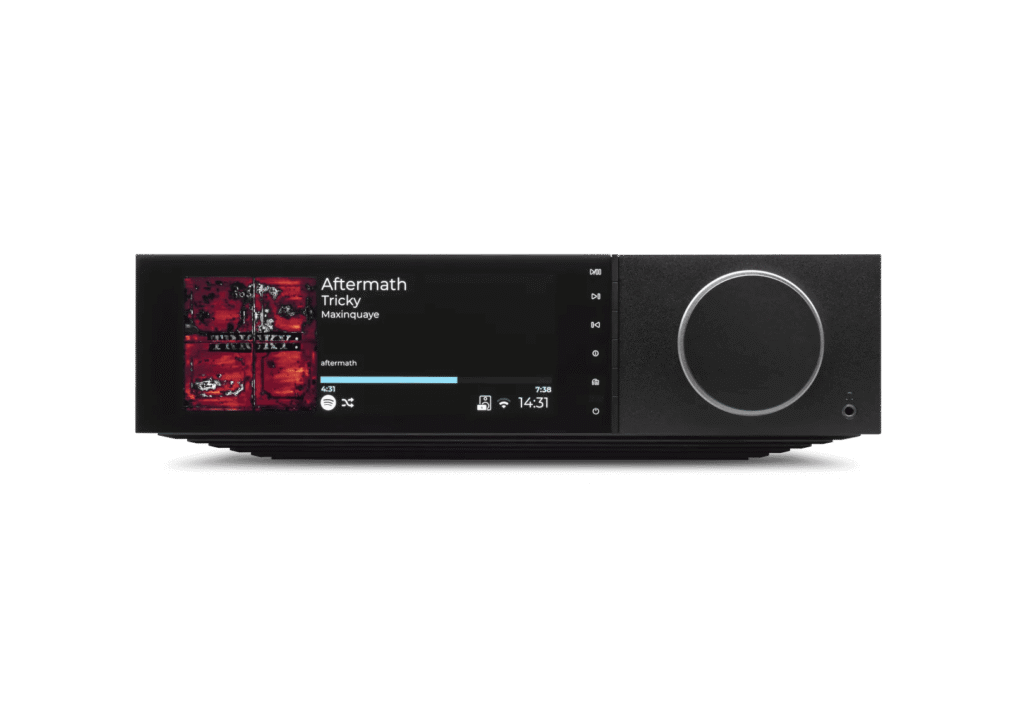
Cambridge Audio Evo 150 combines streaming, digital conversion and amplification in a compact just-add-speakers system. Its original Hypex-based design offers a broad source selection, including moving-magnet phono, USB computer audio and a stereo television ARC route. It does not contain loudspeakers and should not be confused with either Evo One or the newer Evo 150 SE. This research-based review considers the original model’s documented facilities, published listening evidence and practical speaker-system role, rather than treating a sophisticated all-in-one enclosure as a substitute for careful installation.
Research-based review. This assessment draws on manufacturer documentation and the original published evaluations linked below. Audio Review has not performed a hands-on test of this model.
Refined scale with a useful comparative qualification
What Hi-Fi’s original review hears a clear, detailed and refined presentation with substantial soundstage scale. Its comparison with Naim Uniti Atom favours the Cambridge’s breadth and polish, while finding the Naim more convincing at rhythmic interplay. That is a useful distinction between musical priorities rather than a reason to reduce either product to a single adjective.
Audition with the intended speakers and familiar recordings at a matched level. Use a voice-led track, a rhythmically busy arrangement and a larger-scale passage to assess different demands. Listen to how easily musical parts remain connected, not only how much detail appears around them. A spacious presentation may be especially appealing for one collection, while another listener values a more direct sense of momentum. The published evidence provides a strong shortlist case without guaranteeing the same preference in every system. Speaker placement and room behaviour remain part of the result. Choose the combination that stays engaging through complete albums rather than the one that creates the most impressive first minute.
Just add speakers still means choosing speakers carefully
The official original-model specification identifies Hypex Ncore amplification and a manufacturer output rating into an eight-ohm load. That is useful context for a substantial stereo system, but it should not be treated as an independent measurement or a promise that any speaker load and listening level is appropriate.
Check the speaker requirements and the amplifier’s operating guidance before connection, including any plan to use both speaker outputs. Two sets of terminals do not mean that arbitrary pairs can be run together without considering the combined load. Start with a sensible placement that creates a coherent stereo image, then assess bass balance from the normal seat. A compact electronics box does not make the loudspeakers or their required spacing disappear. Budget for the speakers, stands and ordinary cabling as part of the complete system. The Evo’s attraction is reducing the electronics count while retaining a real stereo layout, not turning the room into an installation that needs no planning.
StreamMagic is the daily interface
The Evo 150 combines StreamMagic control with established network playback routes, including AirPlay 2, Google Cast and Roon compatibility. The supplied remote and physical controls remain useful alongside the display. A long list of services is valuable only when the household’s normal listening routine works smoothly.
Test the intended accounts, phone handover, favourite albums and return from standby. Check which route is used by each service rather than assuming all casting paths deliver the same format or control behaviour. An old review may describe a service catalogue or special format that has since changed, so those historical details should not become a current buying promise. Internet radio and local music can be useful alongside subscription services, but access should remain easy for another household member. Keep the system’s ordinary routine simple enough to use without a separate explanation for every source. A premium streaming amplifier earns its convenience case through repeated daily use, not merely through the number of applications represented on a product page.
Analogue sources have clearly different requirements
The documented analogue facilities include line-level RCA, balanced XLR and a moving-magnet phono input. These serve different signal types. A turntable with a suitable cartridge can use the phono route, while a source already producing line level belongs at an appropriate line input.
Check whether the turntable’s own phono stage is active before choosing the connection. Avoid applying phono amplification twice, or sending a low-level cartridge signal to a normal line input and expecting proper level and tonal balance. A moving-coil cartridge may require a suitable separate stage rather than an assumption based on the presence of sockets labelled phono. Balanced line connection can be convenient with a compatible source, but it should not be presented as an automatic sound-quality upgrade in every domestic arrangement. Keep the source levels sensible when making comparisons. The broad analogue provision is a genuine advantage when it integrates equipment already owned, rather than encouraging unnecessary extra components that duplicate functions available inside the Evo.
TV ARC and computer USB are stereo-system facilities
The television ARC input is documented for PCM audio, not multichannel cinema decoding. USB-B provides a separate computer-audio role, while optical and coaxial inputs cover other compatible digital sources. Those paths should be configured according to their own format and operating requirements.
Set the television to an appropriate stereo PCM output and test internal apps and external sources independently. Check lip synchronisation and normal remote-volume operation. This can make the stereo system a useful television upgrade without pretending it becomes an Atmos soundbar or AV receiver. For a computer, select the correct USB audio setting and any required manufacturer driver, then confirm ordinary playback and system-volume behaviour. Do not infer identical maximum formats across every digital input from a headline DAC capability. The useful question is whether the intended sources work reliably at their actual settings. A clear stereo route often provides more practical value than chasing a file specification that the listening collection rarely uses.
Original-model value and long-term flexibility
The Evo 150 provides preamp, subwoofer and headphone routes in addition to its speaker outputs, supporting several practical system arrangements. Its compact dimensions and interchangeable side-panel design also make it a product intended to remain visible rather than disappear into a large equipment rack. The original and SE versions must remain distinct when comparing offers and reviews.
Measure rear connector clearance and ventilation, not only the front footprint. Try the headphone output with the actual headphones if that role is important, rather than assuming a universal match from the presence of a socket. Check current regional warranty, included remote and panels, and software operation when buying used or remaining stock. Compare the complete system price with speakers and any required accessories. A cheaper amplifier plus separate streamer may offer a different upgrade route; another integrated platform may provide room adjustment that matters more in a difficult space. The Cambridge is strongest when its varied sources, physical usability and refined presentation solve the requirement together. Its older premium status alone is not a reason to ignore today’s alternatives.
Alternatives to consider
NAD M10 V3: Compare the room-adjustment approach, source facilities and musical presentation with the intended speakers. Judge the complete installed system rather than a streaming-platform list alone.
WiiM Amp Ultra: Consider a different price and software proposition where a compact streaming amplifier is the main requirement. Check analogue needs, speaker suitability and the current local package.
Cambridge Audio Evo 150 key specifications
- Product
- Original Evo 150, not Evo 150 SE
- Role
- Streaming integrated stereo amplifier; passive speakers required
- Manufacturer output
- 150 W per channel into 8 ohms
- Amplification
- Hypex Ncore Class D
- DAC
- ESS ES9018K2M
- Analogue inputs
- RCA line; balanced XLR; moving-magnet phono
- Digital inputs
- Two optical; coaxial; USB-B audio; TV ARC
- TV audio
- PCM stereo; no surround decoding implied
- Streaming
- StreamMagic; AirPlay 2; Google Cast; connect services; Roon Ready
- Outputs
- Speaker A/B; preamp; subwoofer; 3.5 mm headphones; Bluetooth
- Bluetooth
- SBC; aptX; aptX HD, compatible source required
- Dimensions / weight
- 317 × 89 × 352 mm; approximately 5.3 kg
Verdict
The original Evo 150 remains a well-equipped stereo hub with a strong research case for clarity, scale and refinement. Its value depends on suitable passive speakers, a useful daily streaming routine and a current price that reflects the exact generation. Confirm the PCM television path and analogue requirements. It is a persuasive compact system when those facilities genuinely replace several separate boxes.
Documentation and original reviews
Cambridge Audio official EU original Evo 150 specifications · Cambridge Audio official shared Evo manual, model-specific sections · What Hi-Fi original Evo 150 listening and comparison review
Editorial record
Sources and updates
Product specifications and factual claims were checked against Official Cambridge Audio Evo 150 product page ↗. Scores and buying advice follow our category-specific editorial methodology.
- Published
- November 17, 2026
- Last updated
- November 17, 2026