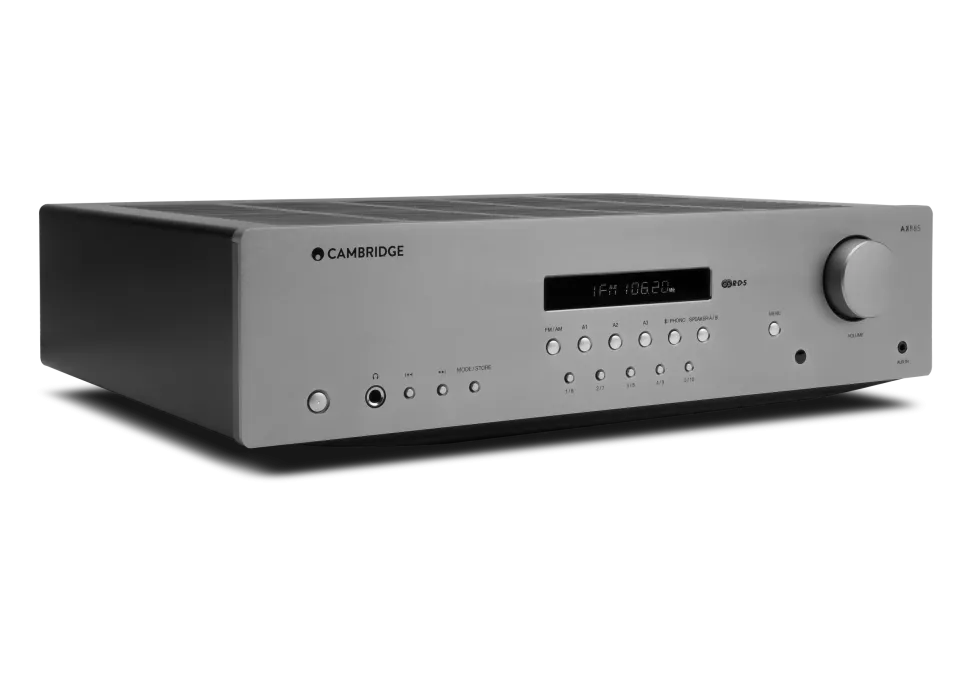
Cambridge Audio AXR85 is a traditional stereo receiver with analogue inputs, phono, AM/FM radio and Bluetooth. It needs passive speakers and does not include the optical and coaxial inputs of the AXR100, despite sharing a manual and remote layout with that model. The official European page now identifies it as archived, making exact condition and price especially relevant. This research-based review considers its useful conventional source role, original exact-model listening evidence and the practical limitations that can be missed when comparing it with newer network amplifiers.
Research-based review. This assessment draws on manufacturer documentation and the original published evaluations linked below. Audio Review has not performed a hands-on test of this model.
A friendly stereo presentation worth hearing with the actual speakers
AV-Online’s original AXR85 evaluation describes an open, detailed and slightly warm presentation. Its speaker comparisons also show why a system match matters: a fuller speaker balance changed the subjective impression, particularly at lower levels. The reviewer found that heavy tone-control adjustments could undermine clarity. Those observations support a considered audition rather than a promise of identical character with every loudspeaker.
Use familiar recordings at the normal household level. Compare a voice, a rhythmically busy track and a quieter acoustic passage without letting volume differences dominate the judgement. Listen for a coherent musical whole rather than isolated detail alone. A traditional receiver can be a satisfying foundation when the speakers suit the room, but no amplifier specification removes the effects of placement and bass reinforcement. Begin with sensible positioning and modest settings before deciding that another component is required. The strongest purchase is the complete combination that remains engaging over an album, rather than the receiver that happens to sound most impressive through a dealer’s unrelated speakers.
An analogue receiver, not the AXR100 digital platform
The shared manual explicitly reserves optical and coaxial inputs for AXR100. AXR85 has analogue sources and Bluetooth, without HDMI or an independent Wi-Fi streamer. The rear service port is not a music input; current manufacturer instructions say not to connect devices to it. Older descriptions of a USB-shaped socket should not override that guidance.
Map the actual sources before purchase. A CD player with analogue outputs can connect directly, while an optical-only television or digital transport requires a suitable separate conversion path. Price and configure that requirement before assuming the receiver is the simplest answer. A network streamer needs an appropriate analogue output for the AXR85 rather than an unused digital cable. Those additions can be perfectly sensible, especially when equipment is already owned, but they change the complete-system comparison. A buyer starting from nothing may prefer an integrated platform with the required digital facilities built in. The AXR85 makes most sense when its conventional analogue arrangement already fits the collection.
The phono connection needs the correct cartridge and signal level
Cambridge’s manual documents phono support for moving-magnet and specified compatible high-output cartridges. Low-output moving-coil types require suitable matching equipment. The manual also advises attention to grounding and separation from potential interference sources.
Check whether the record player already has an active phono stage. A line-level output belongs at a line input, while a suitable unamplified cartridge signal uses the receiver’s phono route. Avoid applying phono amplification twice or expecting a low-output cartridge to behave like an ordinary line source. Keep the ground arrangement consistent with the equipment instructions and assess hum with the intended position before finalising the furniture. Do not assume an external stage improves every setup simply because it adds another box. Compare it only when a real requirement exists, with levels matched sensibly. The built-in stage is valuable when it makes a straightforward record system possible without duplicated amplification or an unnecessary purchase.
Speaker A/B and subwoofer output need informed use
The manual permits speaker switching and specifies nominal eight-ohm speakers when two pairs are used. Its dedicated subwoofer output follows volume and has a fixed second-order low-pass filter at 200 Hz. The main speakers continue to receive the full frequency range, so this is not a complete adjustable high-pass bass-management system.
Choose speakers within the documented operating requirements and follow the connection guidance. Two terminal sets do not create four independent amplifier channels or make arbitrary combined loads appropriate. For external active bass, use the actual subwoofer output and assess the crossover and level arrangement carefully. Start from sensible placement and check whether bass joins the stereo speakers naturally rather than attracting attention separately. The fixed record output has a different role: it does not follow the listening volume and should not be mistaken for a variable preamp or bass feed. Those distinctions make the receiver more useful when understood early, instead of discovering that a planned upgrade relies on a connection the model does not supply.
Radio and Bluetooth are simple but source-dependent
AM/FM radio is a genuine part of the receiver’s design, with suitable aerial connections and presets. Bluetooth 5.0 uses SBC according to the official specification. That is a practical phone source rather than independent network playback, service integration or an assumption of an advanced codec based on the version number.
Check reception with a suitable aerial in the intended room before judging the tuner. A favourite station’s local signal matters more than a generic claim that radio is included. Test the ordinary remote and preset routine from the sofa. For Bluetooth, check pairing, playback and return from standby with the actual phone, particularly if another person regularly takes control. If direct service playback or multiroom grouping is essential, a suitable external streamer or a different receiver may be required. Keep those requirements distinct from casual phone music. The simple source arrangement can be pleasant to live with when it fits the routine, but it should not be expected to acquire an unspecified network platform later.
Archived-model value depends on the complete requirement
The official enclosure dimensions are approximately 430 mm wide, 110 mm high and 340 mm deep, with a weight around 8.1 kg. The ventilation arrangement should remain unobstructed. As an archived product, the AXR85 should be assessed on today’s offer, condition and support rather than a historical launch price.
Measure rear cable clearance and allow the documented ventilation space. For a used or remaining-stock example, check the remote, aerials, input operation and local warranty terms. Include speakers and any required DAC or streamer in the final calculation. A buyer with analogue sources and a good passive-speaker pair may find the traditional approach efficient and familiar. Someone needing television ARC, several digital sources and app-based streaming may spend more and create more complexity by adding each separately. A discount is meaningful only if the receiver already suits the intended system. Compare the full working arrangement against current alternatives, then choose the one that meets the source and listening needs with the least unnecessary equipment.
Alternatives to consider
Cambridge Audio AXR100: Compare the actual digital-input requirements rather than assuming the shared manual means the two receivers have identical connections. Check current condition and complete prices.
Denon PMA-900HNE: Compare an integrated network-capable alternative with the intended speakers and sources, considering whether its additional facilities reduce the need for separate equipment.
Cambridge Audio AXR85 key specifications
- Role
- Stereo receiver for passive speakers
- Manufacturer power rating
- 85 W per channel into 8 ohms
- Radio
- AM / FM; aerial and reception dependent
- Analogue sources
- Rear line inputs; front auxiliary; phono
- Phono
- MM and specified compatible high-output cartridges; not low-output MC directly
- Bluetooth
- Version 5.0; SBC
- Optical / coaxial / HDMI
- Not provided on AXR85
- USB computer audio / Wi-Fi
- Not provided
- Speaker outputs
- A / B; obey documented combined-load requirements
- Subwoofer output
- Volume-following; fixed 200 Hz low-pass filter
- Record output
- Fixed level; not a volume-controlled preamp output
- Dimensions
- 430 × 110 × 340 mm
- Weight
- Approximately 8.1 kg
- Status
- Archived model on official EU product page
Verdict
AXR85 is a credible traditional stereo receiver with a useful tuner, phono facility and exact-model listening evidence supporting an approachable presentation. Its analogue boundaries, fixed record output and limited bass-management arrangement deserve attention before purchase. Check condition, speaker requirements and the complete source cost. It is strongest when conventional sources already match the system rather than when several missing digital facilities need adding.
Documentation and original reviews
Cambridge Audio official EU AXR85 specification and archived status · Cambridge Audio official AXR85 / AXR100 manual, model-specific connections · AV-Online original AXR85 listening evaluation
Editorial record
Sources and updates
Product specifications and factual claims were checked against Official Cambridge Audio AXR85 product page ↗. Scores and buying advice follow our category-specific editorial methodology.
- Published
- November 17, 2026
- Last updated
- November 17, 2026