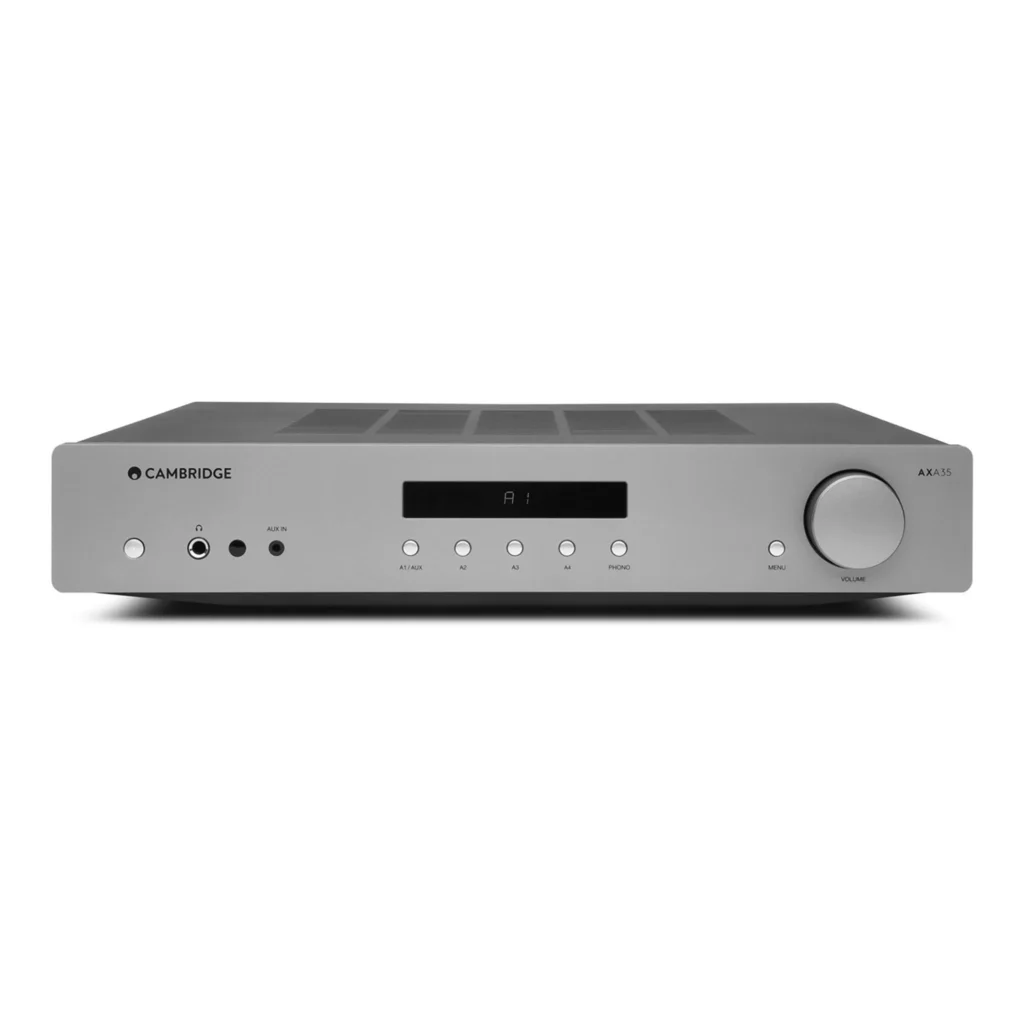
Cambridge Audio AXA35 is an established analogue integrated amplifier for a straightforward two-speaker system. It combines several line inputs with an MM phono stage, headphone socket and remote control, while keeping streaming and digital conversion outside the box. That narrow role can be a strength for a first vinyl or CD-based setup. The original listening test supports its musical appeal, but the modest output and deliberately limited connection set need to match the actual system rather than an imagined future expansion.
Research-based review. This assessment draws on manufacturer documentation and the original published evaluations linked below. Audio Review has not performed a hands-on test of this model.
A deliberately analogue system centre
The AXA35 accepts analogue sources and drives passive speakers. There is no internal network streamer, Bluetooth receiver or digital-to-analogue conversion path for a computer cable. Its rear USB connection is for power, not playback from a USB stick or direct USB audio.
List the sources before buying. A CD player with analogue output can fit the role directly, while a digital-only source needs an appropriate external conversion stage. A phone may need an adapter or separate receiver. Those additions can be perfectly workable, but they change the complete price and the number of controls involved. The AXA35 is strongest when the basic analogue arrangement already suits the owner, rather than when several extra purchases are required immediately to recreate features included in another amplifier.
A positive listening assessment with a sensible ceiling
What Hi-Fi’s original evaluation finds a confident, clear and spirited performance, with useful bass weight and focus. It is also positive about the phono stage and headphone output. The review qualifies the amplifier’s grip when pushed into more ambitious speaker demands, rather than presenting it as an unlimited route to every future system.
Audition with the speakers and listening level intended for the room. Include music with a strong bass line and changes in intensity as well as simple vocals. A system can sound satisfying at moderate level while running out of comfortable headroom when the room or distance grows. Compare on that practical basis instead of ranking amplifiers from power alone. The relevant result is clean, enjoyable playback in the actual installation, with enough margin for the material being played.
MM vinyl without an extra box
The built-in phono stage provides a useful starting connection for a suitable moving-magnet cartridge. It is not an unrestricted input for every cartridge type. The manual distinguishes compatible higher-output arrangements from low-output moving-coil cartridges that require additional matching equipment.
If the turntable already has a phono stage, select the correct output and amplifier input so the signal is not processed twice. Ask the dealer to demonstrate the intended arrangement rather than assuming every pair of RCA connectors is interchangeable. Keep the deck on a suitable support with sensible cable routing. The internal stage can make a first vinyl system simpler and more affordable. That is a practical advantage even if a different stage might be evaluated later; it does not require planning an upgrade before learning the supplied system.
A recording output is not a volume-controlled preamp
The manual identifies Rec Out as a fixed-level recording connection. It does not follow the main volume control, so it should not be treated as the variable preamp output that a buyer might expect for an external power amplifier or ordinary subwoofer arrangement.
If a subwoofer or separate amplifier is part of the plan, establish the exact supported connection method before purchase. Do not assemble an adapter solution simply because the socket shapes appear compatible. A source-level recording output has a different role from a controlled system output. This distinction can determine whether the AXA35 is the right foundation for the system at all. Choosing an amplifier with the required output from the outset may be simpler and less costly than discovering that the desired expansion needs another control stage.
Front-panel convenience and everyday control
The front auxiliary input makes a temporary analogue connection easy, while the headphone socket provides another listening route. The manual notes that plugging into the auxiliary socket overrides the A1 input. The USB power output also has its own limitations and is not a hidden digital upgrade path.
Try the remote and display from the normal listening seat. What Hi-Fi notes off-axis limitations in both viewing and remote communication, so a shelf position can affect daily convenience. Leave room for rear cables and ventilation instead of fitting the amplifier tightly between other components. A simple system should remain easy for another household member to operate. Label sources clearly if several are connected, and make sure the ordinary routine does not depend on remembering which temporary lead currently overrides a rear input.
Budget, speaker choice and long-term ownership
Thirty-five watts into eight ohms is the manufacturer’s rated starting point, not a universal prediction of loudness in every room. Speaker sensitivity, impedance behaviour, distance and programme demands all affect the practical match. Avoid choosing a speaker solely because its nominal impedance is printed beside a reassuring number.
For a small system at moderate levels, the AXA35 may be entirely adequate. For a large room or difficult load, compare a more capable arrangement before stretching the budget on unrelated accessories. With used examples, test inputs, controls, both channels and the headphone socket. Include any remote replacement, source adapter or external DAC in the total cost. Its value comes from a clear analogue role and a sound the owner enjoys, rather than from competing with network amplifiers feature for feature. A deliberate limit can keep a system manageable when it matches a real listening need.
Alternatives to consider
Cambridge Audio CXA81 Mk II: CXA81 Mk II is a higher-budget comparison when digital connections and a more ambitious speaker system are part of the plan. Include any phono requirement separately instead of assuming every Cambridge amplifier has the same inputs.
Audiolab 6000A MkII: 6000A MkII offers another integrated-amplifier route. Compare the complete source and output requirements, then audition the proposed speakers at the levels and distances expected at home.
Cambridge Audio AXA35 key specifications
- Type
- Integrated stereo amplifier
- Power claim
- 35 W per channel into 8 ohms
- Line inputs
- Four rear RCA pairs
- Phono input
- Moving magnet
- Front auxiliary input
- 3.5 mm, shares A1 selection
- Headphone output
- 6.35 mm
- Recording output
- Fixed level RCA
- USB
- 5 V / 500 mA power, not audio input
- Tone controls
- Bass, treble and balance
- Bluetooth / Wi-Fi
- Neither built in
- Digital inputs
- None
- Dimensions (W × H × D)
- 430 × 83 × 335 mm
- Weight
- 5.6 kg
Verdict
AXA35 remains a credible budget analogue amplifier with a positive original listening assessment and useful vinyl and headphone provision. It can make a coherent first system without unnecessary complexity when the sources and speakers are well matched.
Confirm the modest power requirement, absence of digital and wireless inputs, and the fixed nature of Rec Out. If those boundaries fit the plan, the Cambridge offers an appealing combination of music and straightforward control. If streaming, television connectivity or flexible preamp outputs are central, compare the complete cost of another amplifier before building those functions around it.
Documentation and original reviews
Cambridge Audio official European AXA35 product specifications · Cambridge Audio official AXA35 connection and operating manual · What Hi-Fi original AXA35 listening and usability evaluation
Editorial record
Sources and updates
Product specifications and factual claims were checked against Official Cambridge Audio AXA35 product page ↗. Scores and buying advice follow our category-specific editorial methodology.
- Published
- November 17, 2026
- Last updated
- November 17, 2026