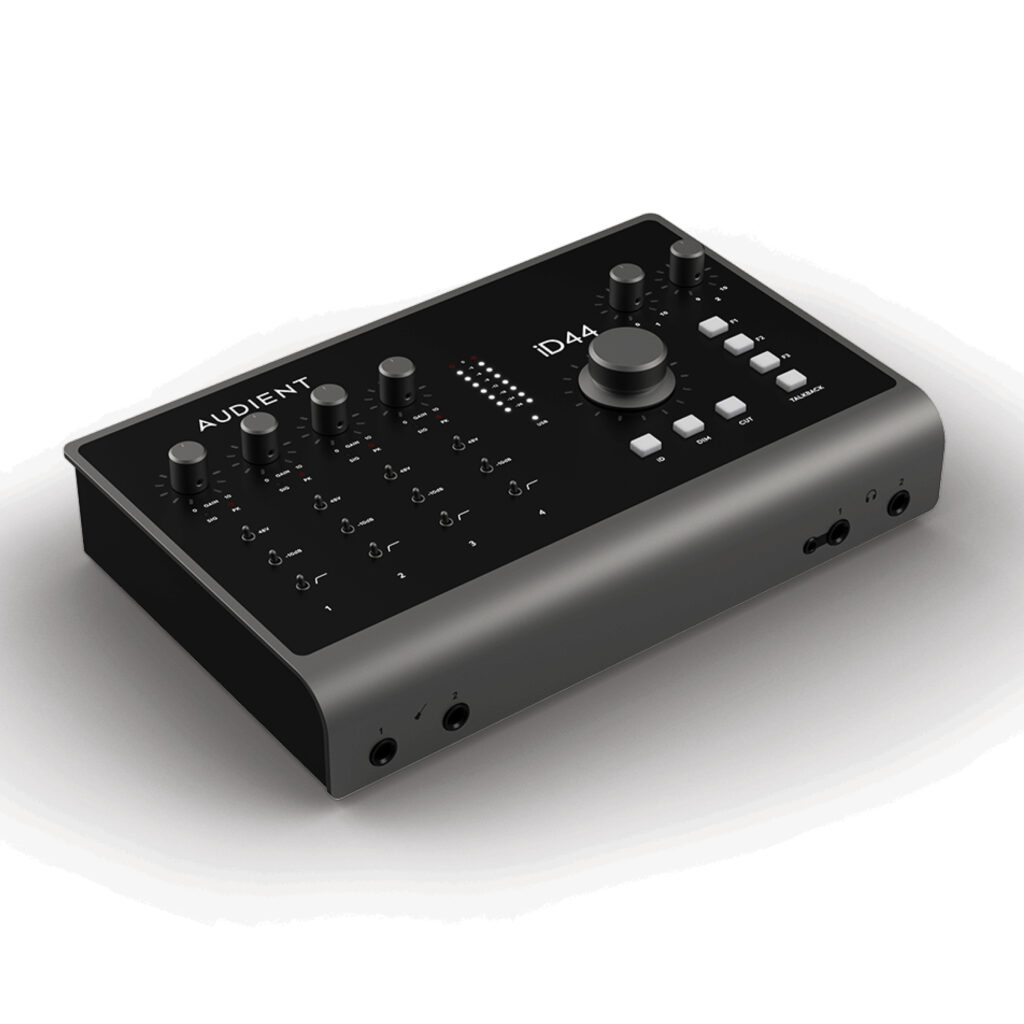
Audient iD44 MKII is a desktop interface intended to remain useful as a studio grows. Four microphone preamps, analogue inserts, dual optical expansion and independent headphone channels give it a broader role than a basic personal recording box. The attraction is the complete working arrangement, including its hands-on monitor controls. This assessment concerns the MKII generation and its documented external-power requirement, keeping it separate from the later iD4+ MK3 platform. The central buying question is whether those routing and monitoring capabilities match a real session plan.
Research-based review. This assessment draws on manufacturer documentation and the original published evaluations linked below. Audio Review has not performed a hands-on test of this model.
The original evaluation favours quality and practical control
Sound On Sound’s original assessment regards the MKII as a worthwhile refinement of an already capable interface, highlighting audio performance and console-derived monitoring facilities. It also identifies external power and the absence of a built-in talkback microphone as practical considerations.
Assess the interface with a representative session rather than comparing only headline converter figures. Record the actual sources, establish sensible headroom and listen at consistent playback levels. Check the headphone and speaker routes while musicians perform, because a comfortable monitoring arrangement can directly affect the take. The recording room and microphone placement remain central. A substantial interface is not a solution to an untreated source problem. The strongest buyer needs both the analogue quality and the broader control arrangement. Someone recording a single source occasionally may find a simpler model sufficient, even if this one has impressive capabilities. Value comes from using the complete tool effectively, not from assuming a larger desktop unit automatically improves every recording.
Twenty inputs include a significant digital expansion system
The built-in analogue section has four microphone preamps. The larger total includes digital channels from external equipment, and the front instrument sockets share existing analogue paths. A socket count should therefore be translated into an actual simultaneous recording plan.
List every microphone, instrument and stereo line source needed for the largest ordinary session. Then identify which can connect directly and which require an external converter or preamp. Include the price and location of expansion equipment before comparing with a larger all-in-one interface. Four preamps may be ideal for compact acoustic work or a personal production room, while a regular multi-microphone session can justify more immediate analogue capacity. The iD44 MKII’s flexibility is attractive when growth is planned deliberately. It is less convenient if the buyer discovers after delivery that most of the advertised inputs require another purchase. Choose around the real session, leaving useful margin without paying for an imagined studio that may never exist.
Dual optical paths need deliberate configuration
Two optical inputs and outputs provide a substantial ADAT expansion route. The supported channel count falls at the higher sample rates, and S/PDIF is an alternative format rather than another unrelated set of simultaneous sockets. Word-clock output supports an appropriately planned digital system.
Choose the recording rate and expansion device first, then follow the manuals to establish the clock relationship. Confirm every channel with a short labelled test recording and output check. A successful stereo test is not proof that the complete expanded session is configured correctly. Keep the working routing and clock settings saved so another session can start predictably. Extra digital capacity is useful when it prevents constant re-patching or supports a genuine ensemble requirement. It also introduces more equipment and potential setup mistakes than a small analogue-only arrangement. Compare those practical costs alongside the purchase price. The best expansion plan has a defined source list, a known rate and a clear reason for each additional device.
Independent headphone channels are a meaningful distinction
The iD44 MKII provides two independent headphone channels. The first has duplicate socket sizes carrying the same feed, so three physical sockets do not establish three separate performer mixes. This is a useful distinction from smaller models with two plugs but one shared channel.
Plan an engineer and performer trial before a serious session. Check that each person can hear the intended backing-track and input balance, then verify the physical controls affect the expected destination. Keep speaker levels sensible while changing routes. If more performers require individual mixes, establish the additional output and amplifier arrangement rather than assuming every socket solves it. Headphone choice also matters: test the actual sets for usable level and comfort during a realistic take. The value of independent monitoring is practical communication and a confident performance. It can be more important than a small technical specification advantage, provided the owner understands the routing well enough to restore it quickly and avoid a confusing duplicate signal.
Inserts and talkback extend the studio workflow
Two balanced analogue insert paths support compatible external processing. Talkback is part of the monitoring system, but the interface does not contain its own built-in talkback microphone. These facilities can be valuable without being essential to every owner.
Before adding processing hardware, establish what problem it is intended to solve and whether the connection levels are appropriate. Keep an unprocessed reference and understand which decisions are recorded into the take. For talkback, plan the supported source route and any input it occupies. Test communication at a safe level so it is clear without startling the performer. Label cables and save the configuration once the studio works reliably. A user already working with outboard equipment may find these features decisive. A solo creator may leave them unused. The sensible purchase values the features that will actually improve sessions, while avoiding an accessory budget built around facilities that seemed attractive on paper but have no defined role.
External power and generation identity shape the purchase
The MKII requires its external power supply; it is not a bus-powered travel interface. The original model also has its own specification set, distinct from the later iD4+ MK3 successor. A current range name should not be used to silently add newer functions to an older listing.
Check the label, supplied adapter, driver support and manual before ordering. Allow a practical mains location and cable route at the desk. For used equipment, confirm that the correct power supply and essential accessories are present and that every required input and output works. Test the normal computer connection, reconnection and a realistic project during the return period. The lowest possible buffer number is less useful than stable performance with the plug-ins actually used. Then compare total cost against alternatives offering the required preamps and monitoring. The iD44 MKII is most convincing as a supported foundation that already suits the studio. It is less persuasive if the buyer expects portable bus power, a newer generation’s processing or a fully expanded session without additional hardware.
Alternatives to consider
Audient iD14 MKII: iD14 MKII is a useful lower-complexity comparison when digital input expansion matters but inserts or a larger routing system do not. Compare the exact monitor and headphone requirements before paying for extra facilities.
MOTU M4: M4 is a useful simpler desktop comparison when optical expansion and analogue inserts are not requirements. Compare the actual simultaneous microphone and line-source layout, monitoring controls and software workflow before deciding which arrangement offers better value.
Audient iD44 MKII key specifications
- Version
- iD44 MKII, not iD4+ MK3
- USB format
- USB 2.0 audio over USB-C, up to 24-bit / 96 kHz
- Microphone preamps
- Four, 60 dB gain range
- Instrument
- Two JFET sockets sharing analogue input paths
- Inserts
- Two balanced analogue send/return paths
- Line outputs
- Four balanced
- Headphones
- Two independent stereo channels; first has duplicate 6.35/3.5 mm sockets
- Optical
- Two inputs and two outputs, ADAT / S/PDIF modes
- ADAT channels each way
- Sixteen at 44.1/48 kHz; eight at 88.2/96 kHz
- Clock
- Word-clock output
- Power
- External 12 V supply required
- Advertised total
- 20 inputs / 24 outputs including digital and headphone paths
Verdict
iD44 MKII offers a persuasive combination of four preamps, independent headphone channels and substantial optical growth. Its monitoring and inserts suit a developing studio, while external power and expansion costs need planning. Confirm the exact generation and build a realistic session map. Choose it for a complete workflow that will be used, with stable operation valued above a headline channel count or minimum latency figure.
Documentation and original reviews
Audient official iD44 MKII manual overview · Audient official iD44 MKII technical support specifications · Sound On Sound original iD44 MKII evaluation
Editorial record
Sources and updates
Product specifications and factual claims were checked against Official Audient iD44 MKII product page ↗. Scores and buying advice follow our category-specific editorial methodology.
- Published
- November 17, 2026
- Last updated
- November 17, 2026