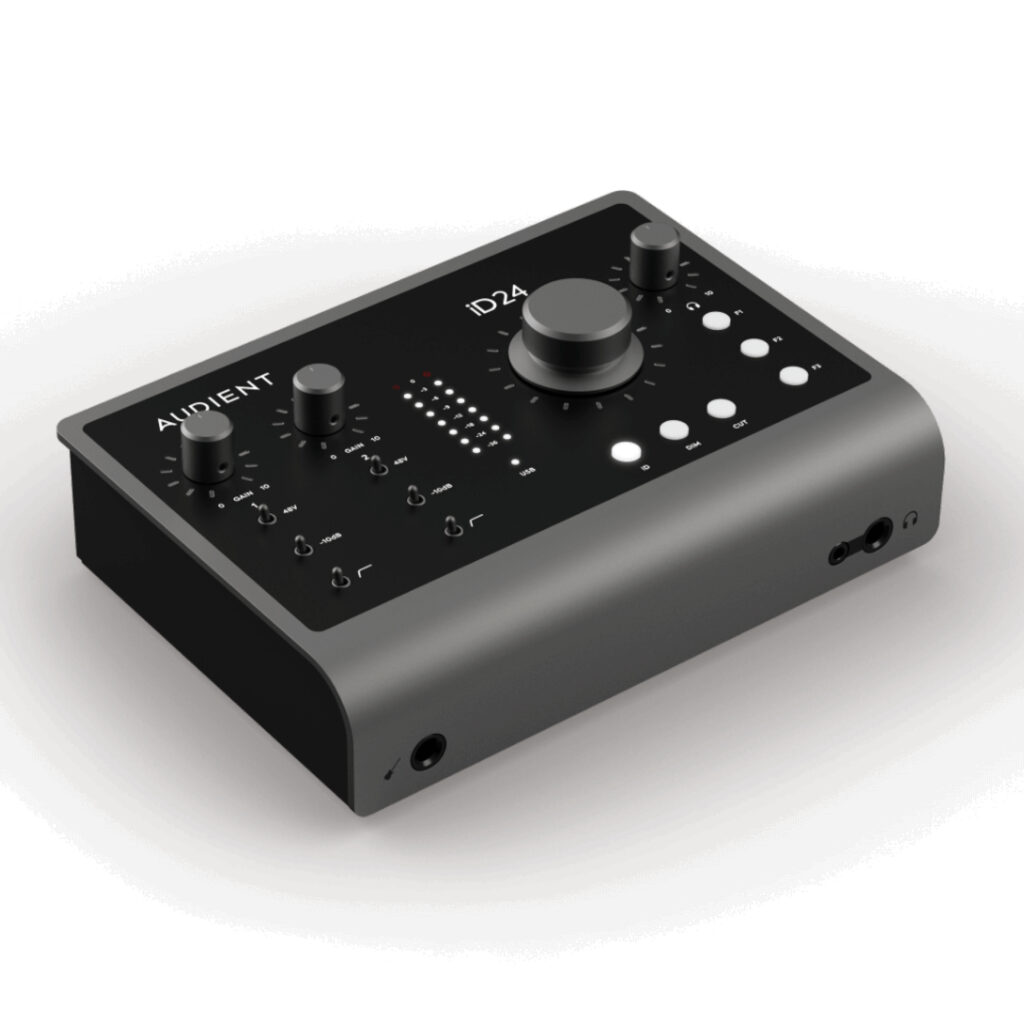
Audient iD24 adds two particularly useful facilities to a compact recording desk: balanced analogue inserts and optical expansion in both directions. Its appeal is therefore broader than simply providing a pair of microphone inputs. The original model also offers practical hardware monitoring controls and a substantial software mixer. This assessment concerns that iD24, with its documented original 58 dB preamp range, rather than the later iD2+ MK3 platform. It is most convincing when the owner has an identifiable use for the routing and processing connections.
Research-based review. This assessment draws on manufacturer documentation and the original published evaluations linked below. Audio Review has not performed a hands-on test of this model.
The original front end is a strong reason to audition
MusicRadar’s original trial praises the microphone recording result and finds the hardware and software combination flexible. Its evaluation favours a neutral presentation with useful headroom. That supports the iD24 as a quality-focused working tool without making it a substitute for good recording technique.
Test the actual microphones and instruments expected in ordinary sessions. Record quiet and louder passages with sensible headroom, then listen to the files at comparable levels. The room, source placement and performance can have a greater practical effect than a small numerical converter difference. If a microphone needs substantial gain, verify the result with the intended voice and distance rather than judging suitability from one maximum figure. Establish a clean reference before adding external processing. The strongest buyer can use the supplied front end confidently and then benefit from the extra routing facilities. Someone needing more simultaneous microphones should not sacrifice that basic requirement merely because this smaller interface has an attractive analogue specification.
Two microphone preamps are different from ten inputs
The advertised total includes optical channels supplied by an external digital device. The built-in analogue arrangement remains two microphone or line paths, and plugging into the front instrument socket replaces the first channel’s other source.
Draw the largest realistic session before purchase. A stereo keyboard plus a vocalist already needs more analogue paths than the basic pair provides together. An external ADAT preamp can change that arrangement, but it adds cost, cables and clock configuration. Include those requirements in the comparison with an interface that has more preamps built in. For an owner mostly overdubbing one or two sources, the compact layout can be entirely sensible. For regular ensemble work, a larger starting unit may be simpler. The useful purchase is the one that captures the intended sources simultaneously without avoidable re-patching. A headline input total is helpful only after it has been translated into the physical connections and operating mode needed for the session.
Balanced inserts are useful when processing is intentional
The two analogue send-and-return paths allow compatible external processing in the recording chain. They are a distinct facility, rather than extra ordinary microphone channels. The arrangement deserves planning before an outboard purchase is added to the budget.
Identify what the external device is meant to achieve and check the level and connection requirements of both products. Establish a clean unprocessed reference first. If compression or equalisation is being recorded into the take, understand that the decision becomes part of the captured result. A repeatable comparison is more useful than simply hearing a louder or more heavily processed sound. Leave adequate room for the extra cables and label the path so it can be restored reliably. Someone who already owns suitable analogue equipment may find these inserts decisive. Someone recording a basic voice and guitar may never need them. The feature earns its value by supporting an actual workflow, not by implying that external hardware is necessary for a professional result.
Optical expansion requires a clear clock and rate plan
The original specification supports ADAT input and output, with fewer channels at the higher supported sample rates. It also provides word-clock output and an alternative optical S/PDIF mode. These capabilities do not all add together as unrelated extra paths in every configuration.
Choose the session rate and required source count before ordering expansion equipment. Confirm which device will supply the clock and how the other follows it, using the manuals for both. Test every intended input and output with a short labelled recording. A lit optical cable or an apparent connection does not prove the digital formats and clock settings agree. Save a working configuration after it is established. If the studio only needs a few sources, a simpler analogue arrangement may be more practical than unnecessary expansion. If growth is genuinely planned, the bidirectional route can make the iD24 more flexible over time. Price that complete arrangement against a larger interface so the expansion path remains a deliberate decision.
Headphone sockets and cue mixes need careful distinction
The two front socket sizes carry the same stereo headphone feed. The software can create useful monitoring routes, but the sockets are not two independent headphone amplifiers with separate performer balances. The main and alternative speaker outputs are a different part of the monitoring arrangement.
Plan who needs to hear what before a collaborative session. If an engineer and performer require different headphone mixes at the same time, establish the complete output route and any additional equipment required. Test speaker switching at a sensible level and confirm which controls affect which destinations. A clear reference level helps avoid surprising changes between monitor sets. The original evaluation notes useful tactile controls but no top-panel input-level overview, making the software display important during setup. Keep that view accessible when adjusting recording gains. The best use of the monitoring facilities is a repeatable daily routine, with known output behaviour, rather than a complex collection of routes that is difficult to explain or restore.
Generation checking matters to value and power expectations
The original iD24 uses USB bus power and requires a suitable host connection. It should not be confused with the later iD2+ MK3 simply because the manufacturer describes the newer product as the successor to this position in the range.
Check the exact model label, manual and driver support before buying current stock or used equipment. Do not transfer newer room correction, tone shaping or converter claims to an older unit without documentation. Confirm the normal computer port and cable can support recording and monitoring under the intended load. Test sleep recovery and reconnection as well as a brief initial signal. Then compare the complete price with alternatives using the facilities actually needed. A good offer on the original can be attractive when its inserts and optical routes suit the studio. It is less persuasive if the owner is paying for unused complexity or expects features that belong to another generation. The durable value is a correctly identified, supported tool that makes the real recording process easier.
Alternatives to consider
Audient iD14 MKII: iD14 MKII is a useful lower-complexity comparison when digital input expansion matters but inserts or a larger routing system do not. Compare the exact monitor and headphone requirements before paying for extra facilities.
MOTU M4: M4 is a useful simpler desktop comparison when optical expansion and analogue inserts are not requirements. Compare the actual simultaneous microphone and line-source layout, monitoring controls and software workflow before deciding which arrangement offers better value.
Audient iD24 key specifications
- Version
- Original iD24, not iD2+ MK3
- USB format
- Up to 24-bit / 96 kHz
- Built-in microphone preamps
- Two, 58 dB gain range in original support specification
- Instrument
- One JFET input, shares analogue input 1
- Insert paths
- Two balanced send/return pairs
- Line outputs
- Four, main/alternate speaker options
- Headphone sockets
- 6.35 mm and 3.5 mm, same stereo headphone feed
- Optical
- ADAT or stereo S/PDIF input and output
- ADAT channels each way
- Eight at 44.1/48 kHz; four at 88.2/96 kHz
- Clock
- Word-clock output
- Advertised total
- 10 inputs / 14 outputs including optical and headphone paths
- Power
- USB bus power with documented suitable host requirements
Verdict
The original iD24 is a capable compact interface for deliberate analogue processing, optical expansion and controlled desktop monitoring. Its two-preamp layout and shared headphone feed remain important limits. Check the exact generation and host-power requirements, then compare the complete working arrangement. Choose it when the additional connections serve a clear purpose rather than because the advertised channel total seems unusually large.
Documentation and original reviews
Audient official original iD24 manual overview · Audient original iD24 technical support specifications · MusicRadar original iD24 recording and monitoring evaluation
Editorial record
Sources and updates
Product specifications and factual claims were checked against Official Audient iD24 product page ↗. Scores and buying advice follow our category-specific editorial methodology.
- Published
- November 17, 2026
- Last updated
- November 17, 2026