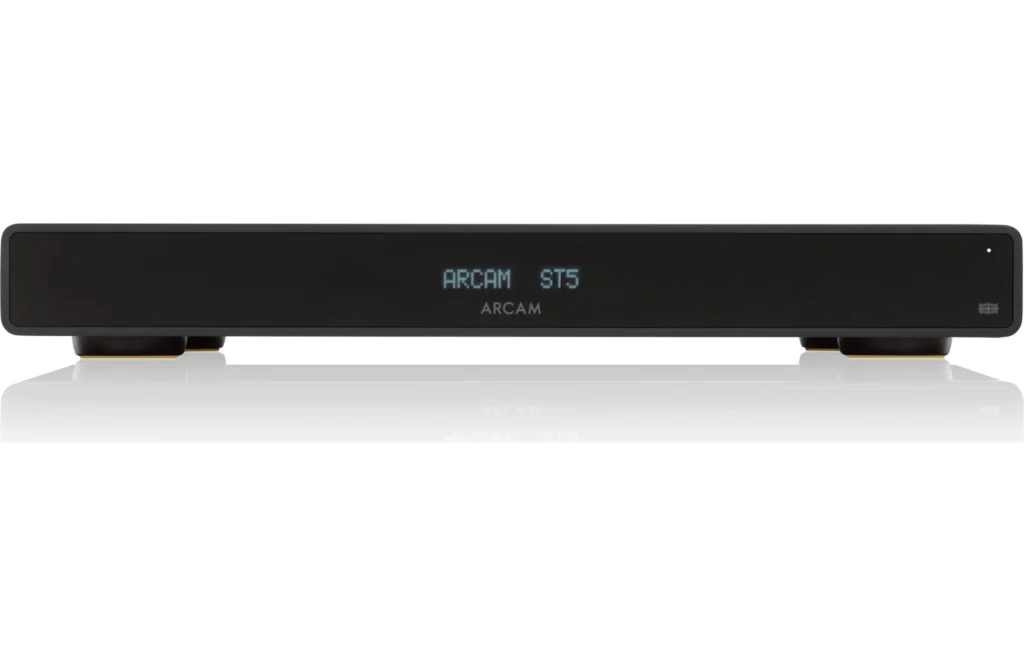
Arcam ST5 is a standalone network source for an existing amplifier, not a just-add-passive-speakers music system. It offers analogue playback through its own DAC or digital output to another converter, with a control link for compatible Radia amplification. This research-based review considers its smooth original listening character and the more qualified interface assessment, while updating the service list from current official documentation. In particular, Qobuz Connect is now listed officially even though early reviews describe a different service workflow. Output mode and downstream volume control also deserve attention.
Research-based review. This assessment draws on manufacturer documentation and the original published evaluations linked below. Audio Review has not performed a hands-on test of this model.
The original listening case is pleasant rather than class-leading
What Hi-Fi’s evaluation describes an easy-going, full presentation with appealing voices, but finds some rivals more dynamic, agile and revealing. It also reports a fragmented interface and occasional playback interruptions in its tested software environment. Those are historical review observations, not a claim that Audio Review has repeated them on current firmware.
For an audition, compare a familiar voice, a piano recording and more energetic music at matched level. A smoother source presentation can be welcome in one system and feel too restrained in another. Do not assume that visual matching with an amplifier establishes the best musical result. Try analogue output and a suitable digital route separately if both are relevant, keeping volume consistent. The ST5 has a plausible role for listeners who value an approachable balance and a compatible control arrangement. Its original evidence is more qualified than the strongest matching-amplifier reviews, so the complete source decision deserves an independent comparison rather than an automatic brand-matched purchase.
Current services should replace outdated launch descriptions
Arcam’s current page lists Spotify Connect, Tidal Connect and Qobuz Connect alongside AirPlay, Google Cast and Roon Ready support. Earlier accounts of Qobuz access through an app therefore should not be presented as the only current route.
Test the intended service account and phone on the actual unit. Confirm discovery, favourites, changing users and returning from standby after an official update where required. Network services can change independently of the hardware’s audio capability, so a current product list still needs to match the buyer’s daily routine. Check radio and local-library browsing if those are important rather than testing only a popular subscription service. A direct connection route from a familiar service app may make a basic companion application less important. Another listener may want every source organised in one interface. Choose according to repeated tasks, not the number of service logos. Reliable access to the music already used is more valuable than a trial or feature that never becomes part of the household routine.
Analogue and digital outputs change the system role
The ST5 can feed a suitable amplifier’s line input through stereo RCA or send digital audio through optical or coaxial output to another DAC. The manual explains that digital outputs must be enabled in settings and that selecting digital output defaults volume to fixed.
Decide where conversion and volume control belong before connecting the system. Do not assume a remote’s volume buttons remain an independent preamplifier control in every output mode. A compatible Radia control link has a particular purpose and should not be confused with universal control of any power amplifier or active speaker. If a downstream device expects controlled level, confirm the whole path rather than relying on the presence of RCA sockets. Compare the internal DAC against an existing converter using consistent levels and familiar material. Keeping a preferred external DAC can be useful, but it also changes how much of the ST5’s own hardware is needed. The correct route is the one that makes source selection and volume predictable, not the one that maximises the number of connected cables.
A network source is not a general-purpose digital hub
USB media and network libraries are supported source roles, while optical and coaxial are outputs. Bluetooth and HDMI are absent. The ST5 also has no speaker power stage, so passive speakers cannot be connected directly.
Check the actual library formats and drive arrangement before assuming all stored music will play. Documented maximum PCM and DSD-file capabilities do not establish identical output formats through every route. A computer may share music through an appropriate network arrangement, but that is different from using the unit as a general USB computer DAC. For television or a digital games source, use another suitable device rather than expecting the ST5 to accept audio through its output sockets. This narrower source focus can be perfectly sensible in an established hi-fi system. It becomes inconvenient when the buyer expects one new component to solve television, computer conversion and network playback simultaneously. Map those jobs before comparing prices.
The control link and display need a current demonstration
A compatible Radia amplifier can share aspects of input and volume operation through the supplied control connection. The original review nevertheless finds a split between app and remote settings less intuitive than some competing platforms.
Demonstrate that split with the exact devices. Start an album, select a radio preset, change output mode and return to the normal listening source. Check display legibility from the chair rather than only at the rack. Another household member should be able to restore ordinary playback without remembering which setting lives in which interface. If the matching control link reduces the number of remotes in practice, it has tangible value. If the owner frequently switches services and libraries, a more unified platform may be preferable. The sensible test is a few repeated daily operations, not a brief showroom track. Current software may differ from the review period, so check it directly rather than assuming either that all reservations remain or that all have been resolved.
Its value is strongest in an accurately matched existing system
ST5 can add network access without replacing familiar amplification. That is a useful long-term role when the amplifier and speakers are already satisfactory and the owner wants source technology kept separate.
Compare current complete offers with the actual network, library and volume requirements. Confirm regional mains, remote, control cable and support on a used or demonstration example. An inexpensive alternative may already provide the required digital output, while a more expensive source may justify itself through a substantially better interface rather than a format ceiling. Do not buy a matching stack purely for symmetry. Price only the functions that improve the real listening routine and consider whether the source’s analogue stage will be used. The ST5 makes the clearest case when its current service support, smooth presentation and compatible control link are all useful. A buyer seeking maximum excitement or a single comprehensive app should compare other platforms carefully before committing.
Alternatives to consider
WiiM Ultra: Compare the actual library, service and control routine rather than choosing from case size alone. Check required output formats and the downstream amplifier connection.
Eversolo DMP-A10: A considerably more ambitious source route to investigate where interface, library handling and system control justify a larger budget. Compare complete needs rather than assuming equivalent pricing.
Arcam ST5 key specifications
- Role
- Network streamer-DAC; no passive-speaker amplifier
- Network
- Ethernet and Wi-Fi
- Current playback list
- Spotify Connect; Tidal Connect; Qobuz Connect; AirPlay; Google Cast; Roon Ready
- Local sources
- Supported UPnP library and USB media
- Analogue output
- Stereo RCA to suitable amplifier line input
- Digital outputs
- Optical and coaxial to suitable external DAC or amplifier
- Output mode
- Digital enabled through settings; digital selection defaults volume to fixed per manual
- Bluetooth / HDMI
- Not provided
- Control link
- Compatible Arcam Radia amplifier operation
- Documented media ceiling
- PCM up to 24-bit/192 kHz; supported DSD128 files
- Dimensions / weight
- Approximately 431 × 57 × 344 mm; 3.5 kg
Verdict
ST5 is a useful research-based option for adding network music to a compatible existing system, with current service support broader than some launch accounts suggest. Its original sound and interface evidence remains qualified. Confirm output mode, downstream volume control and the actual app routine. Choose it for a specific system fit rather than matching styling alone.
Documentation and original reviews
Arcam official current ST5 service list and specification · Arcam official ST5 V3 owner manual · What Hi-Fi original ST5 sound and interface evaluation
Editorial record
Sources and updates
Product specifications and factual claims were checked against Official Arcam ST5 product page ↗. Scores and buying advice follow our category-specific editorial methodology.
- Published
- November 17, 2026
- Last updated
- November 17, 2026