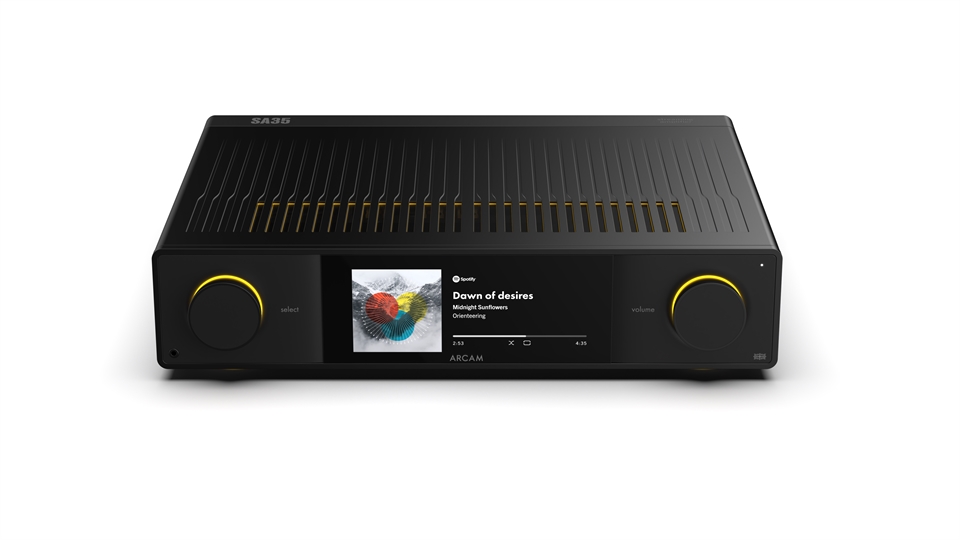
Arcam SA35 combines network music, Class-G speaker amplification, television HDMI eARC and both MM and MC vinyl inputs in a premium full-width system. Full Dirac Live Room Correction is included, but the current Dirac listing explicitly separates that from unsupported Bass Control and ART. This research-based review considers positive original evidence for musical precision and expression while examining calibration, software and source expectations. Its attraction is a genuinely complete stereo electronics platform, provided its particular interface and room-adjustment workflow suit the household.
Research-based review. This assessment draws on manufacturer documentation and the original published evaluations linked below. Audio Review has not performed a hands-on test of this model.
The original evaluation supports precision with expression
What Hi-Fi’s SA35 review describes controlled piano, expressive voices, layered imaging and agile, textured bass. It also identifies the split between app and remote tasks as less seamless than ideal. Its room-correction preference is tied to the publication’s treated listening environment. These are original-review observations, not Audio Review hands-on results.
That evidence suggests a system to audition for both control and emotional involvement. Compare a natural vocal recording, a busy arrangement and music with strong low-frequency changes at matched levels. Listen at ordinary evening volume as well as louder passages. A precise system should preserve phrasing and tonal variety rather than merely expose detail. Room and speaker interaction can change the result substantially, so use suitable speakers and sensible placement before judging the amplifier. The published evidence is strong enough to justify a premium audition, but it does not eliminate preference. Another network platform may still be more convenient or offer a presentation better matched to the room.
Included Dirac Live has a clear current limit
Dirac’s own SA35 page lists full Room Correction as included, with Bass Control and Active Room Treatment unsupported. Those are separate product tiers. Two subwoofer outputs do not establish the presence of the advanced licences or processing implied by those names.
Begin with sensible speaker placement and use the supplied microphone with the correct calibration information and documented workflow. Compare a saved correction with bypass at matched level and assess several familiar recordings. A correction target and measurement area should reflect the actual listening arrangement. Avoid promising that calibration will improve every aspect in every room, or that it can replace placement decisions entirely. If advanced multi-subwoofer integration is central to the purchase, confirm the exact current capabilities before buying instead of treating general Dirac compatibility as sufficient. The included full correction is a meaningful facility on its own. It does not need to be expanded into a claim about every advanced Dirac technology to justify attention.
Network playback should match the household accounts
Arcam’s current technical and feature lists include established Connect routes, AirPlay, Google Cast and Roon Ready, with Ethernet and Wi-Fi networking. The Radia application also serves setup and relevant library or radio tasks. Supported services still depend on current software and accounts.
Try discovery, favourites, changing users and waking from standby with the intended phones. Confirm local-library browsing if stored music matters, rather than testing only one subscription track. A direct service-app route may be easiest for one household, while another prefers browsing everything through a shared library. Check which tasks require the remote and which are available in the application. A large display helps show playback information but does not itself make every source task intuitive. The main advantage of a streaming integrated amplifier is fewer boxes and a coherent daily sequence. Choose the platform that makes repeated listening simple, not merely the one with the longest collection of service logos.
Television and vinyl broaden the one-box role
HDMI eARC and conventional digital inputs support a mixed music-and-screen system, while separate MM and MC phono provision broadens cartridge options. USB-A media is a local playback role rather than a promise of a general-purpose computer USB-DAC connection.
Test the actual television for stereo format selection, remote volume, synchronisation and standby recovery. A stereo streaming amplifier does not become a surround receiver through HDMI. For records, match cartridge output and loading requirements to the documented input, and use line level if a turntable’s internal stage remains enabled. Check hum with the intended layout and a quiet record section. For USB media, confirm drive and file compatibility before transferring an entire library. These source facilities can replace several electronics components when they are all useful. A buyer using only a single streaming service may gain less from the broad input list than someone balancing records, television and stored music every day.
Wireless listening and physical use need a demonstration
Bluetooth 5.4 and its documented modern features provide another source and compatible wireless-headphone route. The amplifier’s 6.5-inch display, paired rotary controls and remote support a traditional physical interface alongside application control.
Demonstrate the actual headphones and phone rather than assuming that every codec or broadcast mode operates with every device. Check the documented restrictions when Bluetooth input and output roles are involved. Try returning to speaker playback and verify fine volume adjustment from the normal seat. Leave the required ventilation and rear connector clearance; a tidy rear overhang can still make initial cabling less convenient. The substantial full-width unit also needs appropriate support and separation from a sensitive turntable. Another household member should be able to restore the usual source without a detailed explanation. Those practical checks matter because an all-in-one system concentrates many daily tasks in the same interface. A strong musical demonstration should be followed by a few ordinary operating tasks before purchase.
The complete system determines whether the premium is justified
SA35 includes amplification, conversion, network playback and room correction, but still needs suitable passive speakers and a thoughtful installation. Its manufacturer output figures have stated load, frequency and distortion conditions and should not be treated as interchangeable with a rival’s peak claims.
Compare current complete offers with appropriate speakers, stands and any specialist source needs included. A buyer already owning capable separate components may not gain the same convenience as someone starting again. Check regional mains, remote, microphone, accessories and current software on a used or demonstration unit. The room-correction facility has value when someone is willing to perform the measurements carefully, not simply because the logo appears on the box. Another platform may offer a more unified app or different bass-management tools. SA35 is strongest when its broad sources, positive musical evidence and included full Dirac correction all solve real needs. That is a substantial case without assuming universal compatibility or unsupported advanced processing.
Alternatives to consider
NAD M10 V3: Compare the compact interface, exact room-adjustment provision and source needs at complete current prices. Include any additional licences consistently.
Yamaha R-N2000A: Consider a different network, physical-control and room-adjustment approach with the actual speakers. Demonstrate the household service and television routine.
Arcam SA35 key specifications
- Role
- Network streamer-DAC and Class-G stereo amplifier
- Manufacturer output
- 120 W/channel into 8 ohms, both channels 20 Hz–20 kHz at stated 0.5% THD
- Four-ohm output
- 200 W/channel at 1 kHz under stated conditions
- Network playback
- Ethernet / Wi-Fi; supported Connect services, AirPlay, Cast and Roon Ready listing
- Analogue sources
- Three RCA line inputs; separate MM and MC phono
- Digital sources
- HDMI eARC; two coaxial; two optical; USB-A media
- Wireless
- Bluetooth 5.4; source / sink; Snapdragon Sound, LE Audio and Auracast
- Room correction
- Full Dirac Live included; microphone supplied
- Advanced Dirac tiers
- Bass Control and ART currently listed as unsupported
- Display
- 6.5-inch high-resolution panel
- Dimensions / weight
- Approximately 432 × 99 × 344 mm; 12 kg
Verdict
SA35 has strong research support as a premium stereo system combining music, television, vinyl and full Dirac Live correction. Demonstrate the actual service and remote routine, match the speakers and calibrate thoughtfully. Keep Bass Control and ART outside the current supported claim. With those expectations clear, its one-box source flexibility is particularly persuasive.
Documentation and original reviews
Arcam official SA35 current sources and specification · Arcam official SA35 V2 owner manual · Dirac official SA35 included and unsupported tiers · What Hi-Fi original SA35 listening and usability evaluation
Editorial record
Sources and updates
Product specifications and factual claims were checked against Official Arcam SA35 product page ↗. Scores and buying advice follow our category-specific editorial methodology.
- Published
- November 17, 2026
- Last updated
- November 17, 2026