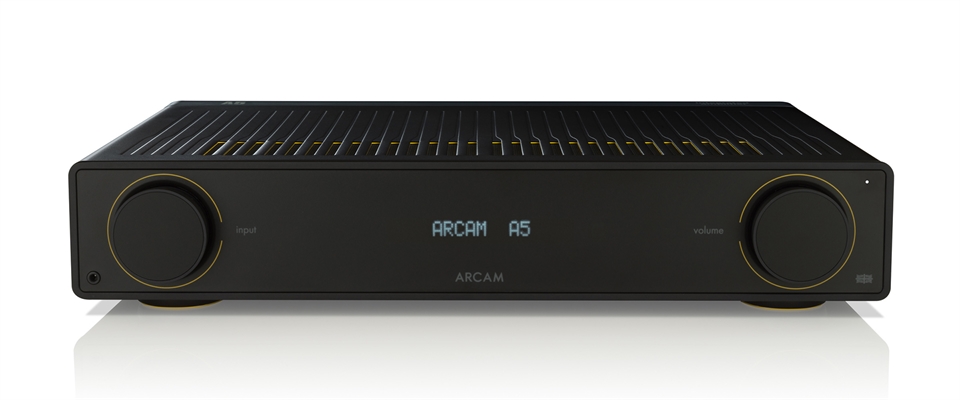
The original Arcam A5 is a Radia integrated amplifier that combines conventional stereo amplification with MM vinyl, digital transports and two-way Bluetooth. It is a separate model from A5+, so the newer generation’s wireless specifications should not be copied into an original-model offer. This research-based review considers the unusually positive original evidence for a refined but lively presentation, alongside the lack of HDMI, computer USB audio and native network music. Its value depends on an accurately matched source system rather than the assumption that every modern connection is included.
Research-based review. This assessment draws on manufacturer documentation and the original published evaluations linked below. Audio Review has not performed a hands-on test of this model.
Refinement does not have to remove musical momentum
What Hi-Fi’s original evaluation describes a full-bodied, smooth presentation that remains articulate, rhythmically assured and composed with demanding music. It also supports the phono and headphone facilities while identifying the frosted display and absent USB input as qualifications. Those are the publication’s observations, not listening performed by Audio Review.
That balance is worth checking with a familiar recording that is less than perfectly polished. An amplifier can soften harshness without becoming slow or indistinct, but listeners differ in how much refinement they prefer. Compare at matched levels and follow a bass line, vocal phrasing and changes in musical intensity. Include ordinary quiet listening rather than judging only a loud demonstration. A comfortable presentation should still communicate energy when the music asks for it. The evidence makes the A5 a strong candidate for a balanced conventional system. It does not remove the need to establish that the particular speaker pair and room preserve the same useful combination.
Original A5 and A5+ should remain separate buying decisions
The original A5 uses Arcam’s earlier Bluetooth implementation with aptX Adaptive, while the later Plus range has a different wireless feature set. A listing that omits the suffix can therefore hide a meaningful specification difference even when the styling looks familiar.
Confirm the rear label, invoice description and correct manual before comparing offers. Do not assume that an original model gains every new codec or broadcast function through a routine update. Conversely, a newer model is not automatically the better purchase if the buyer does not use the added function and the original is attractively priced with proper support. Compare the actual intended phone, headphones and source routes. Keep claims about sound improvements tied to the exact original evaluation rather than mixing comments from different generations. The A5 has a strong case in its own right. It does not need an inflated feature list borrowed from its successor to remain interesting as a conventional stereo amplifier.
The wired input list favours familiar stereo sources
Three line-level inputs, MM phono and optical/coaxial digital conversion cover a useful range of conventional components. Computer USB audio, native streaming and HDMI are absent. The service connection does not fill those music-input roles.
An existing CD player or streamer with appropriate outputs can fit neatly into that arrangement. A new buyer should price any external source needed for direct network playback before judging the amplifier’s apparent value. For television, a supported stereo optical route may be useful, but HDMI remote and standby behaviour should not be expected. Check the actual television’s PCM setting and lip synchronisation. With vinyl, confirm whether the turntable supplies cartridge level or an already equalised line output. Use the correct input and suitable cartridge match. The A5 is easy to understand when each source has a defined role. It is less convenient if several missing functions become separate purchases after installation.
Wireless headphones add a useful second Bluetooth role
The original model can receive Bluetooth audio and send sound to compatible Bluetooth headphones. That second role can be particularly useful when a conventional source needs to be heard privately without running a long cable across the room.
Demonstrate the actual headphones and check pairing, volume behaviour and returning to speakers. Codec negotiation depends on both ends of the link; the amplifier’s supported list does not mean every phone or headphone uses the same codec. For video, assess delay rather than assuming all wireless routes remain synchronised. Try the wired headphone output separately for comfortable level, noise and balance with the intended pair. A positive review using other headphones is useful context, not a guarantee of identical results. Decide whether the household will actually use wireless private listening often enough to value it. A feature that changes an everyday routine can be more important than another rarely used input, but only when its operation is clear and dependable.
The enclosure and power specification need practical context
Arcam specifies fifty watts per channel into eight ohms across the audio band under stated distortion conditions, with a differently conditioned four-ohm figure. The full-width enclosure is relatively slim, but it remains a mains-powered Class-AB amplifier requiring ventilation.
Consider speaker sensitivity, load, listening distance and required headroom together. A modest headline figure does not establish poor domestic performance, while a positive demonstration does not prove compatibility with every difficult speaker. Leave cable and airflow space as instructed rather than stacking another warm component directly on top. Check the display from the actual seating distance because its appearance is a documented reservation. Try the two main controls and remote for source changes and fine volume adjustment. A clean front panel should not make basic tasks harder. Room fit, legibility and ordinary operation belong in the same assessment as musical performance, particularly for a system another household member will also use.
A fair original-model offer can be a sensible purchase
The source flexibility and strong original musical evidence make the A5 worth comparing at the actual current price. Its attraction is greatest when a suitable streamer or transport already exists, or when the buyer deliberately prefers sources separate from amplification.
Check condition, regional mains, remote and support on an older or demonstration unit. Include passive speakers, stands and any external network or phono equipment in the system total. Do not use an old launch price or award as a permanent value judgement. A different integrated platform may provide more convenience for a television-centred household, while an analogue-only amplifier may be sufficient for someone whose conversion is already handled elsewhere. Choose the model that simplifies the real source collection. The original A5 is a particularly coherent option when its musical balance is preferred and the limited modern-source integration has been planned honestly. That is a more durable basis for purchase than chasing a model suffix alone.
Alternatives to consider
Audiolab 6000A MkII: Compare the exact-generation source arrangement and operating style with the intended speakers. Include a suitable network source in both systems where needed.
Denon PMA-900HNE: Consider native network convenience when direct service playback is more important than a separate-source approach. Compare the actual daily interface, not just input counts.
Arcam A5 key specifications
- Generation
- Original A5, not A5+
- Amplification
- Class AB
- Manufacturer output
- 50 W/channel into 8 ohms, both channels 20 Hz–20 kHz at stated 0.5% THD
- Four-ohm output
- 75 W/channel at 1 kHz under stated conditions
- Analogue sources
- Three RCA line inputs and MM phono
- Digital sources
- Two coaxial and one optical; supported PCM up to 24-bit/192 kHz
- Wireless
- Original Bluetooth implementation with aptX Adaptive; reception and headphone transmission
- Headphones
- Wired 3.5 mm and compatible Bluetooth route
- Expansion
- Variable stereo preamplifier output
- Not included
- HDMI, computer USB audio, native network streamer
- Dimensions / weight
- Approximately 431 × 83 × 344 mm; 8 kg
Verdict
The original A5 has strong research support for refined, involving stereo and useful conventional sources. Its wireless-headphone facility adds flexibility, while HDMI, computer USB and native streaming remain outside its role. Verify the generation and complete source costs, then audition the actual speakers. A fair offer can make it a sensible choice without borrowing features from A5+.
Documentation and original reviews
Arcam official original A5 product and specification · Arcam official original A5/A15/A25 reference manual · What Hi-Fi original A5 listening evaluation
Editorial record
Sources and updates
Product specifications and factual claims were checked against Official Arcam A5 product page ↗. Scores and buying advice follow our category-specific editorial methodology.
- Published
- November 17, 2026
- Last updated
- November 17, 2026