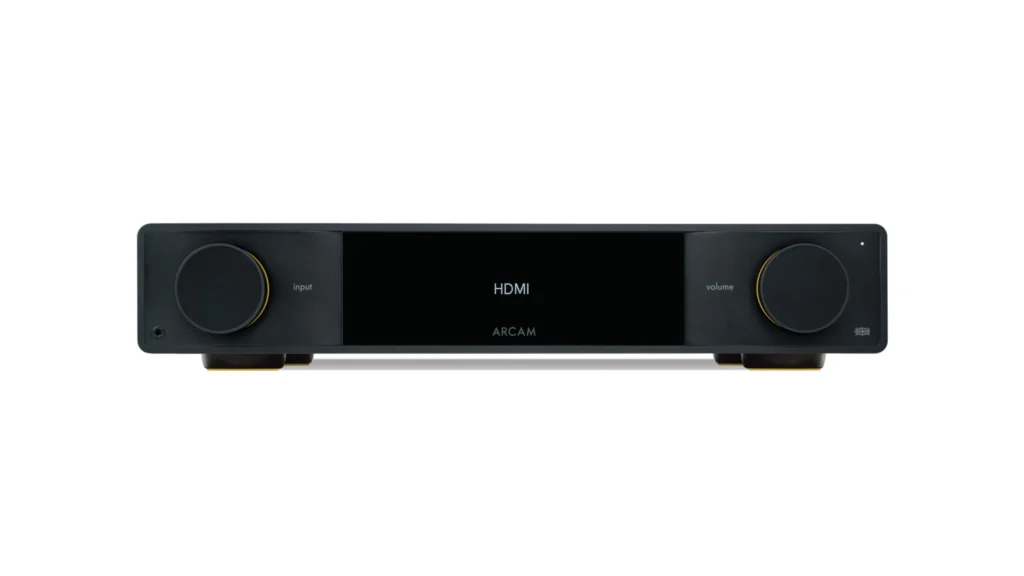
Arcam A25+ places Class-G amplification alongside a useful modern source section: HDMI eARC, computer USB-C, conventional digital inputs, MM phono and two-way Bluetooth. It is still an integrated stereo amplifier rather than a native network streamer. This research-based review considers the positive original evaluation of the A25+ paired with an ST25, keeping the external streamer’s contribution and functions distinct. That distinction helps show where the amplifier itself is versatile and where the complete system still requires another source or control interface.
Research-based review. This assessment draws on manufacturer documentation and the original published evaluations linked below. Audio Review has not performed a hands-on test of this model.
Combined-system evidence supports delicacy and energy
Audiograde’s original A25+ and ST25 evaluation describes an intimate, clear and rhythmically energetic presentation, with good low-level listening and a useful built-in MM stage. Its musical observations concern a combined system with particular speakers, not an isolated amplifier measurement or an Audio Review hands-on test.
That scope matters when drawing a buying conclusion. An amplifier cannot be assigned every quality heard through an external source simply because both components share a matching finish. Demonstrate the A25+ with the source that will actually remain in the system. Compare natural voices, complex percussion and a quieter recording at matched level. Listen at the ordinary evening volume, where subtle expression may be more useful than a brief loud demonstration. The original evidence supports a serious premium-system audition. It does not mean that purchasing the matching streamer is compulsory, or that every source will deliver an identical result. The preferred combination should earn its complete price through the actual listening and control routine.
Class G is an architecture, not a universal sound ranking
Arcam identifies the A25+ as a Class-G design and specifies one hundred watts per channel into eight ohms across the audio band under stated distortion conditions. The four-ohm output figure is given at a different frequency condition. Keep those distinctions attached to the claims.
Do not rank amplifier sound purely by class label. Speaker load, sensitivity, required level and installation remain important. A well-matched system may benefit from the A25+’s capability without using high volume every day, while a particularly difficult load deserves a direct demonstration. Compare control and clarity during changing musical intensity, not just the size of a bass impact. A more efficient architecture also does not remove the need for ventilation. Follow the supplied operating guidance and leave room around the case and connectors. The technology is relevant because it describes how the amplifier is designed to work. It does not establish automatic superiority over every Class-AB or Class-D competitor at every price.
HDMI and USB-C cover two different modern source jobs
HDMI eARC/ARC provides a television route, while USB-C provides computer audio. Optical and coaxial inputs remain available for conventional digital transports. The product page distinguishes USB’s supported maximum PCM rates from the other digital connections.
Test the actual television and computer separately. Check stereo output, synchronisation, remote volume and standby behaviour with internal television applications and external sources. For USB, confirm operating-system device selection and any official setup requirement, including recovery from sleep. A USB-C socket does not imply every storage, charging or recording function that uses the same connector. Keep supported audio input distinct from generic USB accessory use. Likewise, television eARC does not make the amplifier a multichannel receiver. A successful stereo setup should handle normal music and screen use without repeated troubleshooting. These additions are valuable when they simplify real sources, not merely because they make the rear panel look more current than the original A25.
Bluetooth and an external streamer should not be conflated
The Plus generation adds a newer Bluetooth platform with documented codecs, two-way operation, LE Audio and Auracast. Those are wireless audio facilities, but the A25+ does not itself provide the ST25’s Wi-Fi service player and library functions.
Decide whether casual phone playback is sufficient or music must continue independently through a network source. Demonstrate the intended phones and headphones, checking codec compatibility, reconnection and return to speakers. Auracast needs compatible equipment and a suitable workflow; it should not be treated as a promise that every existing headphone will join a broadcast. If a separate streamer is chosen, include its current services and interface in the audition. A combined review may praise a pairing while individual buyers prefer a different source platform. Match the network component to the household’s accounts and music library. The amplifier’s modern Bluetooth support is useful on its own terms without inheriting another component’s streaming specification.
MM vinyl, headphones and the display add practical substance
Three line inputs, MM phono, a variable preamplifier output and a wired headphone connection broaden the source system. The Plus model’s glass-front presentation is also a visible distinction from the earlier styling. Its usefulness should be assessed in the actual room.
Check cartridge compatibility and turntable output mode before selecting phono or line level. Demonstrate a quiet record passage to assess hum in the intended installation. Try the actual headphones for usable volume range and noise instead of assuming the speaker result transfers unchanged. From the sofa, check source names, volume display and remote operation under ordinary lighting. Leave sufficient rear access; a tidy overhanging case design can still make frequent cable changes awkward. A variable pre-out allows suitable expansion, but does not establish automatic subwoofer crossover or room correction. The best installation may remain a carefully positioned speaker pair and a clear source routine rather than a growing stack of accessories. Physical ease of use deserves the same attention as the premium finish.
A complete-source comparison establishes the real value
The A25+ can gather television, computer and vinyl sources into one amplifier while leaving network playback modular. That balance is particularly useful for buyers who already own a preferred streamer or want to change software platforms independently of speaker amplification.
Compare the current complete price with passive speakers, an external network source if needed and any different phono requirement included. An original A25 offer may remain sensible when the newer HDMI, wireless and display changes are not important. A fully streaming integrated system may be simpler for someone starting from scratch. Check regional mains, remote and support on an older or demonstration unit, and confirm the exact Plus designation. Avoid treating a matching pair’s old combined price as a permanent benchmark. The strongest value case is a system whose source flexibility and musical presentation are both useful now. The A25+ has a coherent premium role when its modern connections reduce friction without forcing a particular network interface on the owner.
Alternatives to consider
Arcam A25: Compare an original-model offer after accounting for the Plus generation’s HDMI, wireless and display changes. Identify the exact source needs before judging the price difference.
Audiolab 9000A: Consider a different premium integrated interface and source arrangement with the actual speakers. Include a network player in the complete system wherever required.
Arcam A25+ key specifications
- Generation
- A25+; not original A25
- Amplification
- Arcam Class G
- Manufacturer output
- 100 W/channel into 8 ohms, both channels 20 Hz–20 kHz at stated 0.5% THD
- Four-ohm output
- 165 W/channel at 1 kHz under stated conditions
- Analogue sources
- Three RCA line inputs and MM phono
- Digital sources
- Two coaxial, one optical, HDMI eARC/ARC and USB-C
- USB-C
- Computer audio; supported PCM rates up to 384 kHz
- Wireless
- Bluetooth 5.4; two-way operation; documented codecs, LE Audio and Auracast
- Outputs
- Passive speakers; variable stereo RCA pre-out; 3.5 mm headphones
- Network / correction
- No native Wi-Fi service player or automatic room calibration
- Dimensions / weight
- Approximately 431 × 83 × 344 mm; 9 kg
Verdict
A25+ is a compelling research-based candidate for premium stereo with computer, television and MM-vinyl sources. Positive combined-system evidence supports an audition, while the external streamer’s contribution must remain clear. Confirm current source behaviour and speaker matching, then compare complete offers. Its versatility is strongest when each included connection serves a real daily need.
Documentation and original reviews
Arcam official A25+ product and technical specification · Arcam official Radia Plus owner manual · Audiograde original A25+ and ST25 combined-system evaluation
Editorial record
Sources and updates
Product specifications and factual claims were checked against Official Arcam A25+ product page ↗. Scores and buying advice follow our category-specific editorial methodology.
- Published
- November 17, 2026
- Last updated
- November 17, 2026