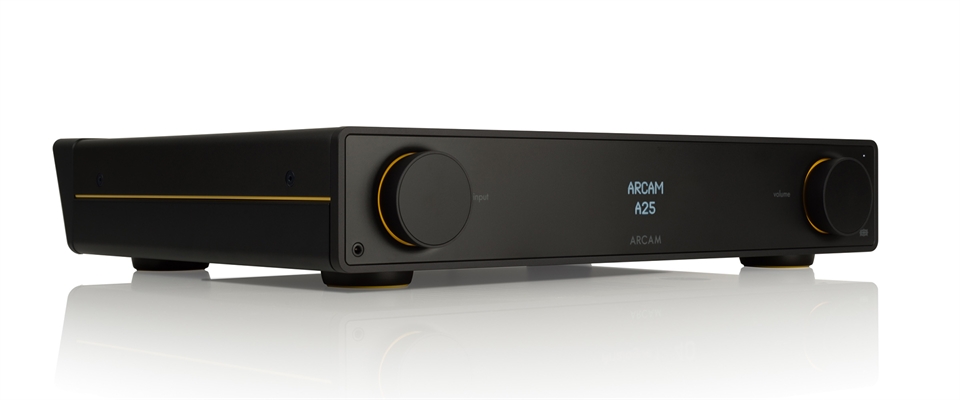
The original Arcam A25 combines Class G amplification with a broad set of music inputs, including a proper USB-C computer audio connection. It offers a more complete digital source arrangement than the original A15 while retaining a traditional separates role. Its strengths are stereo flexibility and understated design, with no built-in network streaming or HDMI to complete a television-first system.
Arcam A25 — Original model and physical design
The A25 covered here is the original Radia model, not the later A25+. That distinction is essential when using a current dealer listing or another generation’s manual. Confirm the exact suffix and connections before assuming a newer feature appears on discounted stock. A familiar front panel can conceal a materially different source arrangement.
The original uses a slim dark enclosure with illuminated control surrounds. This is a restrained hi-fi design rather than a large artwork display. Stereophile’s reviewer liked its presentation and everyday controls, while AVForums identified the rear cable flap as irritating. Check rear access with the leads actually required, particularly if the amplifier will sit deep inside a cabinet. Leave ventilation clear, since the manual describes warm casework as part of ordinary operation.
Class G and the power evidence
Arcam specifies 100 watts per channel into eight ohms across the audio band at 0.5 percent distortion. Its separate 165-watt four-ohm rating uses a one-kilohertz condition. Class G describes the amplifier’s power-supply and operating approach; it does not mean the product is a network amplifier or that every loudspeaker becomes an easy load.
Stereophile’s original bench test met the 100-watt eight-ohm claim and recorded 150 watts into four ohms at its one-percent clipping criterion, slightly below the manufacturer’s four-ohm figure. Reporting those conditions matters more than choosing whichever number looks most impressive. They are the publication’s measurements of its sample, not measurements performed by Audio Review.
The same laboratory work found the noise result depended on volume setting. That is a reminder to assess gain structure in a real system rather than reading one best-case distortion number as the entire performance. Use a suitable source level and sensible volume range, then judge whether the chosen speakers receive clean headroom at the required listening distance. An expensive interconnect is not a substitute for correct source and gain matching.
USB audio and other source connections
The A25’s USB-C audio input allows a compatible computer to feed its internal DAC directly. That is a genuine functional distinction from a USB socket used only for servicing. Select the amplifier as the computer’s output device and use a suitable data cable. A power-only cable can look correct while failing to provide any audio connection.
Optical and coaxial digital inputs support other sources, while three ordinary RCA line inputs accommodate external analogue equipment. An external streamer can therefore use the internal converter or supply its own analogue output, depending on the preferred system. Compare those complete paths at matched levels if both are available, rather than assuming a particular DAC chip dictates the better result.
There is no HDMI audio connection or independent network streaming platform in the original A25. A socket associated with Radia control integration is not proof of network music playback. If the system needs a service browser, multiroom music and one-remote television operation, include the appropriate external components and their limitations in the purchase plan. A USB-equipped amplifier can be digitally versatile without being a complete streaming system.
Phono and headphone use
The moving-magnet phono input adds a direct route for a suitable record player. It should not be treated as a universal moving-coil stage. Check cartridge output and loading, and connect a turntable with an enabled internal phono stage to an ordinary line input. Correct gain and equalisation are basic compatibility requirements, not optional fine tuning.
The 3.5 mm headphone output is useful for private listening without another desktop box. Stereophile’s original listening included several headphones and found particularly positive results with the Meze 109 Pro. That is relevant evidence for a capable connection, but it is not a guarantee that every sensitive earphone or demanding planar headphone will behave identically. Use the intended pair when possible and check both usable volume and background noise.
The manual allows headphone override behaviour to be configured, so verify whether speakers remain active when headphones are inserted. That detail matters in a shared room. A front socket alone does not establish automatic privacy, and someone else using the system should understand the chosen setting. Set up the ordinary listening routine before placing the amplifier somewhere that makes its controls difficult to reach.
Bluetooth and sound quality
Two-way Bluetooth provides convenient reception from compatible devices and transmission to suitable headphones. aptX Adaptive support depends on the other end of the connection; a supported codec on the amplifier does not make every phone use it. The manual also rules out using Bluetooth headphones with the Bluetooth input, so do not plan a simultaneous wireless relay through the amplifier.
Stereophile’s original listening described a smooth and engaging presentation, with the speaker pairing influencing scale and impact. AVForums likewise supported the amplifier’s broad input performance and usability while finding Bluetooth less convincing than its wired capability. Together these sources support a strong all-round assessment rather than a claim of unmatched performance in every individual category.
For an audition, start with the wired source most likely to be used and familiar music at realistic levels. Then try USB, vinyl or Bluetooth as appropriate to the intended system. Compare tonal balance, vocal intelligibility and dynamic comfort rather than concentrating on one spectacular bass passage. If a speaker needs more physical output than the room and system can provide, a different amplifier topology alone will not solve that limitation.
Expansion and total value
A variable preamp output and processor-mode option make the A25 adaptable to a larger system. Fixed-volume processor use needs deliberate setup, because another component then determines listening level. Follow the manual and document the arrangement for other users. Do not experiment with full-level source signals before establishing which volume control is active.
The original A25 makes a persuasive case for someone who wants direct computer audio, records and conventional sources with strong independent evidence for amplification. It is less complete for an owner who immediately needs streaming, television return audio and automatic room correction. Compare current European pricing with those additions included and with the newer plus generation clearly separated. Its value comes from the complete music system it enables, not simply the Class G label or a maximum supported file rate.
Alternatives to consider
Cambridge Audio CXN100: A separate network source to consider if an amplifier-led system needs streaming; it does not replace speaker amplification.
Naim Uniti Atom: Compare a premium integrated streaming approach if the network interface and fewer boxes are more important than direct computer USB audio.
Arcam A25 key specifications
- Version
- Original A25, not A25+
- Amplification
- Class G
- Rated output
- 100 W/channel at 8 ohms, 20 Hz–20 kHz, 0.5% THD
- Separate 4-ohm rating
- 165 W/channel at 1 kHz, 0.5% THD
- Analogue
- Three line RCA pairs and MM phono
- Digital
- USB-C audio, optical and coaxial
- Bluetooth
- Two-way, aptX Adaptive where supported
- Outputs
- Speakers, variable preamp and 3.5 mm headphones
Verdict
A well-rounded original Radia amplifier with useful USB-C audio, MM phono and convincing independent listening and bench evidence. It rewards a clear source plan, while streaming and television integration require additional equipment.
Primary documentation and independent reviews
Arcam official original A25 product specifications · Arcam official original A5/A15/A25 manual · Stereophile original A25 listening review · Stereophile original A25 bench measurements · AVForums original A25 review
Editorial record
Sources and updates
Product specifications and factual claims were checked against Official Arcam A25 product page ↗. Scores and buying advice follow our category-specific editorial methodology.
- Published
- November 8, 2026
- Last updated
- November 8, 2026