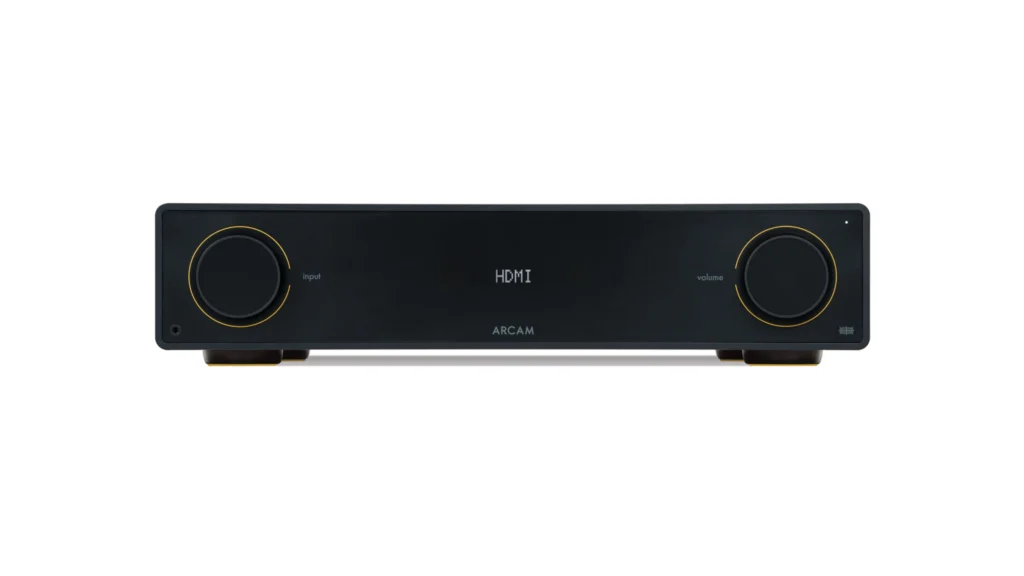
Arcam A15+ refreshes a successful conventional integrated amplifier with HDMI eARC and a newer Bluetooth platform while retaining Class-AB amplification and moving-magnet phono. It should not be confused with the original A15 or the USB-equipped A25+. This research-based review considers the strong original comparison evidence for improved clarity and expression, alongside the practical television, wireless and source requirements. It remains an integrated stereo amplifier rather than a complete network music system, and that distinction matters when comparing the total cost and daily control routine.
Research-based review. This assessment draws on manufacturer documentation and the original published evaluations linked below. Audio Review has not performed a hands-on test of this model.
The original comparison describes a measured improvement
What Hi-Fi’s evaluation compares A15+ directly with the original A15 and reports clearer detail and more expressive dynamics, while finding broadly similar tonality and overall authority. It also supports the phono and digital sections. The display and absent USB input remain qualifications. These are original-review findings, not Audio Review testing.
That evidence supports considering the Plus model without pretending that the predecessor suddenly became inadequate. An existing owner should identify an actual need before replacing a functioning system. A new buyer should compare current offers with the same speakers and sources, paying attention to quiet musical changes as well as louder crescendos. A small refinement can be worthwhile over years of listening, but its value depends on the price difference and whether HDMI or wireless additions are useful. The preferred amplifier should make the whole arrangement feel natural at everyday levels. Do not turn a positive side-by-side review into a universal instruction to upgrade regardless of system or budget.
HDMI eARC makes television integration more practical
The A15+ adds a television HDMI eARC/ARC route to optical and coaxial digital inputs. That is a meaningful distinction from the original A15. It remains a stereo amplifier, so an HDMI socket does not imply multichannel speaker decoding or cinema-receiver processing.
Use the appropriate stereo output settings and test the actual television’s internal applications and external sources separately. Check remote volume, lip synchronisation, source selection and recovery from standby. Automatic source switching can be convenient, but the chosen behaviour should match the household. If another device unexpectedly takes over through Bluetooth or HDMI, investigate the documented settings instead of assuming a hardware fault. Demonstrate how to return to music after television use. A successful mixed-use system should be understandable without a long sequence of app changes. The added HDMI route can remove a practical obstacle for a conventional integrated amplifier, but its usefulness still depends on how the particular television and connected sources behave.
Bluetooth adds modern options with compatibility conditions
Arcam documents Bluetooth 5.4, two-way operation, relevant aptX variants, LE Audio and Auracast. These features expand wireless possibilities, but they require compatible sending and receiving devices. A codec name on the amplifier does not establish that every phone uses that route.
Try the actual phone and headphones. Confirm pairing, reconnection and the process of moving back to speakers. Auracast should be assessed with compatible equipment and its intended broadcast workflow rather than treated as identical to ordinary paired Bluetooth. For video, check audible delay with the real source. Wired listening remains worth comparing at matched level, but convenience may be the stronger reason to use Bluetooth. A household should understand whether playback depends on a phone remaining connected and what happens when another device starts sending audio. Modern wireless support is valuable when it solves an actual routine; it does not turn the A15+ into a Wi-Fi service streamer or guarantee a particular codec under every condition.
MM vinyl and conventional digital remain central
Three line inputs, a moving-magnet phono stage, optical and coaxial conversion support a familiar source collection. The A15+ does not provide computer USB audio, and the A25+ specification should not be transferred to it. Native network music likewise requires an external source.
Confirm the turntable’s output mode and cartridge match. A line-level record-player output should use a line input, while low-output moving-coil operation needs an appropriate separate solution. For a CD transport, choose a supported PCM connection. A computer can use another suitable source path, but budget and convenience should be assessed honestly instead of treating a service connector as a DAC input. Demonstrate the actual streamer or transport that will remain in the rack. The positive original evidence for the included digital and phono sections makes them worth using before buying external replacements automatically. Additional equipment should solve a specific need, not simply be assumed superior because it occupies another box.
Controls and speaker matching still deserve an audition
The documented output is eighty watts per channel into eight ohms across the audio band under stated distortion conditions, with a differently conditioned four-ohm figure. A modern clean front and remote support operation, while the frosted display remains a recognised limitation.
Listen with the intended speaker load and ordinary seating distance, especially where high levels or a large room are expected. Do not assume a positive general compatibility assessment makes every difficult load suitable. Check display legibility from the sofa and fine volume adjustment late at night. Try the wired headphone output independently for noise, comfortable gain and the preferred balance. Leave ventilation and rear connection space as described in the instructions. A variable preamp output offers expansion, but should not be interpreted as automatic crossover or room correction. The amplifier works best within a sensibly installed stereo system. Its design can simplify daily operation without replacing the acoustic decisions that determine how speakers interact with the room.
Value depends on whether the Plus additions are useful
A15+ combines strong original musical evidence with a source list that now suits more television-centred rooms. That is a meaningful value argument when the buyer otherwise needs external conversion or a more awkward control arrangement.
Compare current complete prices, including a streamer if direct network music is required. An original A15 offer may remain attractive for a buyer who has no need for HDMI or the updated wireless platform. A network integrated amplifier may be more convenient when a single service interface is the main priority. Confirm regional mains suitability, remote, firmware and support on a demonstration or used unit. Avoid choosing solely from a review award or an old launch-price difference. The best system is the one whose sources and controls fit the household while preserving the preferred musical presentation. A15+ has a particularly coherent case when vinyl, conventional digital sources and television all matter, and the buyer is comfortable keeping network playback in a separate component.
Alternatives to consider
Arcam A15: Compare an original-model offer only after accounting for the Plus generation’s HDMI and wireless differences. A lower price can be meaningful if the added functions are not needed.
Audiolab 6000A MkII: Compare the exact source list, physical controls and musical presentation with the intended speakers. Include an external network player where either system needs one.
Arcam A15+ key specifications
- Generation
- A15+; distinct from original A15
- Amplification
- Class AB
- Manufacturer output
- 80 W/channel into 8 ohms, both channels 20 Hz–20 kHz at stated 0.5% THD
- Four-ohm output
- 120 W/channel at 1 kHz under stated conditions
- Analogue sources
- Three RCA line inputs and MM phono
- Digital sources
- Two coaxial, one optical and HDMI eARC/ARC
- USB audio
- Not provided on A15+; do not confuse with A25+
- Wireless
- Bluetooth 5.4; two-way operation; documented codecs, LE Audio and Auracast
- Outputs
- Passive speakers; variable stereo pre-out; 3.5 mm headphones
- Network / correction
- No native network player or automatic room calibration
- Dimensions / weight
- Approximately 431 × 98 × 344 mm; 10 kg
Verdict
A15+ is a strong research-based recommendation for a flexible stereo system with television and MM vinyl. Its documented refinements and HDMI addition have clear value, while computer USB and native streaming remain absent. Compare the exact generations, demonstrate the intended sources and audition suitable speakers. Its versatility is convincing when those real functions match the room.
Documentation and original reviews
Arcam official A15+ product and technical specification · Arcam official Radia Plus owner manual · What Hi-Fi original A15+ listening evaluation
Editorial record
Sources and updates
Product specifications and factual claims were checked against Official Arcam A15+ product page ↗. Scores and buying advice follow our category-specific editorial methodology.
- Published
- November 17, 2026
- Last updated
- November 17, 2026