The original Arcam A15 is a traditional integrated amplifier with a useful DAC and two-way Bluetooth. It focuses on stereo music rather than building a complete network and television system into one box. Its strong independent listening evidence makes it appealing, provided the missing USB audio, HDMI and network streaming match the intended source arrangement.
Arcam A15 — The original A15 and its design
This review concerns the original A15, without a plus sign. Newer A15+ listings and specifications should not be assumed to describe the same product. Confirm the exact model on an offer, especially when comparing a discounted original with a replacement generation. Differences in connections can matter more than a small change in price.
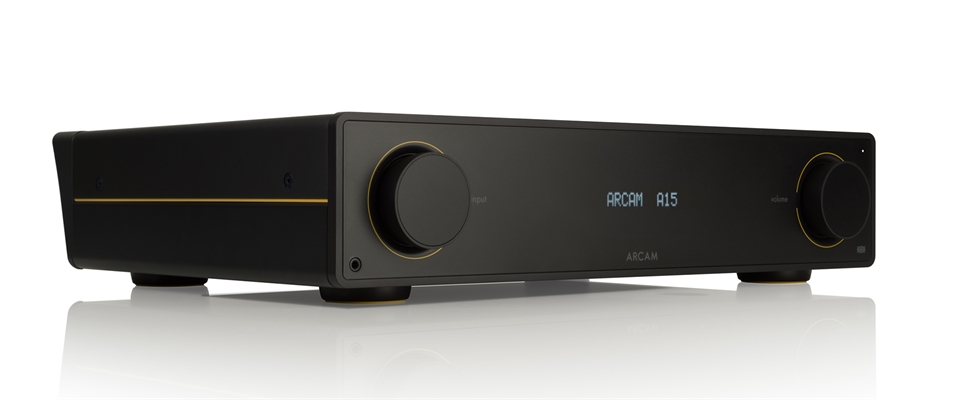
The Radia design combines dark casework with restrained yellow accents and two prominent controls. It looks cleaner and less traditional than many full-width stereo amplifiers, while still offering direct operation. What Hi-Fi’s original review praised construction but found the display less crisp than ideal. Try reading it from the normal seat, and allow sufficient ventilation: the manual explains that the amplifier runs warm in ordinary operation.
Amplification and speaker matching
Arcam specifies Class AB amplification and 80 watts per channel into eight ohms. That is a meaningful step above a small desktop amplifier, but the number alone cannot establish compatibility with every floorstander or listening room. Speaker efficiency, impedance behaviour and the desired peak level determine the real demand.
Use the intended speakers in a demonstration where possible. Listen at an ordinary evening level and at the loudest realistic level, rather than making the whole judgement from a short loud excerpt. A system should remain composed through peaks without requiring excessive average volume. Speaker position and room acoustics still determine much of the bass balance and perceived clarity.
The A15 is not a room-correction amplifier. If the room produces a strong resonance, changing amplifier brands may be less effective than adjusting placement, adding appropriate treatment or using a source with suitable correction. Its appeal lies in good conventional amplification and a coherent source package, not an automatic solution to every room problem. Plan that distinction before deciding how much of the system budget belongs in the amplifier.
Digital and analogue sources
The original A15 supplies three line-level RCA inputs, two coaxial digital inputs and one optical input. That gives a disc transport, streamer or television several possible routes, depending on their outputs. An external streamer can use the internal DAC through a digital connection or its own converter through an analogue input, allowing a practical comparison of the two arrangements.
There is no computer USB audio input and no HDMI return-audio connection. A service USB socket is not a substitute for either feature. A computer that only offers USB needs another suitable interface or DAC, and a television requires a supported optical or external analogue route. A passive lead cannot create the missing USB conversion or HDMI control system.
A control connection intended for another Radia component should not be mistaken for a built-in Ethernet streamer. The A15 does not browse a music service independently. That is not necessarily a disadvantage when a preferred streamer is already owned, but it belongs in the total price and box-count comparison with an integrated network amplifier. Draw the signal path before ordering accessories.
Vinyl, headphones and Bluetooth
The MM phono stage supports a moving-magnet turntable system without requiring another box. A low-output moving-coil cartridge needs appropriate gain and loading elsewhere. If the turntable already has an enabled phono preamp, use a line input instead of the phono socket. This avoids applying gain and equalisation twice.
The 3.5 mm headphone output adds a convenient private listening route. What Hi-Fi’s original evaluation gave both the phono and headphone sections particular praise with the equipment used in that test. That is stronger evidence than simply counting sockets, although it still does not promise ideal results with every headphone. Check sensitivity, available level and comfortable volume adjustment with the intended pair.
Two-way Bluetooth supports receiving music and sending suitable sources to wireless headphones, with aptX Adaptive available where the other device supports it. The manual explicitly says Bluetooth headphones cannot be used with the Bluetooth input at the same time. It is therefore not a wireless relay that takes a phone’s Bluetooth feed and retransmits it to Bluetooth headphones. That restriction is easy to miss when the specification is reduced to the phrase two-way Bluetooth.
Sound quality and independent evidence
What Hi-Fi’s original A15 review described a controlled, clear and dynamically expressive amplifier, with convincing performance across its inputs. It also found the A15 less forgiving of partnering equipment than the cheaper A5. This supports a high sound assessment without making it a universally ideal match for every bright room or speaker. The original review’s listening belongs to that publication, rather than to an Audio Review hands-on test.
Use that evidence to frame an audition, not to replace it. A revealing presentation can make a well-balanced recording engaging while also exposing rough production. Include music that is representative of the actual library rather than only exceptionally polished demonstration material. Listen for stable vocal placement, useful detail and rhythmic coherence through a whole song.
Level-match alternatives and pay attention to the practical input that will be used most. An analogue demonstration through an expensive external DAC does not fully establish the experience of a modest optical source or a particular cartridge. The A15’s broad positive evidence is encouraging, but the complete chain still determines the result. Avoid assuming an award establishes that every source, headphone and loudspeaker combination has been tested.
Expansion and value
A variable preamp output gives the A15 a route into a larger separates system. It can be useful for an appropriate external power amplifier or a compatible subwoofer arrangement, but it is not automatically a dedicated filtered bass output. Check the receiving component’s input and crossover facilities. The manual’s processor mode also requires careful level setup when another system controls the gain.
The original A15 is especially attractive when a good external streamer is already part of the system and current European pricing reflects its generation. It is less compelling if several missing functions must immediately be added. Compare the full installation, including the source, television control and any room correction required. Choose it for documented stereo ability and useful conventional inputs, while keeping the original-model connection limits clear.
Alternatives to consider
WiiM Ultra: A separate streaming source to consider for an amplifier-led system; it is not a speaker amplifier by itself.
NAD C 700 V2: Compare a complete compact network amplifier if fewer boxes and television integration are priorities.
Arcam A15 key specifications
- Version
- Original A15, not A15+
- Amplification
- Class AB, 80 W/channel at 8 ohms
- Analogue
- Three line RCA pairs and MM phono
- Digital
- Two coaxial and one optical
- USB / HDMI / network streaming
- Not included
- Bluetooth
- Two-way, aptX Adaptive where supported
- Outputs
- Speakers, variable preamp and 3.5 mm headphones
- Bluetooth restriction
- Cannot use Bluetooth headphone output with Bluetooth input
Verdict
An excellent original Radia option for a carefully matched stereo system, with strong listening evidence and useful phono and headphone sections. Its source plan needs to accommodate the absence of USB audio, HDMI and built-in network streaming.
Primary documentation and independent reviews
Arcam official original A15 product page · Arcam official original A5/A15/A25 manual · What Hi-Fi original A15 review
Editorial record
Sources and updates
Product specifications and factual claims were checked against Official Arcam A15 product page ↗. Scores and buying advice follow our category-specific editorial methodology.
- Published
- November 8, 2026
- Last updated
- November 8, 2026