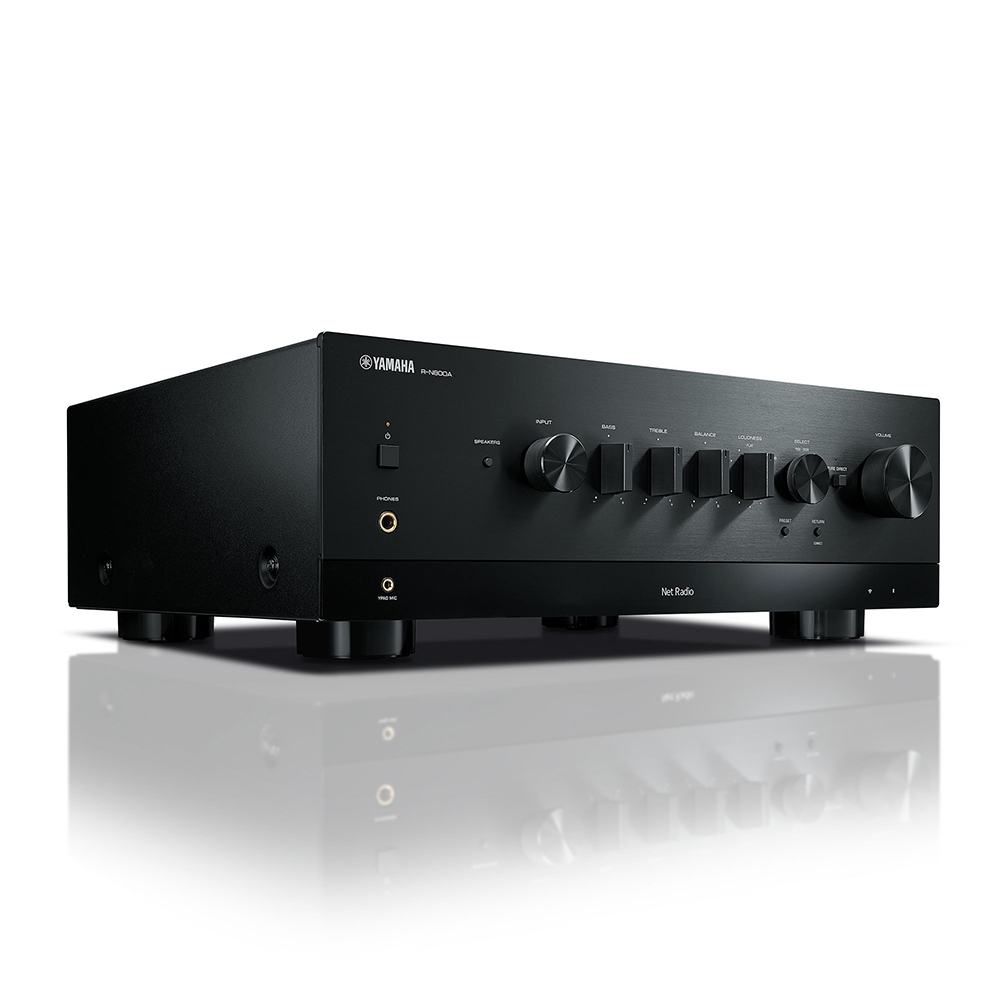
The Yamaha R-N800A combines a traditional stereo receiver layout with network streaming, USB DAC operation and automatic room setup. It is a broad just-add-speakers system for music rather than a multichannel home cinema receiver. Its most important limitation for a mixed living-room system is straightforward: unlike the R-N1000A, it has no HDMI ARC input.
Yamaha R-N800A — Design and daily listening
The R-N800A looks like a conventional Yamaha stereo component rather than a touchscreen streamer. Physical controls can make source and volume changes feel immediate, while the smaller display leaves artwork browsing to the controlling device. That is a useful arrangement for someone who wants familiar hi-fi operation with network convenience added, rather than an amplifier that resembles a tablet.
It is still a full-width receiver and needs a proper shelf. Allow room for rear cables, ventilation and the antenna arrangement. Think about the distance from the listening seat and whether the small status display will be useful there. A component can be easy to operate at the front panel while relying on the app for deeper functions. Test the normal routine in advance: selecting music, adjusting volume, changing to a physical source and returning to the network player should all feel natural to the owner.
Power and matching speakers
Yamaha’s European specification rates the amplifier at 100 W per channel into 8 ohms across 20 Hz to 20 kHz at 0.07 percent THD. That is a manufacturer rating with useful conditions attached, not a measurement performed by Audio Review. It indicates a substantial stereo role, but does not establish an ideal match for every loudspeaker. Sensitivity, impedance behaviour and listening distance determine how the available drive translates into a room.
A sensible pairing begins with speakers that suit the space. Large bass output in a small room can be harder to integrate than a more modest system, while low-sensitivity speakers at a distant seat can use headroom quickly. Do not decide entirely from an amplifier wattage or a loudspeaker’s maximum-power label. Consider the level normally used and the demands of the recordings you enjoy.
Good placement remains essential even with automatic calibration available. Give the speakers a workable position and avoid placing the main seat in an obvious bass problem area where possible. A receiver with correction is not a reason to ignore the physical system. It offers a useful next stage of adjustment after the fundamentals are in place.
MusicCast and computer playback
MusicCast network playback is included, allowing streaming and compatible multiroom use without adding a separate network card. That is a meaningful difference from an amplifier which merely receives Bluetooth. The phone or tablet can act as a controller rather than continuously carrying the programme as a Bluetooth transmission. Check the actual service and library workflow you intend to use, since ecosystem convenience matters more than a broad list of music logos.
USB-B DAC input offers a direct computer-audio route. That is useful for a laptop or desktop which will remain beside the receiver, and avoids assuming every network amplifier must be used only through an app. The documented USB support reaches high-resolution PCM and DSD, but ordinary music does not need maximum-rate conversion to be worthwhile. A stable connection and correct audio routing are the practical priorities.
Wi-Fi, Ethernet, AirPlay 2 and Bluetooth broaden source access, but they are not interchangeable paths with identical behaviour. Choose the one that fits the source and daily routine. A stable wired network is useful where practical, while wireless can make placement easier. Neither route removes the need to verify that the preferred music service and local library work as expected.
Analogue and television connections
The receiver includes MM phono and ordinary line inputs, plus two optical and two coaxial digital inputs. A moving-magnet turntable can use the phono connection, while a turntable with an enabled internal phono stage should enter a normal line input. Low-output moving-coil cartridges require suitable matching equipment rather than an assumption of universal phono support.
The lack of HDMI ARC is a real distinction, not a minor wording issue. A compatible television can still send stereo PCM through optical, but the control arrangement may involve the receiver’s remote rather than the same integrated routine offered by an HDMI model. Check the television’s available output and expected volume behaviour before choosing the cheaper receiver solely because its amplifier power matches the next model.
The R-N800A is a two-channel system. It will not provide separate centre, surround and height channels just because Yamaha also makes AV receivers. For an owner moving from home cinema to stereo, decide whether a strong two-speaker presentation is the goal or whether the missing channels remain essential. The same brand name does not make those product categories functionally interchangeable.
YPAO and sound quality evidence
Yamaha includes YPAO room setup with reflected-sound control and EQ. That can be valuable when the room contributes uneven bass or an awkward balance. Use the microphone and documented procedure carefully, with a quiet room and a measurement position that represents the intended listening area. Compare the result with bypass at similar levels rather than assuming every automated result must be better in every respect.
What Hi-Fi’s original R-N800A review found its presentation open, balanced and enjoyable, while wanting more rhythmic energy and better organisation when pushed. It was also less positive about the phono stage than the streaming section. That supports a good all-round recommendation with clear limits, rather than calling every input equally accomplished. The observations belong to that review’s system and do not represent our own listening test.
For a buyer who uses vinyl heavily, audition that input rather than concentrating only on network playback. If an external phono stage is likely, include its cost in the comparison. For predominantly streamed music, the integrated network path may be the stronger reason to buy. A product can offer a broad feature set while still having different strengths across sources.
Outputs and buying value
Preamp, subwoofer and headphone outputs allow several useful system arrangements, but a subwoofer socket alone does not guarantee a perfect blend. Establish sensible placement, crossover and level, then use the available setup tools to refine the result. The main aim is coherent bass at the listening position, not making the additional subwoofer obvious on every track.
The R-N800A is strongest when a traditional full-size music system, network playback and USB computer access are all useful. If television is central, compare the complete benefit of moving to an HDMI-equipped alternative rather than adding workarounds afterward. Current EU price, support and the intended sources should decide value. It remains a capable integrated music solution, especially for an owner who likes physical controls and does not need the screen or HDMI features offered elsewhere.
Alternatives to consider
WiiM Amp Ultra: A different approach for an owner prioritising a compact app-based streaming system and television integration.
NAD C 700 V2: Compare this when a compact streaming amplifier with a visible screen better fits the room and control routine.
Yamaha R-N800A key specifications
- Type
- Network stereo receiver
- Rated output
- 100 W/channel at 8 ohms, 20 Hz–20 kHz, 0.07% THD
- Network
- MusicCast, Wi-Fi, Ethernet and AirPlay 2
- Computer audio
- USB-B DAC input
- Digital inputs
- Two optical and two coaxial
- Analogue
- MM phono and line inputs
- HDMI ARC
- Not included
- Calibration
- YPAO with R.S.C.
Verdict
A capable music-focused network receiver with useful USB DAC access and included YPAO. Its traditional controls and broad source support are appealing, while absent HDMI ARC and the cited review’s reservations about phono and ultimate drive should shape the purchase.
Primary documentation and independent reviews
Yamaha official European R-N800A specifications · Yamaha official R-N800A features and YPAO · What Hi-Fi original R-N800A review
Editorial record
Sources and updates
Product specifications and factual claims were checked against Official Yamaha R-N800A product page ↗. Scores and buying advice follow our category-specific editorial methodology.
- Published
- November 8, 2026
- Last updated
- November 8, 2026