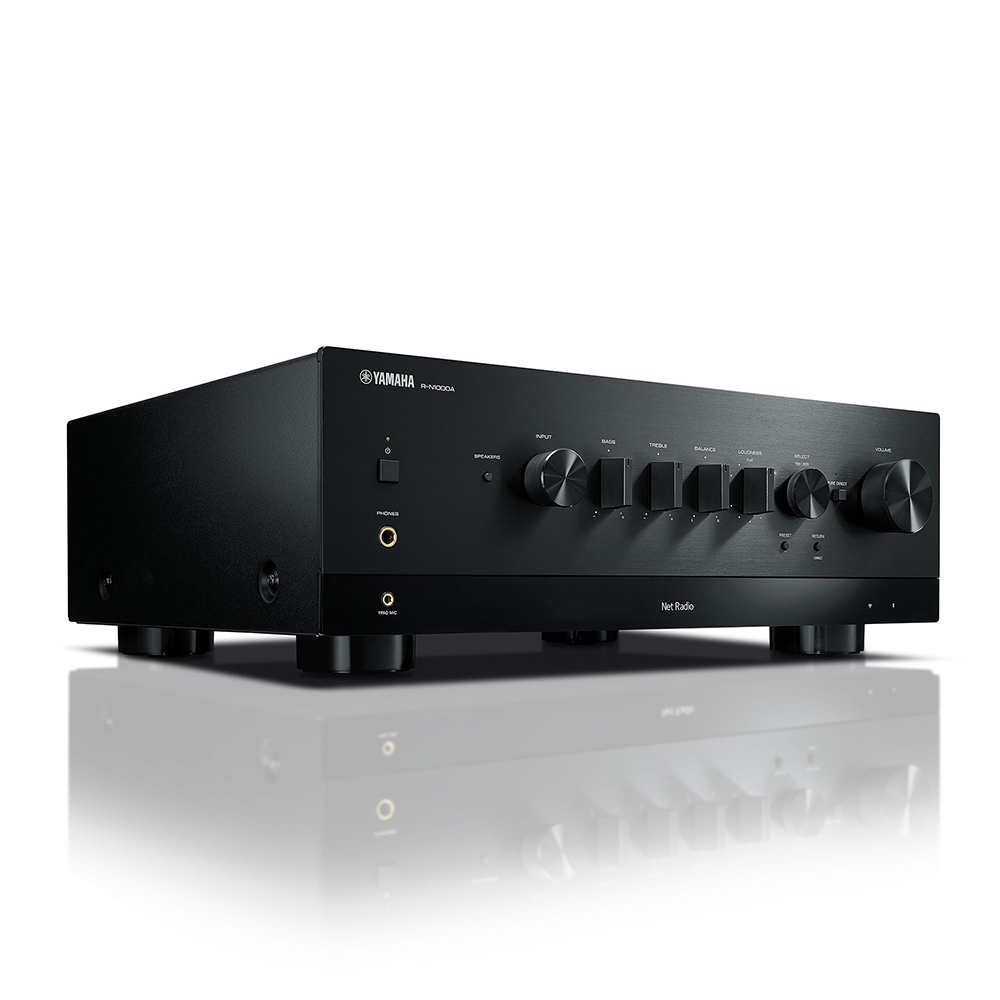
The Yamaha R-N1000A brings network music, computer audio and television into a conventional stereo receiver. It includes MusicCast streaming and YPAO setup rather than depending on optional expansion hardware. The HDMI ARC input makes it especially relevant to a living room where one pair of speakers needs to serve both music and television.
Yamaha R-N1000A — Traditional controls with network convenience
The R-N1000A keeps a full-width receiver format and physical controls rather than replacing the front panel with a large display. That can appeal to an owner who wants familiar source and volume operation while letting a phone or tablet handle library browsing. It is a bridge between conventional hi-fi use and an integrated streaming system, rather than a small app-only amplifier.
Its status display is compact, so decide whether that suits the viewing distance. The original Sound+Image review found the small display a limitation while liking the overall control options. Placement also needs to account for ventilation, rear connections and the antenna. A shallow shelf can become awkward when every source cable is attached. Try the daily routine you expect to use rather than assuming the presence of an app guarantees a simple experience for every member of the household.
Power and the independent bench context
The European specification rates the amplifier at 100 W per channel into 8 ohms from 20 Hz to 20 kHz at 0.07 percent THD. Audioholics’ original bench report separately found 107 W per channel into 8 ohms and 175 W into 4 ohms in its full-bandwidth test below 0.1 percent THD+N, with both channels driven. These are that publication’s measurements under its stated setup, not Audio Review results.
The test supports taking the amplifier’s conventional power role seriously, but it should not become a claim that every speaker is equally easy to drive. Speaker sensitivity, impedance variation and listening distance still matter. Compare continuous and short-term ratings separately, and avoid ranking amplifiers by numbers measured at different distortion thresholds. A useful system needs appropriate headroom for the actual room and recordings.
Start with speakers that fit the space and a sensible placement. If bass balance is awkward, a more powerful amplifier alone is unlikely to solve it. YPAO and the subwoofer options offer useful refinement, but should follow the physical setup. The R-N1000A’s appeal is that several meaningful system tools are available together, rather than forcing the owner to solve every problem by adding another box.
Television and digital sources
HDMI ARC provides a single return-audio connection from a compatible television. It is useful for sharing the stereo speakers and can simplify normal volume control when the TV is configured correctly. ARC is the documented feature; it should not be relabelled eARC or treated as an HDMI video-switching system. The receiver remains two-channel equipment rather than a surround processor.
USB-B DAC input supports a compatible computer source, alongside two optical inputs and one coaxial connection. That gives several routes for a music library or transport without requiring a separate DAC. Choose the direct connection that fits the source and confirm the selected input before investigating more complicated causes of silence. A USB cable needs to carry data rather than merely fit the socket.
For television playback, use a supported stereo format and verify the return-audio socket and control settings. A soundbar-style plug-and-play expectation should not replace a quick source check. The result can be a much more substantial two-speaker presentation, but dialogue remains part of the stereo mix. An owner who specifically needs a dedicated centre speaker or height channels should choose a different system category.
Vinyl, MusicCast and network use
An MM phono input allows a suitable turntable to join the same system. A low-output moving-coil cartridge needs appropriate external matching, and a turntable already delivering line level belongs in a normal line input. The receiver also provides ordinary analogue source connections, making it useful for an existing collection rather than only a new streaming subscription.
MusicCast supplies the network platform, so a phone can control playback without necessarily sending every track over Bluetooth. Check the actual services and local library workflow you use. An excellent receiver can still be the wrong purchase if its app does not fit how the household finds music. Ethernet can provide a stable route where cabling is practical, while Wi-Fi allows more flexible placement.
Bluetooth is a separate convenience path, with the European specification listing SBC and AAC. Do not infer aptX HD or LDAC from the general wireless branding. The source and receiving device must share a codec, and a supported network route may be preferable when available. Choosing among these paths should follow convenience and compatibility rather than a belief that every wireless connection is identical.
YPAO and listening evidence
Included YPAO setup can help account for the speakers and room, and the system provides a subwoofer output with bass-management functionality. Follow the documented measurement procedure in a quiet room and place the microphone to represent the actual listening area. Keep a clear comparison with correction bypassed and match the level. A calibration should be judged on coherent listening, not only whether a graph looks tidy.
Sound+Image’s original review, published by What Hi-Fi, recommended the R-N1000A for its combination of sound and facilities. Audioholics’ independent bench work also found that Pure Direct and processed analogue paths measured differently. Those are separate pieces of evidence: the former is a listening judgement, while the latter concerns the tested signal paths. Neither says that disabling all processing automatically produces the best sound in an untreated room.
If room correction improves a strong room resonance, that audible benefit can matter more than a small laboratory difference between modes. Conversely, a well-behaved system may need little correction. Compare the actual configurations you plan to use. Treat Pure Direct as one option in that comparison rather than a universally superior button that must stay engaged regardless of the room.
Value and the strongest use case
The R-N1000A is particularly persuasive for a mixed living-room system: music streaming, computer playback, records and television can share one amplifier and pair of speakers. Headphone and preamp connections add flexibility, but the most useful feature is the way those sources fit together. There is less justification for buying it if only one simple analogue source is used and all network and calibration functions remain idle.
Compare current EU pricing with complete alternatives, including any separate streamer, USB DAC or room-correction hardware they would need. A smaller integrated streaming amplifier may fit a tight space better, while a conventional separates approach can offer a preferred app or source. The Yamaha’s broad usefulness is a strong argument when the actual connection list matches the owner’s needs, with its small display and traditional size accepted as part of that choice.
Alternatives to consider
NAD C 700 V2: A compact network-amplifier alternative when size and artwork display are more important to the room.
WiiM Amp Ultra: Compare a different streaming and television control approach, including the complete speaker and source requirements.
Yamaha R-N1000A key specifications
- Type
- Network stereo receiver
- Rated output
- 100 W/channel at 8 ohms, 20 Hz–20 kHz, 0.07% THD
- HDMI
- ARC return-audio input
- USB
- USB-B DAC input
- Other digital inputs
- Two optical and one coaxial
- Analogue
- MM phono and line inputs
- Network / setup
- MusicCast and YPAO
- Outputs
- Speakers, preamp, subwoofer and headphones
Verdict
A versatile and well-supported stereo hub for streaming, computer audio, vinyl and television. Included YPAO and the original bench evidence strengthen its case, while the small display, full-size enclosure and need for correct ARC setup are practical considerations.
Primary documentation and independent reviews
Yamaha official European R-N1000A specifications · Yamaha official R-N1000A features · Sound+Image original R-N1000A review via What Hi-Fi · Audioholics original R-N1000A bench tests
Editorial record
Sources and updates
Product specifications and factual claims were checked against Official Yamaha R-N1000A product page ↗. Scores and buying advice follow our category-specific editorial methodology.
- Published
- November 8, 2026
- Last updated
- November 8, 2026