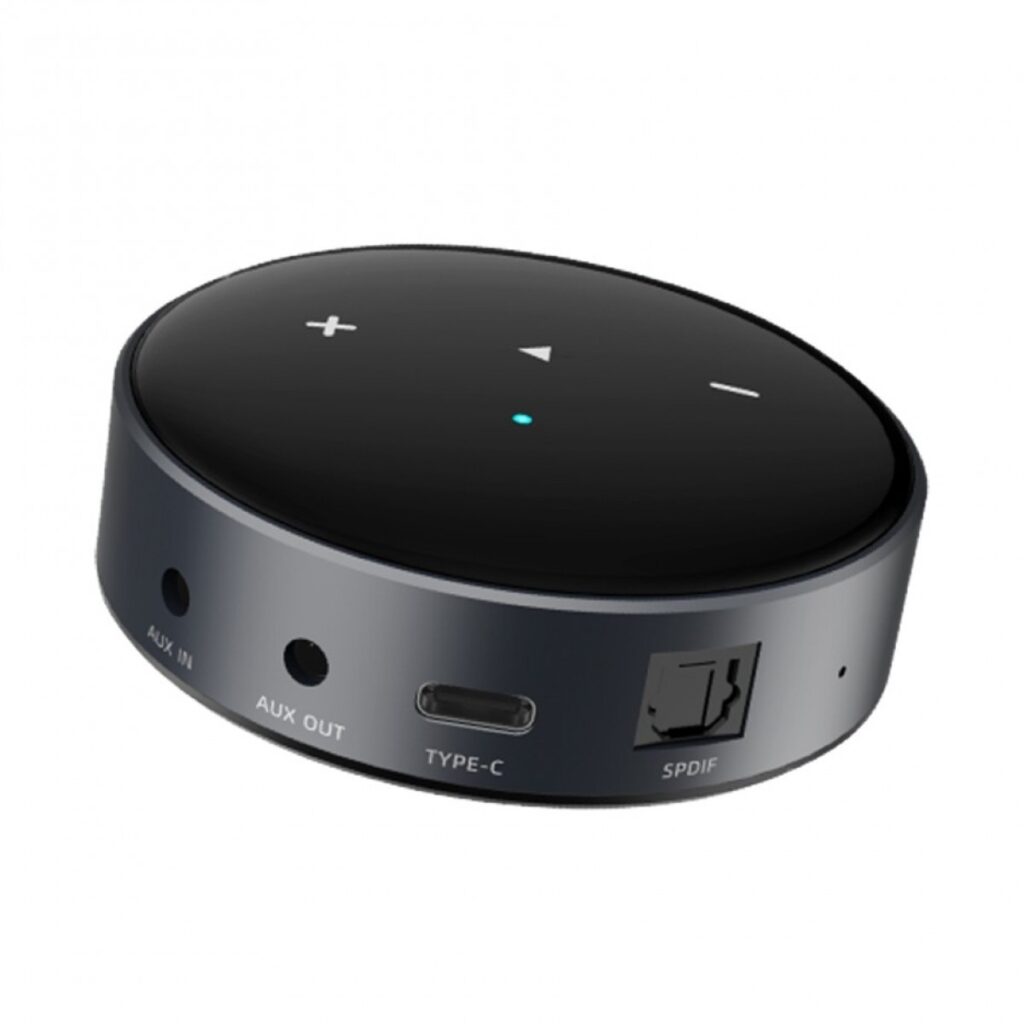
The WiiM Mini is a small upgrade for a system that already has speakers and amplification. Its purpose is to add network music and useful control without replacing equipment that still works. The most important buying distinction is also the simplest: it is a streamer, not an amplifier for passive loudspeakers.
WiiM Mini — Keep the equipment that already works
WiiM explicitly says the Mini needs an amplifier, receiver or powered speakers. Its analogue output can feed a suitable line input, while its optical output can send digital audio to a compatible DAC or amplifier. A passive loudspeaker cannot be connected directly to either output.
Map the existing system before buying another box. If the amplifier has a free analogue input, the Mini’s internal conversion offers a simple route. If a preferred DAC is already installed, optical output may be more convenient. An additional DAC is not mandatory merely because digital output is available.
Optical resolution depends on the receiving device
WiiM advertises up to 24-bit/192 kHz from supported sources. Set the optical output to a format the receiving DAC actually accepts and use the device’s test process where available. A high maximum setting can be counterproductive if an older receiver loses lock or produces silence.
For a bit-perfect digital route, WiiM describes using fixed volume and disabling processing such as EQ, RoomFit or mono conversion. That is a particular signal-routing goal, not automatically the best everyday configuration. Listeners who need volume control or room adjustment should understand the trade-off rather than enabling a setting solely because it sounds purist.
Multiroom does not make every input universal
The official information distinguishes WiiM-only grouping from AirPlay and Alexa ecosystem behaviour. Analogue and Bluetooth inputs can be shared within an appropriate WiiM group, but should not be assumed to forward to HomePods or Echo speakers simply because the Mini receives network playback from those ecosystems.
This matters for a turntable or other analogue source. A turntable must first deliver the correct line-level signal through a suitable phono stage. The Mini’s auxiliary input is not a substitute for cartridge equalisation and gain, and grouping still depends on the supported destination devices.
Small hardware, ongoing software ownership
The specified dimensions are 69 by 69 by 24 mm and the weight is 48 g. That makes the Mini easy to place beside an existing system, although the power and audio cables still need room. Dual-band Wi-Fi is documented, so a dependable local network remains part of the experience.
The WiiM Home app handles setup, updates and many playback functions. Check the current support for the music service and control device used in your household. A service subscription or account may still be required, and the maximum resolution available from one service should not be assumed for every casting route.
For value, compare the Mini with the cost of replacing an otherwise suitable amplifier. It is strongest when it solves a missing streaming function cheaply and simply. We have not measured its analogue noise, distortion or wireless reliability, so those specifications should not be converted into an untested sound-quality ranking.
What to expect in a real setup
Do I need an amplifier with passive speakers? Yes. The Mini supplies line-level or digital audio, not speaker-driving power. Powered speakers already contain their own amplification.
Can a turntable plug straight into Aux In? Only if it delivers an appropriate line-level signal. A cartridge-level output needs a suitable phono preamplifier first.
Turning an existing hi-fi into a daily streaming system
The Mini makes most sense when the amplifier and speakers already suit the room. Its job is to add a route from a music service or local source into that equipment, rather than to replace the equipment itself. Before installation, choose between its analogue connection and the optical route to a separate DAC or compatible amplifier. The latter moves digital-to-analogue conversion downstream; it does not guarantee a different audible result. Use the connection that works reliably with the receiving input and leaves volume control clear to everyone using the system.
An analogue input can be useful for an additional source, but it expects an appropriate signal. A turntable without a built-in phono stage needs a separate stage before reaching an ordinary auxiliary input. Likewise, a passive speaker cannot connect directly to the Mini. These are functional differences rather than cable problems. For a compact second-room system, the complete shopping list may therefore include an amplifier, speakers and any required source conversion, even though the streamer itself takes very little shelf space.
Small installations still need a reliable routine
Place the Mini where its wireless connection remains dependable and where cables are not under tension. Check the power supply and cable requirements in the documentation, especially with a used unit or an installation assembled from spare accessories. Test standby recovery and the first playback session of the day; a system that works once immediately after setup is not yet proven convenient. A brief loss of connectivity should be investigated before committing the device to an inaccessible location behind furniture.
The strongest purchase test is deliberately ordinary. Open the service you use most, find a saved album, adjust volume, stop playback and restart it later. If more than one person will listen, repeat the exercise with their controller and account arrangements. Keep the distinction between streaming control, Bluetooth use and an external input clear, because success with one path does not establish that every path behaves the same way. The Mini’s value comes from making familiar equipment easier to use. Spending more is sensible only when a specific missing connection, control or network feature would improve that routine.
Alternatives to consider
WiiM Pro Plus: A relevant step up when the existing system needs a different connection set rather than simply a smaller streaming adapter.
WiiM Ultra: Compare the larger control-and-input platform if display, connection or system-management needs justify more hardware.
WiiM Mini key specifications
- Role
- Network streamer; no speaker amplifier
- Analogue input
- Aux In
- Analogue output
- Aux Out
- Digital output
- Optical SPDIF
- Advertised supported-source resolution
- Up to 24-bit/192 kHz
- Wi-Fi
- Dual band, 2.4 / 5 GHz
- Dimensions
- 69 × 69 × 24 mm
- Weight
- 48 g
- Control
- WiiM Home app
Verdict
The WiiM Mini is a focused way to keep a useful stereo relevant. Choose the output, receiving format and grouping arrangement deliberately, then check service support. Its value comes from solving a specific connection problem without replacing the rest of the system.
Primary documentation
Specifications and feature descriptions were checked against the following official documents on 6 November 2026. Compatibility advice is our interpretation of those documented capabilities; it does not establish measured sound quality. Regional bundles, software features and service availability can change, so verify the exact European model and current support information before purchase.
Editorial record
Sources and updates
Product specifications and factual claims were checked against Official WiiM Mini product page ↗. Scores and buying advice follow our category-specific editorial methodology.
- Published
- November 7, 2026
- Last updated
- November 8, 2026