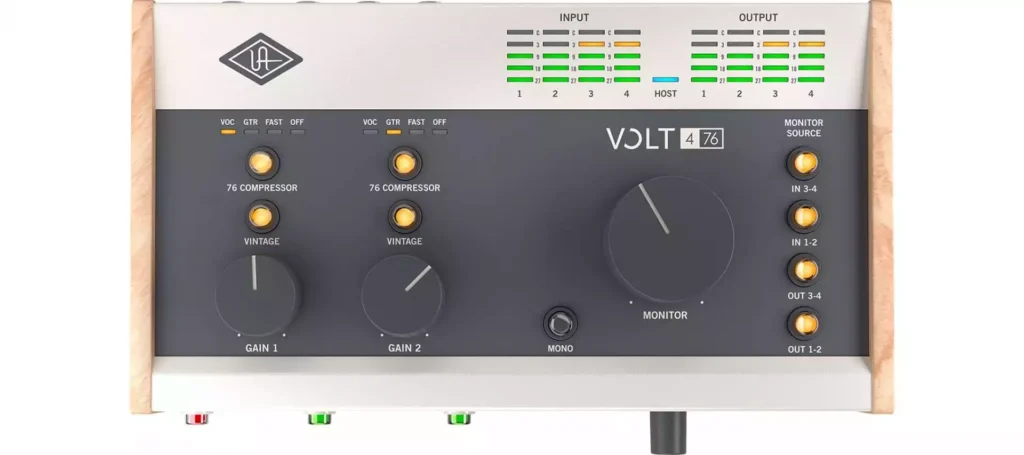
Universal Audio Volt 476 adds a stereo pair of line inputs and more direct monitoring choices to the small Volt recording approach. This is the original twenty-four-bit model with two microphone preamps, not the four-preamp Volt 476P or a later-generation interface. It is particularly relevant when a voice or instrument needs to be recorded alongside a stereo keyboard or another line source. The benefit is a specific session layout, rather than an unrestricted four-microphone recording system.
Research-based review. This assessment draws on manufacturer documentation and the original independent evaluations linked below. Audio Review has not performed a hands-on test of this model.
The four-input layout in a real session
The front pair can serve microphones, instruments or line sources. Rear inputs three and four are line-level paths, without the front gain controls. They are useful for an appropriate keyboard, sound module or external processor, but a microphone needs suitable preamplification before entering those rear sockets.
Imagine a songwriter keeping a stereo keyboard connected while using a vocal microphone and guitar at the front. That is a plausible reason to choose the 476 over a two-input model. A drummer wanting four microphone preamps has a different requirement. Count source types as well as channels before purchase. Doing so prevents a product name or photograph with several sockets from creating an expectation that the hardware cannot meet.
Sound evidence from an actual 476 review
Musicngear’s original hands-on evaluation uses the Volt 476 with vocals and a keyboard and is enthusiastic about the recorded result and straightforward setup. It also finds the optional processing musically useful. Those are attributed findings from that test, not a new recording session performed by Audio Review.
The recommendation is therefore strongest for a similar small production role, while leaving room for source and room differences. A microphone in the wrong position will not become ideal because the interface has analogue colour options. Begin with a clean, well-gained recording and evaluate the whole chain. A sensible interface makes that process reliable; it does not remove the need to choose a suitable microphone, control unwanted room sound and listen back critically.
Vintage and compression on the intended channels
The Vintage and 76 circuits provide optional analogue shaping on the front input pair. The compressor uses presets rather than a complete set of studio compressor parameters. They should not be assumed to process the additional rear line inputs simply because those inputs belong to the same interface.
If a stereo keyboard is connected at the rear, decide whether clean capture is the aim or whether a different input arrangement is required for processing. For vocals at the front, try a short loud passage with the intended preset and listen back before the full performance. An input effect becomes part of the recording. If there is uncertainty, retain headroom and a conservative setting rather than relying on the possibility of removing compression after it has been printed.
Monitor-source buttons make the path visible
The top-panel buttons select which direct inputs and computer playback pairs are heard in the monitor and headphone feed. This can be more immediately understandable than a hidden software mixer, provided the operator knows what the selected buttons represent. The mono control affects the direct input monitoring arrangement, not every aspect of the DAW’s stereo output.
Check the selected computer return when playback seems missing. Also check for duplicate software and direct monitoring when a live source sounds doubled. A simple test recording before the session can confirm both what is heard and what is captured. Physical controls are useful because they make common actions accessible, but they still require a clear mental picture of the signal moving from source to recording and monitor.
Four playback channels are not six independent feeds
The rear has line-output sockets as well as a separate monitor pair. The USB playback specification is four channels, so counting every physical socket as an additional independent computer output would be misleading. The monitor section selects from the available sources and controls its own listening level.
The single headphone output also shares the monitor signal despite having a separate level control. If an engineer and performer need completely different mixes, check a more flexible interface or a deliberately planned external arrangement. An extra headphone amplifier can distribute a signal, but it does not by itself create an independent cue mix. Decide from the number of genuinely different feeds required, not simply how many people can plug in.
Power guidance and mobile expectations
The current hardware manual instructs using the five-volt DC supply for Volt 476 and says USB bus power works only in limited configurations. That specific guidance is more useful than relying on a broad bus-powered phrase in a range description. Include the supply and access to power in the mobile plan.
Verify the correct accessories, host adapter and current system requirements before recording on a tablet or laptop away from the desk. Test the complete setup, including phantom-powered microphones if used, rather than checking only that an indicator lights. If minimal cabling and guaranteed operation from one host connection are central requirements, compare a model whose documented power arrangement better matches that need.
Expansion, software and long-term value
There is no ADAT expansion and no onboard Apollo-style plug-in hosting. Native software supplied with an offer runs on the computer and should not be confused with DSP hardware. Check the current bundle and compatibility directly, especially when buying older or used stock.
The 476 earns its place when the additional line pair and physical monitoring are used regularly. Compare Scarlett 4i4 for another small-studio workflow, and a simpler Volt when two sources are sufficient. If the studio is likely to need several more microphones soon, compare a larger or expandable interface before investing. The best value comes from a source and routing layout that remains useful, rather than a short-term saving followed by an avoidable replacement.
Alternatives to consider
Focusrite Scarlett 4i4 4th Gen: Scarlett 4i4 is a useful comparison for a compact microphone-plus-line-source system. Compare the cue routing, source controls and software workflow with the session you intend to record, rather than treating the input count as the whole decision.
Universal Audio Volt 2: Volt 2 is a simpler choice when two inputs are enough and the added line pair or analogue compressor is unnecessary. The saved budget may be more useful for the microphone, headphones or room than for unused sockets.
Universal Audio Volt 476 key specifications
- Generation
- Original Volt 476, 24-bit model
- USB audio channels
- Four inputs / four outputs
- Microphone preamps
- Two front mic/line/instrument combo inputs
- Additional inputs
- Rear line inputs 3–4
- Input processing
- Vintage and 76 compressor on front pair
- Outputs
- Four line outputs plus separate monitor sockets; four USB playback channels
- Headphones
- One output, separate level with shared monitor signal
- MIDI
- DIN input and output
- Maximum conversion rate
- 24-bit / 192 kHz
- Power
- Use 5 V DC supply as instructed; bus power limited to some configurations
- Digital expansion
- None
Verdict
Volt 476 is a convincing compact interface for two front preamp sources plus a stereo line device, with useful physical monitoring and optional analogue processing. The original recording evaluation supports that focused role.
Keep its identity distinct from 476P, follow the external-power guidance and understand the four-channel playback and shared headphone feed. Choose it when those boundaries match the session. A more flexible or larger interface is preferable when independent cues, digital expansion or four onboard microphone preamps are essential.
Primary documentation and independent reviews
Universal Audio official Volt 476 product information · Universal Audio Volt 476 official hardware and routing manual · Musicngear original Volt 476 recording evaluation
Editorial record
Sources and updates
Product specifications and factual claims were checked against Official Universal Audio Volt 476 product page ↗. Scores and buying advice follow our category-specific editorial methodology.
- Published
- November 17, 2026
- Last updated
- November 17, 2026