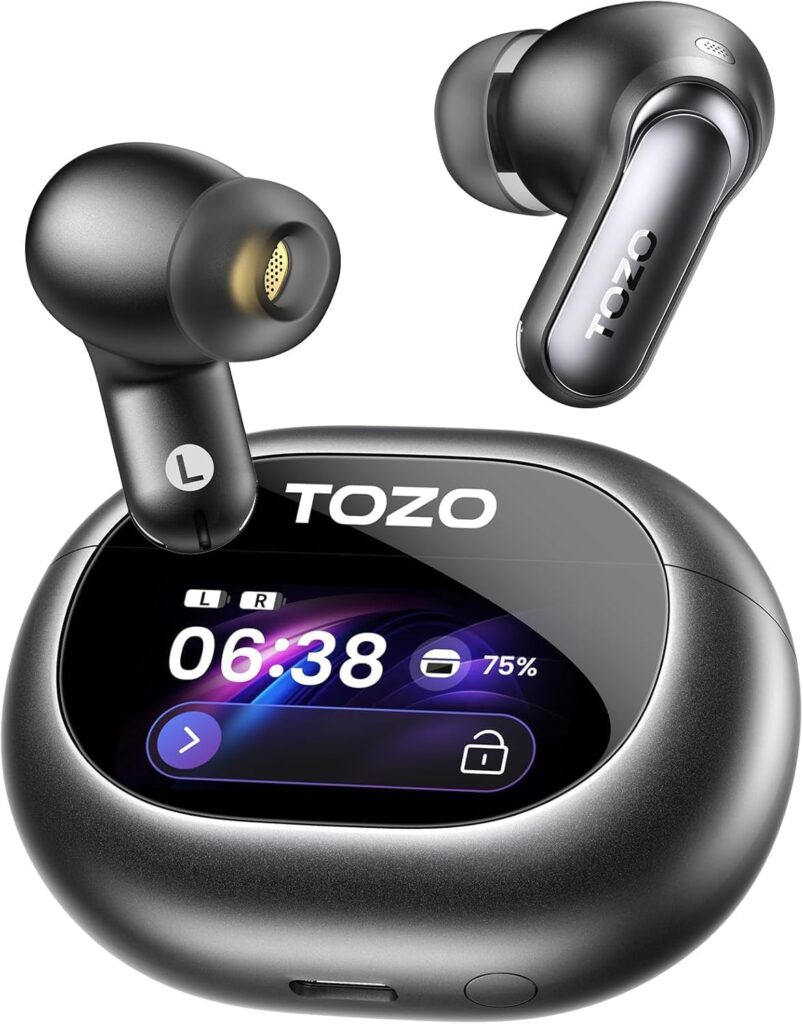
TOZO NC20 Pro puts an interactive display on the charging case and combines it with unusually broad adjustment at an accessible price. The appeal is practical: change settings without repeatedly unlocking the phone, enjoy long listening sessions and keep a familiar set of earbuds ready for different devices. The original comparative evidence is more measured about musical detail than the feature list might imply. It is therefore best approached as a convenient everyday package rather than an automatic rival to the most accomplished music-focused models.
Research-based review. This assessment draws on manufacturer documentation and the original published evaluations linked below. Audio Review has not performed a hands-on test of this model.
The case is useful when it saves real interruptions
The touchscreen is the main distinction from the standard NC20. TOZO describes access to playback, noise modes and EQ, while Scarbir’s original comparison confirms that the Pro case provides an interactive interface. This is more than a numeric battery display, but it is still an accessory to earbuds connected to a source.
Consider where the case normally stays. On a desk within reach, a small control screen may reduce phone handling. Buried in a bag, it may be less convenient than the earbud controls already available. Practise the actions used repeatedly rather than spending the whole trial choosing a background image. Check readability, accidental touches and whether the desired setting can be changed quickly. The presence of a screen does not make the case a standalone music player or remove phone requirements for app services. A buyer who enjoys a visible controller may find it valuable; someone who rarely takes the case out during listening should avoid paying extra simply because the interface looks novel.
Music favours an accessible balance over fine discrimination
Scarbir describes the Pro as less bass-dominated than the standard NC20, with clear forward voices but less texture, positioning and dynamic expression than some strong competitors. That supports easy everyday listening while placing limits on an unqualified audiophile recommendation.
Try a familiar singer and a recording with changing intensity, then follow individual instruments through a busy passage. Decide whether the pair communicates those changes naturally enough for the intended use. A smooth, easy presentation can be preferable for background listening even when another product reveals more fine information. Conversely, a focused listener may value that extra distinction more than a case display. Compare at similar loudness and keep processing consistent, because a spatial preset or brighter EQ can create an immediately impressive difference without necessarily improving the original recording. The useful question is which balance remains engaging after several complete tracks. The answer can reasonably differ between a quiet evening and a commute with competing noise.
Many sound modes call for a deliberate setup
TOZO provides EQ, EarTune personalisation and spatial processing. The original comparison finds that these options can change the presentation substantially, with some modes replacing other adjustments. More options are useful only when the owner understands which setting is active.
Begin with the ordinary profile and save a reference before exploring. Compare personalisation in a quiet room, then try modest EQ changes using familiar music. Test spatial processing as a separate preference rather than assuming a wider impression is necessarily more accurate. Recheck the state after enabling an advanced codec or switching devices; do not assume every maximum setting combines. Shared community profiles may be intended for a different TOZO model or a different fit. Treat them as experiments, not established corrections for every owner. A stable sound setting that requires no daily attention is often the most successful result. The extensive interface earns its place when it helps reach that point, not merely by offering a large menu of effects.
Endurance is a stronger reason to investigate
Scarbir reports notably long sessions in its own ANC and LDAC use, though the precise result depends on settings. The official eighty-hour headline is a case-total claim, including replenishment, and should not be confused with continuous playback from the earbuds themselves.
Map the product to the actual day: the longest uninterrupted journey, time available in the case and access to a charger. Verify the preferred codec and noise mode during that trial. Battery percentages can guide a routine but are not a laboratory measurement of remaining minutes. The useful advantage is reducing charging interruptions, not winning a comparison between incompatible maximum claims. For a long trip, charge everything in advance and confirm both earbuds contact properly after returning them to the enclosure. An established model’s battery condition also deserves attention when discounted or second-hand. Someone using short listening sessions may place less value on maximum endurance, while a commuter with limited charging opportunities may reasonably put it near the top of the brief.
Noise modes have different jobs
The original comparison finds useful ordinary ANC, with higher and sudden sounds still apparent. It also finds the wind-reduction option helpful but less isolating, and transparency insufficient for easy conversation over music. These trade-offs matter more than treating a maximum decibel claim as a complete description.
Try steady room noise separately from voices and wind. Choose the mode that makes normal playback comfortable rather than leaving the most aggressive setting active automatically. Pause music for conversation if the awareness mode does not provide enough clarity. The available ambient function is not a guarantee that traffic or other relevant sounds will always remain obvious. A frequent traveller should compare isolation with a strong rival before deciding that the screen and battery settle the purchase. Someone mainly listening at home may reasonably accept less complete cancellation in exchange for convenience. Evaluate call transmission independently too: what the wearer hears through ANC is different from what the other participant receives from the microphones.
Comfort, water claims and switching need real-world judgment
Scarbir finds the shape comfortable, automatic pause useful and two-device operation practical. Its immersion problem concerns the standard NC20 test unit, not proof that every Pro fails; nevertheless, it is a useful reminder not to turn an IPX8 marketing claim into a swimming recommendation.
Try the oval tips independently in each ear and check stability during ordinary movement. Learn the touch commands before relying on the case for every action. Pair the normal laptop and phone, then test a call and return to music without resetting everything. If a feature requires another mode to be disabled, decide whether the trade-off suits the routine. Keep the charging case dry and follow the care instructions after sweat or rain. A software water-ejection function is not a substitute for proper drying or proof that immersion is harmless. Reliable basic handling, a stable seal and predictable source switching are the foundations of this product’s value. The more elaborate options are worthwhile when those fundamentals are already satisfactory.
Alternatives to consider
Nothing Ear (2024): Compare sound adjustment and the complete daily interface with this existing reviewed alternative. Focus on the current local offer, comfortable fit and source compatibility rather than expecting a hybrid driver or a display to settle the buying decision.
Soundcore Liberty 4 NC: Use this established comparison if cancellation and everyday convenience are priorities. Read the full review and judge the normal call, commute and charging routine; a single maximum feature specification cannot describe the complete ownership experience.
TOZO NC20 Pro key specifications
- Driver
- 12 mm dynamic with DLC diaphragm
- Bluetooth
- 5.4
- Codec option
- LDAC on compatible sources
- Case
- Colour touchscreen with playback and setting controls
- Noise modes
- Adaptive ANC, transparency and wind reduction
- Sound adjustment
- TOZO EQ, EarTune and spatial processing
- Multipoint
- Two-device support; check mode restrictions
- Wear detection
- Automatic pause in original evaluation
- Manufacturer case-total headline
- Up to 80 h; not uninterrupted playback
- Charging
- USB-C and wireless in original evaluation
- Protection claim
- IPX8 earbuds; do not extend to case or assume swimming suitability
- Model distinction
- NC20 Pro with interactive case, not standard NC20
Verdict
NC20 Pro is a strong practical candidate for someone who will use the touchscreen and values long sessions and flexible adjustment. Its more limited fine-detail and dynamics evidence means music-first buyers should compare carefully rather than assume the longest feature list wins. Try the fit and modes, verify daily switching and judge the current price. The case earns its premium when it genuinely simplifies ownership.
Documentation and original reviews
TOZO official NC20 Pro features and specifications · Scarbir original NC20 and NC20 Pro comparison · Alpha Audio original NC20 Pro listening evaluation
Editorial record
Sources and updates
Product specifications and factual claims were checked against Official TOZO NC20 Pro product page ↗. Scores and buying advice follow our category-specific editorial methodology.
- Published
- November 17, 2026
- Last updated
- November 17, 2026