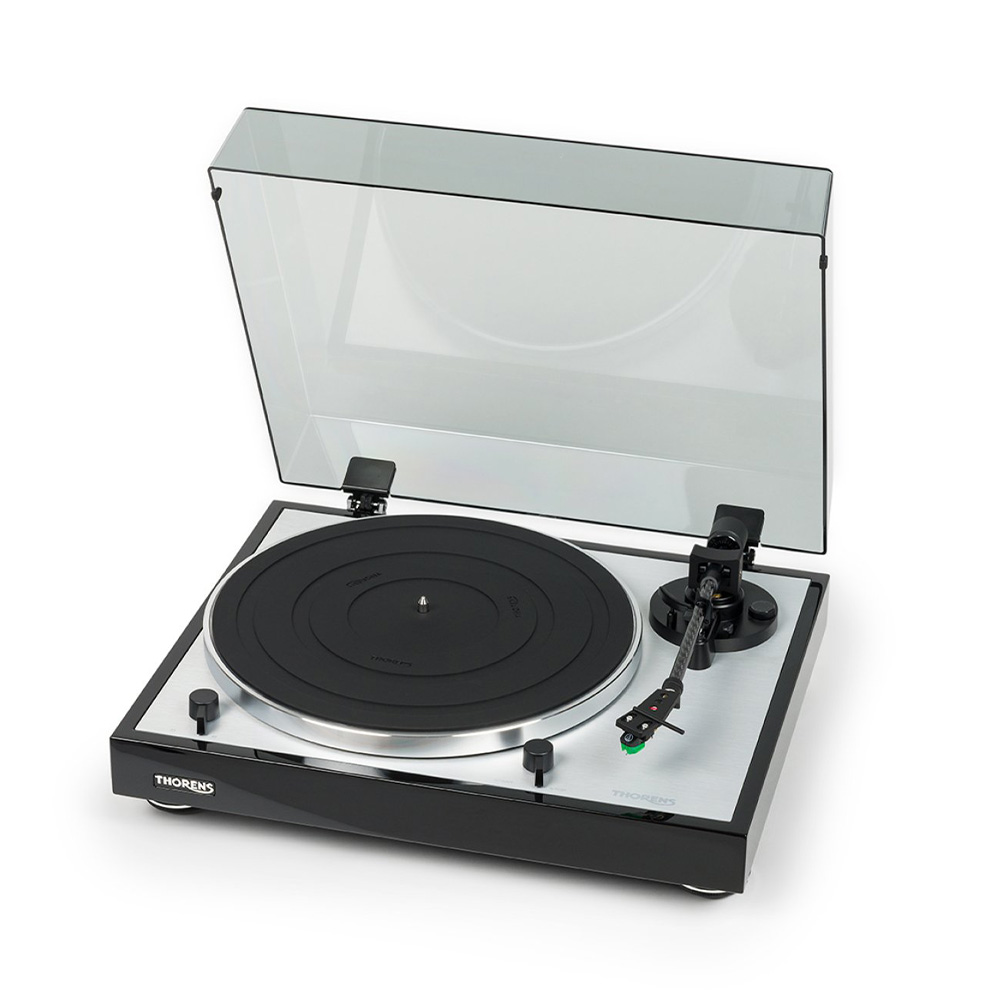
Thorens TD 402 DD combines direct drive with a fitted Audio-Technica cartridge and an internal phono stage that can be bypassed. It is aimed at listeners who want a recognisable hi-fi turntable without having to assemble every part of the signal chain separately. Its useful motor automation needs careful explanation: the platter can start when the arm moves towards the record and stop at the end, while arm handling remains manual. The appeal is a manageable vinyl system rather than complete push-button automation.
Research-based review. This assessment draws on manufacturer documentation and the original published evaluations linked below. Audio Review has not performed a hands-on test of this model.
A complete starting point with room to change
The supplied AT-VM95E establishes a clear baseline for the first system. The removable headshell makes cartridge access easier if the owner later chooses a different arrangement. Neither feature removes the need to set the arm correctly before listening.
Treat the initial purchase as a complete playback system. Ask the dealer to demonstrate the supplied cartridge and internal output before adding upgrades to the order. That gives a meaningful reference for any later change. A deck can become poor value if its attractive starting price is followed immediately by a replacement cartridge, extra stage and other purchases that were absent from the original comparison. The TD 402 DD makes most sense when the standard package already fits the listener’s needs and any future changes remain optional.
What the original listening evidence says
Son-Video’s retailer-published listening test describes the stock combination as warm, clean and relaxed, but wants more punch with energetic material. The same article later changes both the cartridge and phono arrangement. Its more enthusiastic upgraded-system findings should not be attributed to the supplied package.
That distinction gives an audition a useful focus. Include recordings with percussion and strong changes in intensity, alongside voices and quieter arrangements. Decide whether the relaxed balance feels inviting or insufficiently lively. Keep the cartridge and supporting equipment consistent when comparing decks, and match playback level as closely as practical. A system that impresses after two additional purchases may be a different buying proposition from the one on the original price label. The published assessment supports a qualified shortlist rather than a claim that every listener will prefer the Thorens.
Auto-stop is a motor function, not an arm return
The operating manual tells the owner to use the cue lever to lift the arm after playback and move it back to its rest. With Auto Play enabled, motor starting and end stopping are assisted. The arm does not thereby become a fully automatic start-and-return mechanism.
For a listener who wants the platter to stop after a side, this can still be convenient. For someone whose priority is automatic stylus lifting, compare a deck that explicitly provides that action. Ask to see the complete end-of-side sequence rather than relying on the phrase semi-automatic. The distinction is especially important when choosing a first turntable for another person. Everyday operation should be clear before purchase, because a feature description can sound more comprehensive than the routine it actually replaces.
Connecting the internal or external phono stage
With the internal phono equalisation enabled, use a suitable line input. With it bypassed, the cartridge needs an appropriate MM phono input or external stage. The manual’s rear-panel explanation is the relevant guide; do not send the already amplified line output into another phono stage.
Turn the system volume down before altering the connection arrangement. Label the chosen input if several people use the system. The internal stage can save space and an initial purchase, while bypassing it leaves another route open later. An external box should be assessed for an actual improvement or connection need, rather than treated as a mandatory accessory. Compare at similar listening level, because a louder setting can obscure whether a change really improves the qualities that matter to you.
Initial setup and safe record handling
Follow the supplied sequence for assembling the platter, fitting the headshell, balancing the arm and setting tracking force and anti-skating. A preinstalled cartridge does not mean that the counterweight can be left in an arbitrary position after unpacking. If unfamiliar with this work, a dealer setup is worthwhile.
Make sure the deck is level and that there is room to use the cue lever without reaching awkwardly over the record. Handle the headshell by its intended grip and protect the stylus during appropriate assembly steps. If playback sounds distorted on one passage, examine record condition and setup before assuming that the whole model is at fault. Change one relevant factor at a time so that the cause remains understandable. The goal is reliable playback, not constant adjustment for its own sake.
Placement, collection and long-term ownership
The deck provides the two common LP and single speeds through an electronic selector. It is not a three-speed solution for every kind of older disc. Think about the records actually owned before attaching value to features offered by a different model.
Choose a stable support away from strong loudspeaker vibration, with room for the cover and rear cables. Budget for suitable stylus care and eventual replacement. With used stock, examine arm movement, cartridge condition, headshell contacts and motor operation, including the enabled end stop. A visually tidy cabinet cannot establish that a stylus is healthy. Dealer support and a realistic return arrangement can be more valuable than a small saving on an uncertain example. The useful ownership question is whether the complete system can be kept working predictably, not simply whether the turntable carries a historic brand name.
Alternatives to consider
Technics SL-1500C: SL-1500C is a relevant direct-drive alternative when comparing the complete cartridge, phono-stage and end-of-side arrangements. Decide how much convenience matters before judging the difference in package cost.
Rega Planar 3: Planar 3 offers a contrasting manual belt-drive approach. Compare with the actual cartridge and phono equipment included, rather than assuming an audition with upgraded accessories represents either basic package.
Thorens TD 402 DD key specifications
- Drive
- Direct drive
- Speeds
- 33⅓ and 45 rpm
- Tonearm
- TP 72 with carbon tube
- Headshell
- Removable
- Cartridge
- Audio-Technica AT-VM95E moving magnet
- Phono stage
- Switchable internal MM stage
- Output
- RCA, selectable phono or line level
- Automation
- Switchable motor start and end stop
- Arm lift and return
- Manual
- USB / Bluetooth
- Neither
- Weight
- 5.8 kg
Verdict
TD 402 DD is a sensible candidate for an approachable direct-drive system with a clear supplied cartridge and flexible phono connection. Its automation saves some motor control without removing manual arm handling, and the original stock-package assessment suggests an easygoing presentation with a qualification about energy.
Audition the actual package against relevant Technics and Rega alternatives, include all supporting equipment in the comparison and make sure the end-of-side routine suits the intended owner. At a competitive current price, those practical strengths can make a coherent system. It is less persuasive when bought on the assumption of complete automation or when immediate upgrades push the total into another class.
Documentation and original reviews
Thorens official TD 402 DD product information · Thorens official TD 402 DD operating and setup manual · Son-Video original listening test, a retailer-published evaluation
Editorial record
Sources and updates
Product specifications and factual claims were checked against Official Thorens TD 402 DD product page ↗. Scores and buying advice follow our category-specific editorial methodology.
- Published
- November 17, 2026
- Last updated
- November 17, 2026