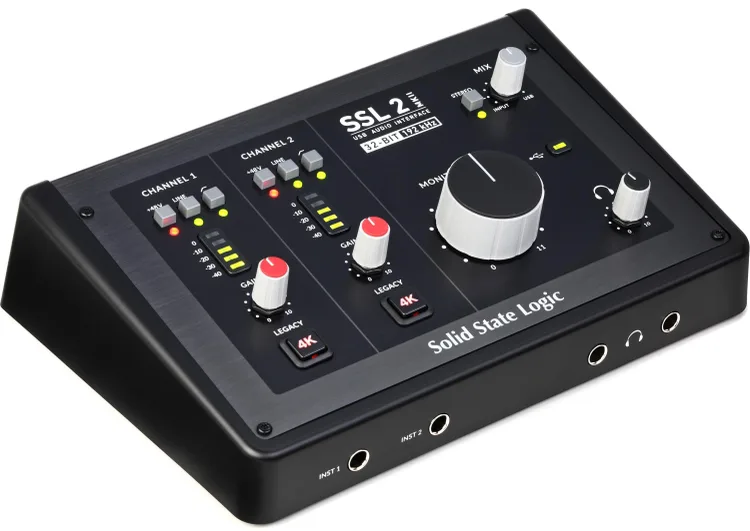
The SSL 2 MKII offers a compact two-input recording setup with physical controls and an optional analogue colour circuit. It must be distinguished from the SSL 2+ MKII, which has a different output and routing proposition. For this model, the most important buying facts are the two-in/two-out architecture and the shared mix at its two headphone sockets.
SSL 2 MKII — Two inputs and two outputs mean what they say
SSL’s official feature list identifies this as a two-in/two-out USB-C interface. It has two microphone preamps, line-input options and front-access instrument connections. The alternative input sockets do not turn the unit into a four-microphone interface; they are different ways to feed the available recording channels.
Draw the simultaneous session before buying. A vocal and instrument can fit a two-channel workflow, but a stereo instrument plus a separate microphone needs another arrangement. A compact interface is good value when it matches the actual source count, not when the limitation becomes obvious halfway through a session.
Two headphone sockets share the same mix
The official page explicitly describes the two headphone outputs as carrying the same mix. This can be useful for two people monitoring together, but should not be advertised as independent performer and engineer cue mixes.
The rear balanced left and right outputs connect to appropriate powered monitors or another suitable line-level destination. Keep monitor level control and headphone use clear when changing sources. The sockets do not power passive loudspeakers, and feeding speaker-level output from another amplifier into the interface is not an appropriate connection.
Legacy 4K is an intentional colour option
SSL describes Legacy 4K as analogue enhancement involving harmonic colour and a high-frequency lift. It is a creative input option rather than a guarantee that every microphone or voice will sound better. Record a comparison at sensible levels and choose according to the source.
For work where flexibility later matters, a cleaner capture may be preferable to committing a colour effect at the input. We have not tested the circuit or measured its response. The useful information is its documented purpose and placement, not an invented claim that it makes a home recording sound like a particular console session.
32-bit does not eliminate level-setting
The product lists 32-bit, 192 kHz converters and a 64 dB microphone gain range. The converter bit-depth label is not a promise of unlimited analogue headroom or a reason to ignore clipping at the microphone or preamp. Set gain for the loudest expected performance and leave margin.
USB-C is the connector, while the documented bus operation is USB 2.0. On Windows, use the current SSL ASIO/WDM driver and check supported OS versions; Mac class-compliant operation has its own requirements. A higher sample rate can increase CPU and storage demand without solving a noisy room or poor microphone placement.
The included software bundle may contain trial subscriptions and licences with different terms. Count the tools you will genuinely use, rather than treating a headline bundle value as cash savings. We have not measured round-trip latency, noise or converter performance, so those claims remain manufacturer information rather than independent findings.
What to expect in a real setup
Are the two headphone outputs independent mixes? No. SSL specifies the same mix for both on SSL 2 MKII. Do not borrow the monitoring description from SSL 2+ MKII.
Does 32-bit mean I cannot clip a recording? No. Analogue microphones and preamps still have finite headroom, and gain setting remains necessary. Converter resolution is not unlimited input range.
Alternatives to consider
SSL 2+ MKII: The direct comparison when additional output routing or its distinct monitoring features are required; verify the plus sign on the actual product.
Focusrite Scarlett 2i2 4th Gen: A relevant two-preamp alternative with a different gain-control and software workflow.
A realistic shared-headphone session
The two headphone sockets can be convenient for a spoken-word interview or a singer sitting beside an engineer, provided both people can work with the same mix. Start by agreeing on a balance that keeps each voice intelligible without making the backing track unnecessarily loud. If one listener needs a substantially different balance, the shared-mix architecture becomes a genuine limitation. An adapter or splitter changes how headphones connect; it does not generate another independent cue bus.
Try the complete arrangement before a session with a guest. Record both microphones, play the file back, and confirm that the person speaking more quietly is not lost. The recording gain and headphone listening level have different purposes. Increase listening volume with the appropriate control, while leaving enough input headroom for laughter, a raised voice or a louder musical passage.
An input colour decision that survives mixing
A short comparison of Legacy 4K on and off is more informative when made inside an arrangement. A brighter solo voice may cut through a backing track, but may also emphasise consonants that need later attention. Match the comparison levels and keep microphone distance consistent. If the difference is not useful for the intended result, there is no obligation to commit it simply because the control is available.
For a changing production, preserving a straightforward source capture can be the more flexible choice. For a performer with a clear direction, choosing colour early may reduce later indecision. The useful distinction is between a deliberate input treatment and an assumed improvement in objective accuracy.
When to choose SSL 2+ MKII instead
Compare the plus model when separate headphone mixes, additional playback routing or its MIDI facilities solve a task already present in the studio. A musician using only one microphone and a stereo monitor pair may not need those additions. A collaborator who repeatedly asks for a different cue balance probably does. Make this decision from the busiest normal session rather than a one-person demonstration. SSL 2 MKII remains a focused two-channel option, with the clearest value when its shared monitoring arrangement is understood and sufficient.
SSL 2 MKII key specifications
- Model
- SSL 2 MKII, not 2+
- USB audio architecture
- 2 inputs / 2 outputs
- Microphone preamps
- 2
- Microphone gain range
- 64 dB
- Converter specification
- 32-bit, up to 192 kHz
- Headphone outputs
- 2 sockets, same mix
- Monitor outputs
- Balanced left / right
- Creative circuit
- Legacy 4K analogue enhancement
- USB
- Type-C connector, USB 2.0 bus powered
Verdict
The SSL 2 MKII is strongest as a clear two-channel tool with useful physical controls and optional input colour. Choose it when the shared monitoring arrangement is sufficient. If the workflow already needs more routing, buying the right model now is more sensible than expecting software to create missing hardware channels.
Primary documentation
Specifications and feature descriptions were checked against the following official documents on 6 November 2026. Compatibility advice is our interpretation of those documented capabilities; it does not establish measured sound quality. Regional bundles, software features and service availability can change, so verify the exact European model and current support information before purchase.
Editorial record
Sources and updates
Product specifications and factual claims were checked against Official SSL 2 MKII product page ↗. Scores and buying advice follow our category-specific editorial methodology.
- Published
- November 7, 2026
- Last updated
- November 8, 2026