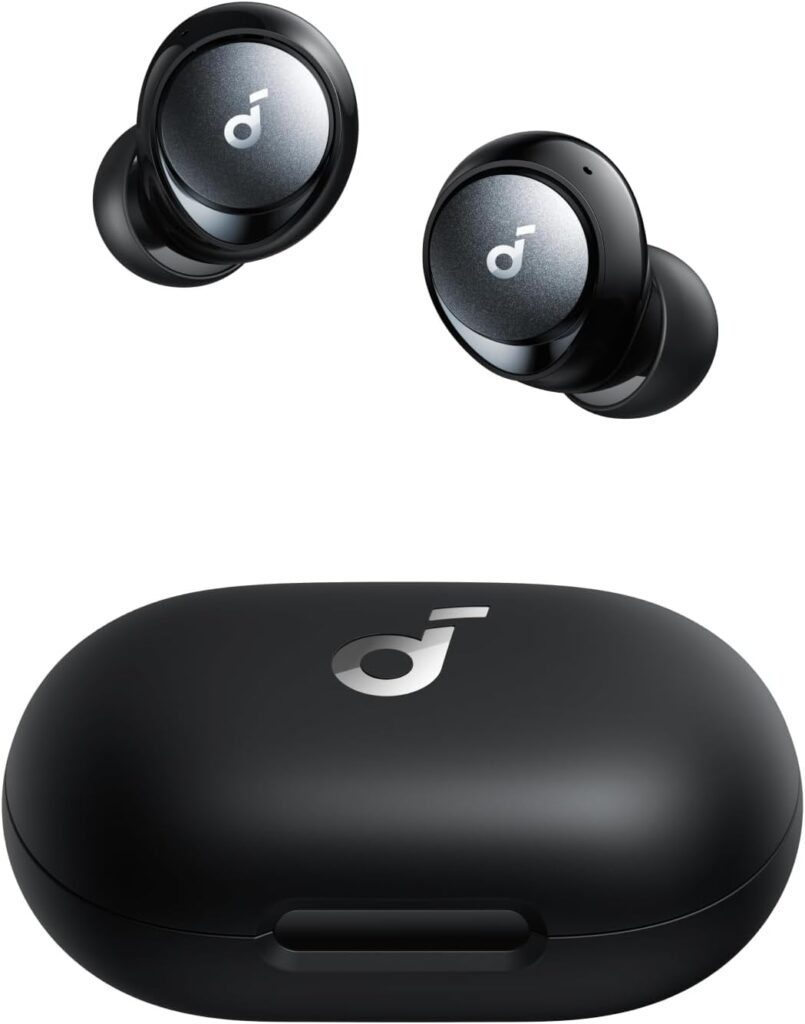
Soundcore Space A40 is a compact stemless earbud whose appeal is practical rather than theatrical. It combines ANC, app adjustment and useful charging options in a shape that may suit someone who dislikes long stems. It is an older model, but the original evidence still provides a meaningful basis for assessing a discounted purchase. The main questions are fit, outdoor call requirements and whether the current price remains competitive with newer alternatives.
Research-based review. This assessment draws on manufacturer documentation and the original independent evaluations linked below. Audio Review has not performed a hands-on test of this model.
Small shells and the tip selection
The Space A40 uses a sealed in-ear design without stabilising wings. Several tip sizes are supplied, so try them before deciding whether the shell is secure. A small body can feel unobtrusive, but an unsuitable tip can still allow movement or create pressure. The correct choice need not be identical in both ears.
Check the seal while speaking and turning your head. Bass should remain stable without repeatedly pushing a bud back into position. For strenuous activity, the absence of a wing or hook makes personal stability more important. A model that sits comfortably at a desk is not automatically the best running companion. Judge the physical arrangement in the situations you need, rather than assuming a compact design is universally easier to wear.
Sound quality and a useful default
SoundGuys’ original evaluation is positive about the default sound, finding it relatively agreeable without the extreme bass or treble emphasis common in some affordable earbuds. It also praises the ANC and reports seven hours and fifty-five minutes in its ANC-on battery test. Its microphone findings are more qualified, particularly in wind.
Our view is that the A40 deserves consideration for ordinary music and spoken content without making heavy customisation an essential first step. Begin with the default setting and familiar recordings. If a preset improves clarity for podcasts or supplies the bass balance you prefer, save it deliberately. Avoid assuming that the flattest-labelled setting is automatically more accurate or that a stronger bass preset is an upgrade for every recording.
ANC and the role of passive isolation
The active system and the tip seal work together, so a fit change can affect how much outside sound remains. Compare ANC on and off with a steady background noise and unchanged playback level. The objective is less distraction at a comfortable level, not a promise that keyboard taps or nearby speech disappear completely.
Transparency is useful when you need a conversation, but it is a processed listening mode rather than an exact replacement for removing a bud. Learn the configured gesture before depending on it for an announcement. If noise control seems uneven, check tips and placement before making large EQ changes. An app setting cannot compensate consistently for air leaking around a poorly seated tip, and louder music merely hides the symptom rather than resolving it.
App adjustment and the touch controls
Soundcore provides EQ presets, custom adjustment and configurable touch actions. The original review notes that volume control needs to be assigned rather than assumed from the default mapping. Set up the actions you use most and test them with the phone out of sight, because that is the real convenience benefit.
Keep the initial configuration simple. Changing sound profile, listening mode and several controls together can make an apparent fault difficult to identify. If a gesture is unreliable, check whether the finger is reaching the intended surface while the earbud remains secure. A different tip or control mapping can be more useful than repeated resets. App updates and firmware should also be checked before comparing behaviour against a launch-period review.
Bluetooth, LDAC and two sources
The Space A40 supports Bluetooth 5.2, SBC, AAC and compatible-source LDAC, along with two-device multipoint. That list describes available capabilities, while the exact operating combination remains dependent on settings and firmware. Do not infer LE Audio or a broadcast feature from the general Bluetooth version number.
For a phone and laptop, pair each separately and confirm ordinary playback before enabling the two-device routine. Test an incoming call and the return to music. Some applications keep an audio session active after sound stops, which can make switching appear inconsistent. Choose reliable everyday behaviour over a codec setting that creates inconvenience in the setup you use most. An iPhone does not gain LDAC simply because the earbuds support it; the source has to support the same format.
Calls and the computer profile
SoundGuys finds the microphone adequate in easier conditions but notes significant processing artefacts in wind. That makes the A40 a more convincing indoor everyday option than a guaranteed outdoor-call specialist. Test a short call in the actual environment before making it your only work communication device.
On a computer, verify that the communication application selects the intended microphone and output. A stereo music path and a microphone-enabled Bluetooth call path can behave differently. If music quality changes when a meeting begins, examine routing before concluding the drivers have failed. A separate microphone may be the better solution for frequent desktop communication, while an alternative earbud may be preferable for someone whose work requires long calls outside.
Battery, case handling and lasting value
The headline normal-mode claim is ten hours from the buds and fifty hours including the case. The cited ANC-on result is a separate test condition, so it should not be compared as though it disproves an ANC-off maximum. Calls, codec choices and volume can change runtime further. Leave reserve for the longest session away from the case.
USB-C and wireless charging are useful, but both buds still need reliable contact in the case. The original reviewer also raises a case-lid security concern, so inspect handling before carrying it loose among other objects. IPX4 applies to the earbuds, not a general permission to wet the case. Compare current warranty, replacement support and the real price against newer options. A compact older model remains good value when it fits well and meets the actual daily routine.
Alternatives to consider
Soundcore Liberty 4 NC: Liberty 4 NC offers a stemmed alternative using the same app ecosystem. Compare fit, case handling and the actual noise-control experience rather than assuming the two shapes will be equally comfortable for your ears.
Sony WF-C710N: The WF-C710N is worth comparing if you prefer a compact Sony design and its control approach. Include current local pricing and your own microphone workflow instead of deciding on a battery total or Bluetooth version alone.
Soundcore Space A40 key specifications
- Design
- Sealed stemless true wireless
- Driver
- 10 mm dynamic
- Bluetooth
- 5.2
- Codecs
- SBC, AAC and LDAC on compatible sources
- ANC and transparency
- Yes
- Claimed normal battery
- Up to 10 h buds; 50 h total
- Multipoint
- Two devices, setting-dependent
- EQ
- Presets, custom EQ and HearID
- Resistance
- IPX4 earbuds
- Controls
- Customisable touch panels
- Charging
- USB-C and wireless
- Stabilising wings
- None
Verdict
Space A40 remains a credible compact ANC shortlist option with encouraging original evidence about sound, noise reduction and endurance. The app and charging options make it a practical everyday package, while the stemless fit may be its most important advantage for the right person.
Compare Liberty 4 NC and Sony WF-C710N, check case handling and test calls where you actually use them. Choose the A40 when its fit and current price provide a clear benefit. For vigorous activity or frequent windy calls, a more specialised alternative can be the better purchase even if the compact Soundcore initially looks like the most economical all-rounder.
Primary documentation and independent reviews
Soundcore official Space A40 product information and support · Anker Japan official Space A40 specifications · SoundGuys original Space A40 evaluation
Editorial record
Sources and updates
Product specifications and factual claims were checked against Official Soundcore Space A40 product page ↗. Scores and buying advice follow our category-specific editorial methodology.
- Published
- November 17, 2026
- Last updated
- November 17, 2026