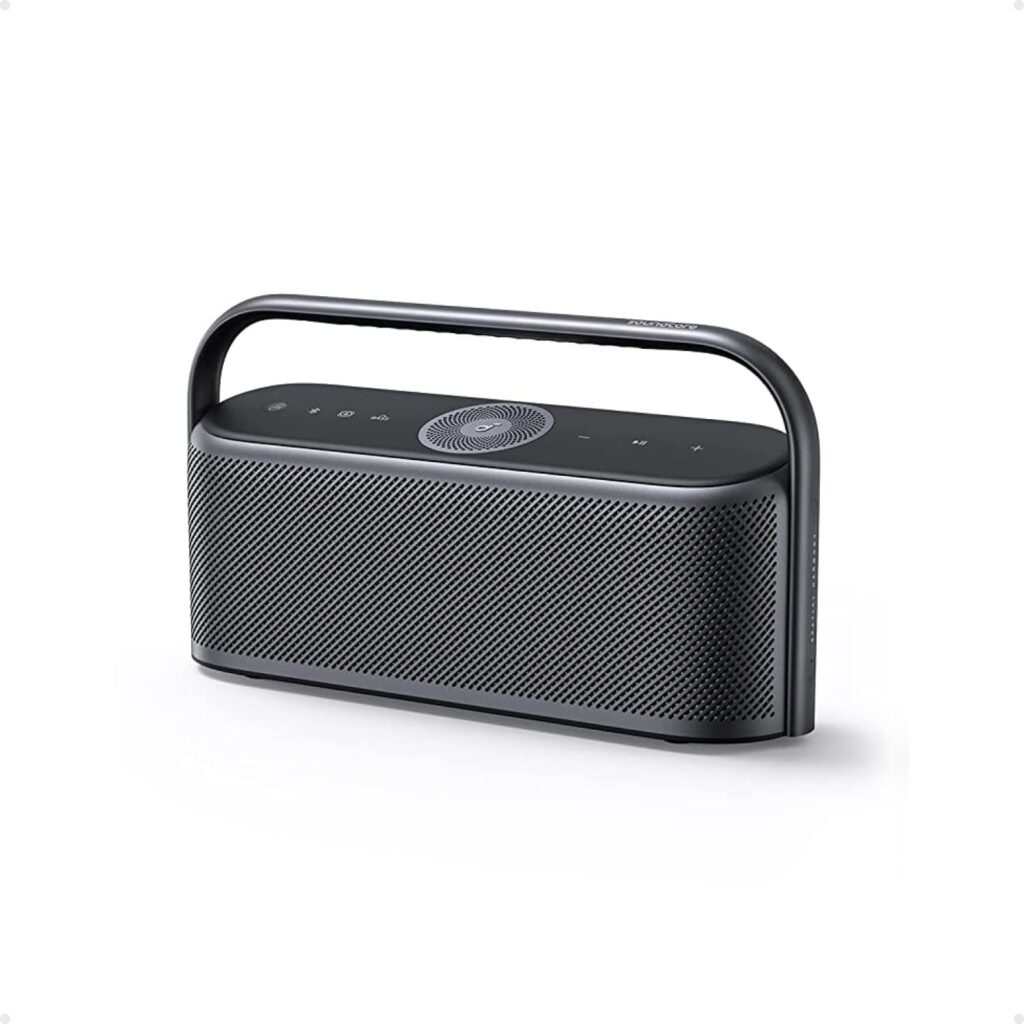
The Soundcore Motion X600 takes a more living-room-friendly approach than many outdoor Bluetooth speakers. Its integrated handle, broad front panel and upward-facing driver make spatial presentation part of the appeal. It is most interesting for someone willing to adjust sound modes and EQ, rather than expecting maximum deep bass or a complete home-cinema system from one portable box.
Soundcore Motion X600 — Design and portability
The Motion X600’s rigid handle and relatively restrained appearance suit movement between rooms, a terrace and occasional trips. It is a transportable music speaker rather than something that disappears into a small jacket pocket. Consider the handle clearance and the space needed around the upward-facing driver when choosing a shelf. A low overhang can make the intended open placement less practical.
IPX7 is the documented water-resistance rating. The X does not establish a tested dust-protection grade, and water resistance should not be expanded into an assumption of immunity to sand, salt or rough handling. Keep the rear cover properly closed for the rated protection and allow connections to dry before charging. The useful benefit is reassurance around ordinary accidental water exposure, not a reason to treat the speaker as an underwater listening device.
Spatial sound: what it means
Soundcore’s spatial mode works with ordinary source material and does not require a special spatial recording. An upward-facing channel and processing aim to make the single enclosure sound less confined. That is different from decoding a full Dolby Atmos soundtrack into discrete room speakers. Do not choose it as a substitute for a properly installed surround system simply because the marketing uses the word spatial.
One X600 can reproduce left and right content within its own enclosure, but the physical spacing remains small compared with separated stereo speakers. Expect an impression of width rather than precise images spread across several metres. Position it where its output can reach the listening area without being obstructed, then compare spatial mode on and off at similar levels.
DXOMARK’s original test found a particularly broad presentation when the available processing features were engaged, while its default setup was less convincing tonally. That supports the idea of trying the modes rather than treating one factory setting as the only valid sound. It does not establish that processing is always better for every track or that the speaker creates identical sound in every room.
Tonal balance and independent evidence
RTINGS’ original evaluation described a somewhat bright balance with clear voices, limited deep-bass extension and some compression near maximum volume. That is useful context for the positive spatial evidence: a wide impression does not automatically mean the smoothest tonal balance or the strongest bass. Audio Review’s sound assessment takes both kinds of evidence into account.
Use familiar voices, cymbals and dense music when adjusting the EQ. If consonants or percussion sound too prominent, a modest reduction can be more helpful than pushing bass aggressively. Large boosts consume headroom and may make a small speaker work harder without producing genuinely extended low bass. The aim is a comfortable overall balance at the level actually used.
BassUp and the app’s custom EQ provide meaningful flexibility, but they should be compared with the speaker in its intended location. A wall or corner can reinforce the low end, while open outdoor placement reduces that support. Save a sensible setting for each ordinary use rather than assuming the most dramatic curve is the best one. These are setup recommendations derived from the product’s role, not claims of an Audio Review listening test.
Bluetooth, LDAC and wired use
LDAC is available with compatible Android sources through the documented app configuration. It is not available from an iPhone’s Bluetooth output, so Apple users should not buy the X600 expecting that particular codec. A supported Android version also does not remove the need to enable the correct mode and maintain a stable connection.
Higher data-rate Bluetooth operation can increase power use and become less reliable in a crowded radio environment. Stable ordinary playback is more useful than forcing a maximum bitrate that repeatedly interrupts music. Compare connection quality at the actual distance and with the phone in its normal position rather than only directly beside the speaker. Codec support is one part of the chain, not a guarantee of an audible transformation.
The auxiliary input offers a route from a suitable analogue source. That can be useful where Bluetooth is inconvenient, but the USB-C connection is for charging rather than a general computer audio interface. An auxiliary lead and wall charger are not included according to the regional product page. Include any needed accessories in the price and check that the source can actually provide a compatible analogue output.
Battery life, charging and pairing
The advertised 12-hour battery figure is conditional. Soundcore states that it was obtained at quarter power with Bass Mode off, while actual time changes with content, volume and EQ. It should not be described as a guaranteed full-day result at party volume. LDAC can further reduce endurance, so leave a sensible margin if the speaker will be used away from power.
The manufacturer quotes around six hours to charge with a suitable 5 V/3 A supply. That is worth considering for someone expecting a quick top-up before leaving home. A connector fitting the socket does not establish that the charger supplies the required current, and the charging setup should be kept dry. Plan charging after use rather than relying on a brief last-minute connection.
Two matching Motion X600 speakers can be paired for separated stereo. That offers more real channel spacing than one enclosure, but it should not be confused with universal pairing to every Soundcore product. Check the documented model compatibility before buying a second speaker. Likewise, a two-speaker Bluetooth arrangement is not the same as a whole-home Wi-Fi multiroom platform with independent room browsing.
Best use and value
The Motion X600 is strongest as a flexible portable speaker for moderate listening, with appearance and a broader presentation valued alongside sound adjustment. It is less obviously the right choice for someone whose only goals are the longest battery life, the deepest bass outdoors or the smallest possible travel bag. Those priorities lead to different enclosure sizes and compromises.
Compare current European pricing with the accessories needed and with the sound modes actually preferred. A demonstration should include both a voice-led recording and music with sustained bass, at ordinary and higher levels. Check whether the tonal balance remains comfortable rather than choosing solely from the first dramatic impression of width.
The app and processing make the X600 more adaptable than a fixed-voicing speaker, but they also ask the owner to spend a little time setting it up. That is a worthwhile trade when the controls solve a real preference. Choose it for that versatility and its portable indoor role, while accepting the documented bass, battery and maximum-volume limits.
Alternatives to consider
Soundcore Motion 300: A smaller portable alternative when packing size matters more than the X600 spatial presentation.
Bose SoundLink Max: Compare a different premium portable approach if straightforward sound and build are higher priorities than codec and EQ flexibility.
Soundcore Motion X600 key specifications
- Type
- Portable Bluetooth speaker
- Sound functions
- Spatial processing, BassUp and custom app EQ
- Bluetooth codec option
- LDAC with compatible Android configuration
- Wired input
- Auxiliary analogue
- USB-C
- Charging
- Battery claim
- Up to 12 hours under stated conditions
- Protection
- IPX7; no dust grade stated
- Stereo expansion
- Two matching Motion X600 speakers
Verdict
An adaptable portable speaker with a distinctive wider presentation and useful EQ. It benefits from thoughtful settings, while bright tonal tendencies, limited deep bass and conditional battery life prevent an unconditional recommendation.
Primary documentation and independent reviews
Soundcore official regional Motion X600 details and FAQ · RTINGS original Motion X600 review · DXOMARK original Motion X600 audio test
Editorial record
Sources and updates
Product specifications and factual claims were checked against Official Soundcore Motion X600 product page ↗. Scores and buying advice follow our category-specific editorial methodology.
- Published
- November 8, 2026
- Last updated
- November 8, 2026