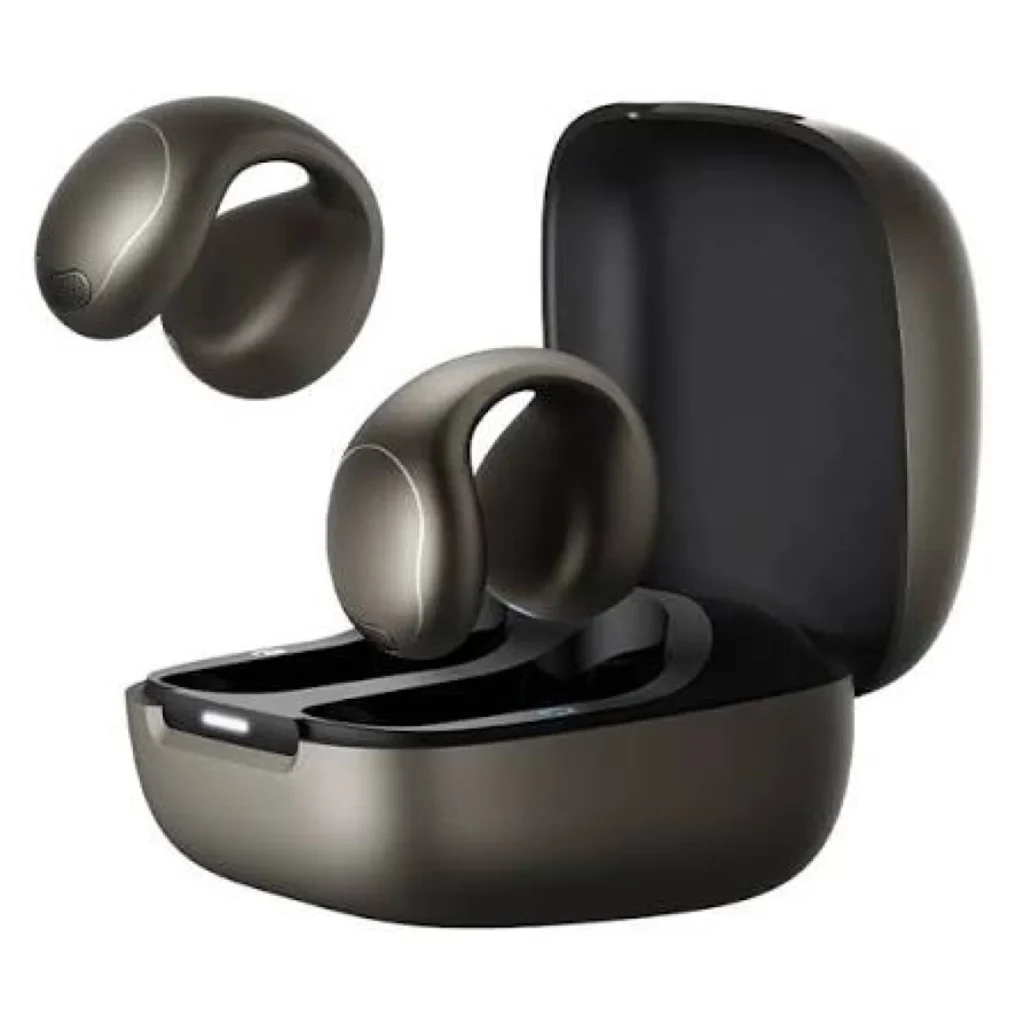
Soundcore C40i is an open-ear clip-on design aimed at people who dislike sealing the ear canal or want to hear their surroundings during ordinary listening. Flexible joints and physical buttons make it a distinct proposition within an increasingly crowded category. Original evaluations support useful sound after adjustment but differ on comfort. This is an awareness-first purchase to make from personal fit and the actual environment, rather than from an expectation of replacing sealed ANC earbuds in every situation.
Research-based review. This assessment draws on manufacturer documentation and the original published evaluations linked below. Audio Review has not performed a hands-on test of this model.
An open clip with a flexible joint
Soundcore identifies a titanium-wire and TPU joint rather than a rigid one-piece cuff. The small speaker directs sound towards the ear without entering the canal. This is air conduction, not a bone-conduction transducer, and the distinction matters when comparing different open listening products.
Try positioning on both ears according to the instructions. Ear shape and cartilage thickness affect how the clip rests, so another person’s successful fit is encouraging but not decisive. Wear the glasses, earrings or headwear normally used. Check whether those items compete for space or create additional pressure. A flexible joint offers scope to conform, not unlimited bending or a reason to force the device into an uncomfortable position. The design is most useful when it remains stable without making the listener conscious of the clip throughout the session. Comfort should be established before sound modes or codec details become the deciding factor.
App tuning changes the recommendation
TechRadar’s original evaluation is unenthusiastic about the default balance but finds the sound more convincing after using the app’s processing options. It reports useful separation for an open design while retaining limits in deep bass and refinement. Tom’s Guide is more broadly enthusiastic about the listening experience.
Start with normal stereo playback and then compare the available settings on the same familiar tracks. A 3D mode that one reviewer enjoys may not be the preferred option for every recording. Check voices as well as energetic music, and return to the default setting periodically to keep the comparison clear. An unsealed fit also makes the surrounding environment part of what is heard. A bass impression formed in a quiet room should not be promised unchanged beside traffic. Choose the C40i because its sound is enjoyable in the real routine, not because processing is assumed to overcome every limitation of open construction.
Buttons are a practical distinction
The C40i uses physical buttons and supports app customisation. For someone frustrated by locating touch panels on small clips, tactile operation is a meaningful reason to shortlist it. The official specification also includes multipoint connections.
Try the main commands while wearing the earbuds, without looking at a diagram. Check whether pressing a button shifts the speaker or creates unwanted pressure. Assign the functions needed most often and test an incoming call before relying on the setup at work. Multipoint should be evaluated with the actual phone and computer, including the return to music after a meeting. A connection feature is useful when it reduces friction in daily use, not simply because two devices can appear in a list. Keep firmware current and note the active settings if comparing with an older original evaluation, since app behaviour can change over time.
Awareness and privacy pull in different directions
There is no ANC and the ear canal remains open. That makes surrounding conversation easier to hear, but also means the C40i cannot offer the isolation of a sealed earbud. Playback can escape into the nearby space as well.
Test the intended listening level beside another person before assuming the design is private enough for a quiet office. In a busy place, consider whether speech or music remains intelligible without repeatedly increasing volume. Open listening can support awareness, but it is not a guarantee of hearing every warning or event. For concentrated listening on transport, a different construction may be more suitable. For household tasks or a setting where quick conversation matters, the open arrangement can be the whole reason to choose it. The correct recommendation follows that role rather than treating a lack of isolation as either universally desirable or universally unacceptable.
Battery claims describe two different intervals
The official figures are up to seven hours from the earbuds and up to 21 hours including recharges from the case. The larger number is not a continuous single-charge session. Soundcore also gives a quick-charge claim for a short top-up.
Plan around the uninterrupted interval actually needed. Calls, volume, processing and battery age can change the result, so a maximum is not a guarantee. Check how the earbuds seat in the case and establish a routine for keeping the charging contacts clean. A pair that is not seated correctly may be unavailable when needed even if the published capacity looks sufficient. Compare rivals using the same distinction between earbud runtime and case total. For occasional daily listening, the capacity may be entirely adequate. Someone wanting an extended working day without a break should investigate the actual pattern more carefully before choosing on portability alone.
Water resistance does not settle sports suitability
The EU specification lists IPX4 for the earbuds. It also includes attachable grips for fit adjustment. Neither detail establishes that every runner will find the clips secure or that the charging case can be treated like a waterproof accessory.
Try the relevant movement in a controlled setting before committing to demanding exercise. Check that the clips remain comfortable when turning the head or moving vigorously. Dry the earbuds before returning them to the case and follow the care instructions. Compare the actual European price and return terms with other open models, including whether a different hook design feels more stable. The C40i is strongest for a person who likes its clip contact and button controls. It is weaker value when fit remains distracting or the primary need is heavy bass in a noisy environment. A successful open-ear purchase begins with the right use and the right ears.
Alternatives to consider
Bose Ultra Open Earbuds: A premium clip-style comparison when comfort and everyday open listening matter. Check the actual ear fit and complete price difference rather than assuming that a similar silhouette produces an identical experience.
Shokz OpenFit Air: An alternative open arrangement using a different support style. Compare stability, glasses interaction and control access during the activity that matters before choosing between clips and hooks.
Soundcore C40i key specifications
- Design
- Open-ear air-conduction clip
- Driver
- 12 × 17 mm titanium-coated
- Weight
- 5.8 g per earbud
- Bluetooth
- 5.4
- Connections
- Multipoint
- Controls
- Physical buttons
- Battery claim
- Up to 7 h earbuds; 21 h including case
- Quick-charge claim
- 10 min for up to 2 h
- Water resistance
- IPX4 earbuds
- Noise cancellation
- None
- Codecs
- SBC and AAC
Verdict
C40i combines flexible clips, tactile controls and useful app options in a clearly open listening design. Its sound can be enjoyable, but the original evaluations make a fit and tuning trial more valuable than a blind purchase.
Consider it for casual awareness-first listening. Choose sealed ANC earbuds when isolation is the priority, or another open support style when the clip does not remain comfortable and stable.
Documentation and original reviews
Soundcore official EU C40i specifications and construction · TechRadar original C40i sound, app and fit evaluation · Tom’s Guide original C40i evaluation
Editorial record
Sources and updates
Product specifications and factual claims were checked against Official Soundcore C40i product page ↗. Scores and buying advice follow our category-specific editorial methodology.
- Published
- November 17, 2026
- Last updated
- November 17, 2026