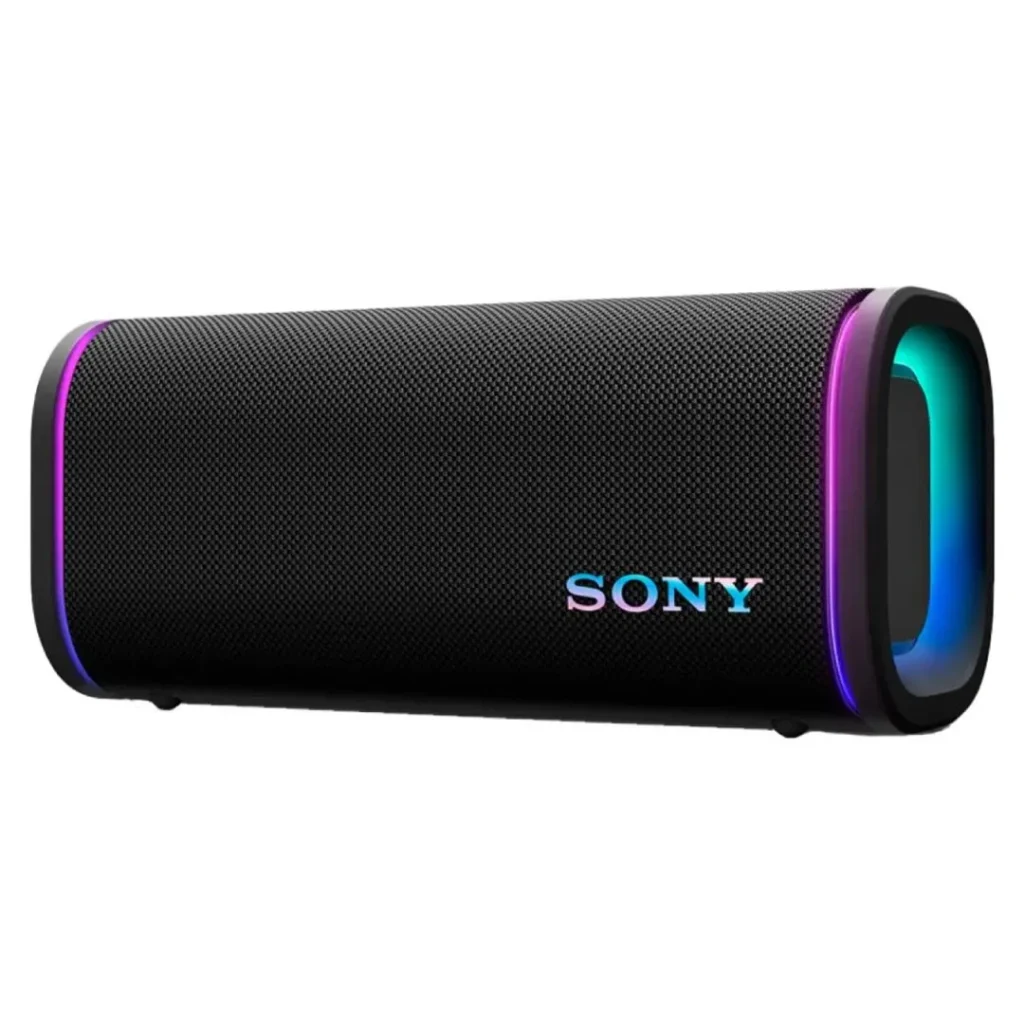
Sony ULT FIELD 5 brings substantial low-end emphasis, lighting and useful connections to a body that is movable without being especially light. Original reviewers enjoy its party character, particularly in ULT 2, while questioning how much independent tuning remains available around that preset. The strongest recommendation is for someone who wants this energetic personality and can accommodate the weight. A buyer seeking delicate home listening or unrestricted sound adjustment should compare more broadly before treating the long feature list as decisive.
Research-based review. This assessment draws on manufacturer documentation and the original published evaluations linked below. Audio Review has not performed a hands-on test of this model.
ULT 2 is an energetic preference, not a neutral reference
SoundGuys enjoys the full presentation and bass in ULT 2. Tom’s Guide also finds the result lively and powerful, while hearing some upper-midrange and treble information recede behind the low end. That is a coherent party proposition with a clear trade-off.
Try a familiar rhythm-heavy recording and then a voice-led arrangement with quieter instrumental details. Decide whether the bass adds the desired drive without masking parts of the music that matter. Compare the available modes at similar apparent level; a louder or weightier first impression can otherwise dominate the judgment. For a gathering, an energetic presentation may be exactly the point. For concentrated listening to natural voices, the same emphasis can be less persuasive. There is no single correct preference, but the buyer should choose it deliberately. A product that makes a lively playlist fun does not need to be described as a studio reference to earn a place.
Custom EQ does not simply sit on top of the ULT preset
Both original reviews identify the same practical frustration: the ten-band editor does not freely refine the existing ULT modes, and its available bass adjustment does not reproduce the full ULT 2 effect. The owner must choose between different approaches rather than assuming every desired setting combines.
During an audition, switch from the preferred ULT mode to a custom profile and compare the complete balance. Check whether a change meant to improve voice clarity also alters the low-end character originally enjoyed. If the unmodified preset suits the normal music, this restriction may be unimportant. If precise independent adjustment is central to the brief, it can be decisive. Avoid planning a purchase around an unverified external EQ workaround or an assumed future firmware feature. The app’s flexibility should be judged on what the present configuration actually does. A dependable preset can be useful, but it is different from a fully adjustable starting point that preserves every part of the original processing.
Wired input is useful, while USB-C has a narrower role
Sony documents an analogue stereo input and specifies USB-C for DC power in and out only. This distinction matters for a buyer expecting to connect a computer or phone as a USB audio source. A physical connector does not establish every possible function of that connector.
Check the output provided by the intended source and use a suitable analogue cable or adapter where required. A turntable needs the appropriate phono stage before a line-level speaker input; a bare cartridge signal is not interchangeable with a phone headphone output. If the application involves video or timing-sensitive performance, test the complete path rather than assuming a wired socket guarantees zero delay. Device charging is useful on an outing, but it shares the stored energy available for playback. The connection list is a strength when it serves an identified source. It is less useful when several different signal types are treated as though the same cable must make them compatible automatically.
LDAC and Party Connect need exact compatibility checks
Sony lists conventional codecs alongside LDAC, and supports Stereo Pair and Party Connect. These are useful options with compatible equipment, not a universal promise of joining any wireless speaker carrying a Sony logo or a similar Bluetooth version.
Check the precise second speaker and the intended pairing mode before purchasing an expansion. Stereo music at a fixed seat and synchronised music around a larger area are different goals. Test reconnection and control behaviour before the event. For LDAC, verify the source supports the mode and compare stability in the actual setting. An iPhone owner should assess the supported connection available to that phone. A crowded wireless environment can make a stable ordinary mode more practical than a maximum data-rate option. Source compatibility, sound preference and sensible placement still determine the experience. Advanced transmission does not compensate for placing the speaker behind furniture or asking one enclosure to cover a much larger audience than intended.
The shoulder strap helps, but does not remove the weight
The official weight is approximately 3.3 kilograms, and the supplied strap gives a practical carrying option. Original reviewers regard the enclosure as substantial; SoundGuys also finds attaching and removing the strap less effortless than expected. This is portable equipment rather than a pocket companion.
Try the normal carrying route with the rest of the outing’s load. A short lift at home is different from a long walk or repeated stairs. Check the strap attachment and a stable listening surface, keeping the front and passive-radiator areas clear. Dust and water protection are useful, but the charging connections still need proper care. Follow the manufacturer’s instructions after wet or dirty use rather than treating the rating as an invitation to unnecessary exposure. If the speaker will mainly move between a room and garden, the weight may be entirely acceptable. If the purpose is daily lightweight travel, a smaller alternative may be used more often and therefore provide better practical value.
Battery expectations should follow the chosen party settings
Sony gives an approximate twenty-five-hour reference under specified conditions. That should not be read as a guarantee with every level, light setting, codec and ULT mode. The original reviews support useful endurance, but they do not establish a universal result for every event.
Try a representative session with the intended music and effects before planning a long outing. Charge in advance and account for any phone charging from the speaker. Verify the available USB power source against Sony’s requirements, rather than assuming a small charger can maintain every operating condition. If preserving battery health through the available care setting matters, understand the corresponding charge-level behaviour. A buyer listening for a few hours at a time may find the routine straightforward; sustained loud playback outdoors deserves more margin. Compare the current local price with alternatives that satisfy the same requirements. The speaker’s value is strongest when its bass character, connections and physical format all fit, rather than when the decision rests on the largest runtime headline.
Alternatives to consider
JBL Xtreme 4: Compare this existing alternative for a substantial portable-speaker routine. Judge the preferred balance, handling, intended connections and current local price rather than assuming a similar physical class guarantees identical musical priorities or expansion compatibility.
Soundcore Motion X600: Consider this existing review if listening at home and a different presentation matter more than party emphasis. Include the intended room, source and carrying routine in the comparison; an energetic bass mode is not automatically preferable for every library.
Sony ULT FIELD 5 key specifications
- Driver system
- One woofer and two tweeters
- Dimensions
- Approximately 320 × 144 × 125 mm
- Weight
- Approximately 3.3 kg
- Bluetooth
- 5.3
- Codecs
- SBC, AAC, LDAC
- Sound options
- ULT 1, ULT 2 and custom ten-band EQ
- Analogue input
- Stereo mini jack
- USB-C
- DC input/output only; not USB audio
- Expansion
- Stereo Pair and supported Party Connect
- Protection
- IP66/IP67
- Manufacturer runtime
- Approximately 25 h under specified conditions
- App and carry
- Sony Sound Connect; supplied shoulder strap
Verdict
ULT FIELD 5 is a strong candidate for energetic music and gatherings with a useful analogue route and rugged body. Its ULT tuning restrictions and carrying weight are material compromises. Audition the preferred mode, check exact expansion and source compatibility, and plan battery use realistically. Choose it for its particular bass-led character and practical connections, with the limitations understood before purchase.
Documentation and original reviews
Sony official UK ULT FIELD 5 specifications · SoundGuys original ULT FIELD 5 evaluation · Tom’s Guide original ULT FIELD 5 evaluation
Editorial record
Sources and updates
Product specifications and factual claims were checked against Official Sony ULT FIELD 5 product page ↗. Scores and buying advice follow our category-specific editorial methodology.
- Published
- November 17, 2026
- Last updated
- November 17, 2026