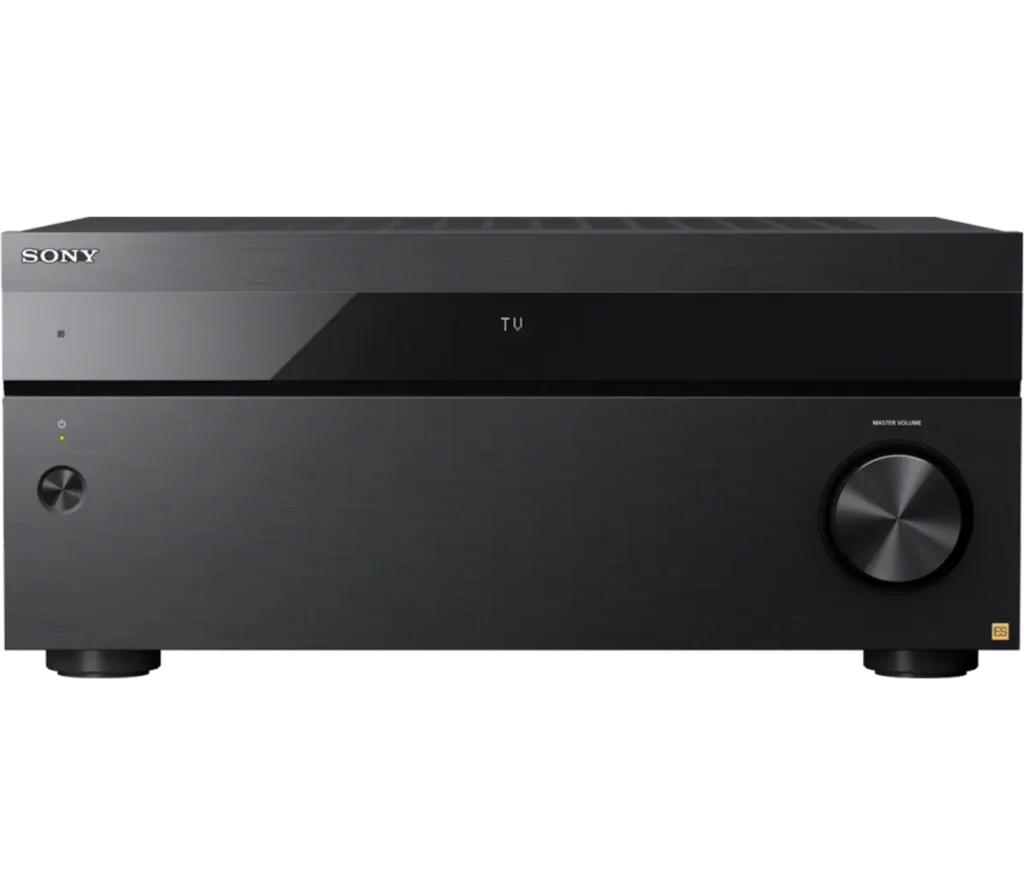
Sony STR-AZ3000ES moves the ES family to nine amplified channels and a noticeably substantial chassis. Its appeal is a home-cinema installation that can use the extra speaker capacity, Sony’s spatial processing and installer controls together. The original evaluation is enthusiastic about surround cohesion and musical drive, but identifies network and sound-mode details that deserve checking. This review concerns the North American model, with the actual electrical rating and local service arrangement to be established before purchase. It is not a substitute specification sheet for a European Sony receiver.
Research-based review. This assessment draws on manufacturer documentation and the original published evaluations linked below. Audio Review has not performed a hands-on test of this model.
The original evaluation supports an ambitious surround brief
Residential Systems’ original trial finds dynamic stereo playback and convincing surround integration, with spatial mapping adding a stronger sense of envelopment. The same review reports casting-discovery trouble on its early sample. That combination supports a positive sound assessment with a practical software check.
Use familiar dialogue and effects passages in an audition, then return to an ordinary music recording. Listen for whether the centre remains easy to understand when the scene becomes busy and whether effects move coherently around the listening position. Compare processing at a similar playback level. A larger surround impression is useful when it serves the content, not simply because it seems more dramatic in a short demonstration. The speaker system and room are part of the result, so a review’s positive experience does not guarantee the same outcome in an unrelated installation. Establish the actual system first, including the network route expected to be used every day.
Nine channels provide useful choices, not every layout at once
The internal channel count supports arrangements such as seven bed speakers with two heights or five bed speakers with four heights. Those are alternative assignments within the supported plan, rather than configurations that can all operate simultaneously from the same nine channels.
Draw the room and decide where speakers can be placed sensibly. Consider the seat, doorway and furniture before choosing the layout with the largest-looking label. Four heights can be appealing when they create clear front-to-back overhead movement, while a surround-back pair may matter more in another room. The manual’s assignment should settle which physical terminals serve the chosen pattern. If extra zones are planned, include their amplifier needs in the same map. A thoughtful smaller installation can be more effective than additional speakers crowded into poor positions. However, do not buy a receiver with a clear channel shortfall if the intended room already has a realistic larger plan. Suitability follows the complete layout, not the position of the model in its range.
The absence of full pre-outs changes the upgrade path
The AZ3000ES lacks the full main-channel pre-out set available on higher ES models. Its zone and subwoofer connections are different facilities and should not be mistaken for an unrestricted route to external amplification of the main speaker system.
Decide whether the receiver will remain the complete amplifier or is expected to become a processor for later power amplifiers. If the latter is a firm plan, confirm the required outputs before buying. An adapter cannot create a missing processing route. For an owner satisfied with the internal amplification and a suitable speaker load, this limitation may have little daily impact. For a demanding external-amplifier project, it can be decisive. Compare alternatives on the full installation rather than assuming every premium receiver supports the same growth path. The useful purchase is one that fits the expected ownership period without forcing an early replacement. Extra zone outputs are valuable when those zones are needed, but do not solve a different main-room requirement.
Stereo subwoofer behaviour deserves a deliberate test
The original trial notes that two-channel stereo and Pure Direct do not behave like the preferred subwoofer-enabled route used by the reviewer. Sony’s mode/output documentation distinguishes these arrangements. A quiet subwoofer in one mode is therefore not automatically evidence of a hardware fault.
Test the actual music sources and intended bass setup after calibration. Check which speakers and subwoofer are active in each chosen mode, then save a useful everyday setting. Do not assume a label such as direct means the same processing or output behaviour as another brand’s implementation. If the system relies on a subwoofer for ordinary stereo music, make that a purchase condition rather than discovering it after installation. Compare at a sensible level so the bass balance does not dominate the first impression. A repeatable working route matters more than selecting the mode whose name sounds purest. The goal is the intended sound and reliable daily use, with a clear understanding of which processing decisions have been made.
HDMI and casting should be verified as complete paths
The published installation evaluation identifies four high-bandwidth HDMI inputs within the six-input total. It also reports intermittent discovery through casting on its early sample. Neither a general HDMI label nor a current menu option replaces a test with the actual sources and software.
Assign demanding gaming sources to the appropriate sockets and confirm display settings, cable suitability and the intended output mode. Test switching and standby recovery as well as a picture from one source. For casting, try the normal phone and service repeatedly over an ordinary session, including reconnection after the receiver has been idle. Check current firmware and support information before assuming an old observation is still present or has definitely been resolved. If network playback is the central reason for buying, require a satisfactory demonstration. If the receiver is mainly an HDMI cinema hub, the weighting of that concern may differ. A defined source plan gives the recommendation more substance than counting badges and assuming every route behaves identically.
Installation and regional identity affect the real value
The substantial cabinet needs a suitable support, cable clearance and ventilation. The named model is a North American ES product, so an import should not be treated as a routine EU-market purchase. It also lacks a cartridge-level phono input.
Measure the available space before ordering and allow safe access to the rear connections. Follow the manufacturer’s ventilation guidance rather than closing the unit into a tight furniture cavity. Confirm the actual electrical label, warranty and local service arrangement with the seller. A plug that can be adapted is not proof of electrical compatibility. For vinyl, include an appropriate phono stage or turntable line output in the plan. Then price any Sony wireless accessories or Sonos hardware required by the desired integration. The receiver can be attractive when its installation features solve a real project, but unused control options should not justify a premium by themselves. Compare the complete supported system with local alternatives and choose the arrangement that can be operated comfortably by the people who will use it.
Alternatives to consider
Sony STR-AN1000 / TA-AN1000: The AN1000 family is a useful comparison for buyers who do not need the ES model’s installation features. Identify the exact regional version, warranty and connection list before assuming the packages are interchangeable.
Denon AVC-X3800H: AVC-X3800H is relevant when a broader speaker or external-amplifier plan matters. Compare the complete channel layout, calibration and regional support rather than choosing from a simple power-number contest.
Sony STR-AZ3000ES key specifications
- Market
- North American ES model; verify local electrical rating and support
- Amplified channels
- Nine
- Example layouts
- 7.2.2 or 5.2.4 within supported assignments
- HDMI
- Six inputs / two outputs
- High-bandwidth inputs
- Four support 4K120/8K; check socket labels and settings
- TV audio
- eARC / ARC on designated output
- Surround
- Dolby Atmos and DTS:X
- Calibration
- DCAC IX and optional 360 Spatial Sound Mapping
- Main-channel pre-outs
- No full set; zone and subwoofer outputs are separate facilities
- Phono input
- None
- Sony wireless
- Specific compatible rear and subwoofer models only
- Installation
- Substantial approximately 18.7 kg chassis in original published specification
- Rated power
- Approximately 120 W/ch into 8 ohms, two channels driven (Sony specification)
Verdict
STR-AZ3000ES is an appealing nine-channel cinema receiver with strong original evidence for drive and surround cohesion. Its missing main-channel pre-outs, mode-dependent bass behaviour and early network observations deserve checking. Confirm the regional model, support and full installation cost. It is most convincing when its internal amplification and Sony integration already fit the planned room, without depending on an unsupported future upgrade path.
Documentation and original reviews
Sony official North American STR-AZ3000ES product information · Sony official AZ3000ES/AZ5000ES/AZ7000ES help guide · Residential Systems original STR-AZ3000ES installation and listening evaluation
Editorial record
Sources and updates
Product specifications and factual claims were checked against Official Sony STR-AZ3000ES product page ↗. Scores and buying advice follow our category-specific editorial methodology.
- Published
- November 17, 2026
- Last updated
- November 17, 2026