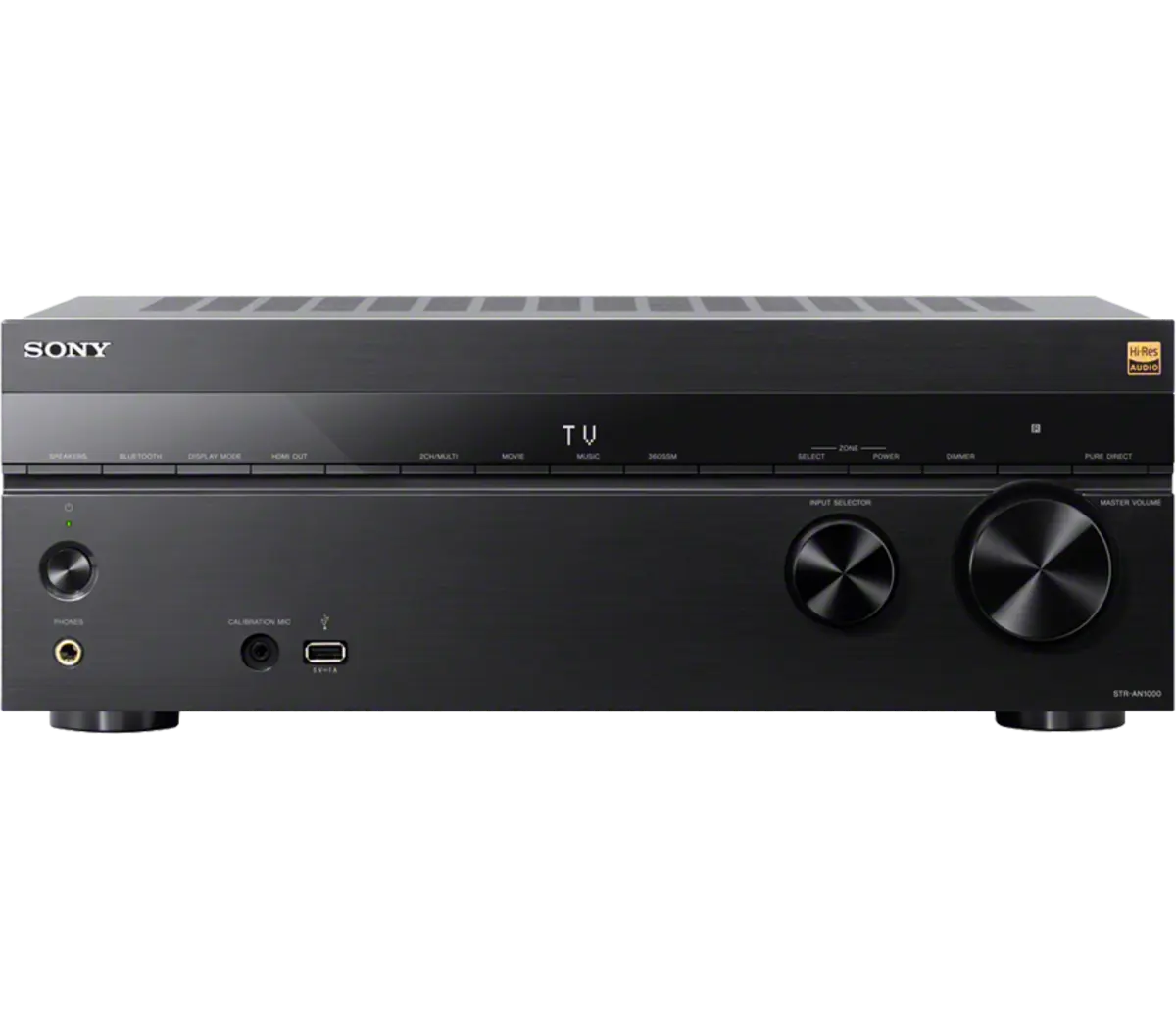
Research note: This is an independent, research-based assessment of the Sony STR-AN1000 / TA-AN1000 Review. It is structured around product documentation and the practical questions buyers should verify in their own system; it does not present unverified research as a personal hands-on listening test.
Sony STR-AN1000 / TA-AN1000 key specifications
- Model
- Sony STR-AN1000 / TA-AN1000
- Amplifier channels
- 7.2 channels / 7 amplifier channels
- Decodable channels
- 7.1 channels
- Rated output
- 120 W + 120 W at 6 Ω, 1 kHz, 0.9% THD
- Speaker impedance
- 6–16 Ω
- Surround decoding
- Dolby Atmos, Dolby TrueHD, DTS:X, DTS-HD MA/HR, DSD and 360 Reality Audio
- Spatial processing
- 360 Spatial Sound Mapping, Phantom Surround Back and Speaker Relocation
- Room calibration
- DCAC IX with Automatic Phase Matching
- HDMI
- 6 inputs / 2 outputs with eARC/ARC
- Video support
- 8K/60 and 4K/120, HDR10, HLG, Dolby Vision, IMAX Enhanced, VRR and ALLM
- Video upscaling
- Up to 4K/8K
- Network and streaming
- Wi-Fi, Bluetooth transmit/receive, Ethernet, Chromecast built-in, AirPlay 2, Spotify Connect, Roon Tested and Works with Sonos
- High-resolution audio
- DSD/DSDIFF and DSF to 11.2 MHz; WAV, AIFF, FLAC and ALAC
- Analogue and digital inputs
- 4 analogue, 1 optical and 1 coaxial digital
- Subwoofer outputs
- 2
- Additional connections
- USB, FM tuner, headphone out, S-Center out and IR in/out
- Dimensions
- 430 × 156 × 331 mm
- Weight
- 9.4 kg
- Power consumption
- 240 W
Design and daily use
A well-considered design should make the Sony STR-AN1000 / TA-AN1000 Review easy to live with over months, not merely attractive in a product photograph. Control layout, build confidence, access to the main functions and the effort required for setup all shape ownership. Buyers should think about available space, cable routing, heat, charging or maintenance needs, and whether the interface remains clear when the product is used quickly rather than explored at leisure.
Sound and performance
Performance is about more than maximum output. The receiver needs to remain controlled with the intended speakers, preserve dialogue clarity, manage dynamic film sound and stay predictable across HDMI switching and streaming. A proper review should compare calibrated and uncalibrated results in a real room.
Features and connectivity
Features should be assessed as a system: HDMI switching, room correction, streaming, control-app behaviour and speaker configuration need to work together. Buyers should confirm the exact video, gaming and surround formats required for their source devices before treating the receiver as future-proof.
Setup and system matching
For an AV receiver, careful speaker measurement, crossover selection and room-correction setup matter as much as the component itself. A useful evaluation should state the room size, speaker load, channel layout and sources used, rather than treating one automated calibration result as universal.
Strengths
- A focused proposition for the right listener or workflow
- Potential to simplify the intended audio system
- Practical value depends on matching it carefully to existing equipment
- A structured evaluation makes comparison with alternatives easier
Limitations to consider
- The best result depends on setup, source material and surrounding equipment
- Some advertised features may vary by version, region or software update
- A personal hands-on test remains important before assigning a final long-term score
- Value should be compared against alternatives that solve the same specific need
Who should buy it?
Consider the Sony STR-AN1000 / TA-AN1000 Review if its approach matches your actual listening or production habits and you can confirm compatibility with the rest of your system. It makes less sense as an impulse purchase based only on a feature list. Buyers with different room sizes, sources, comfort needs or upgrade plans should compare the alternatives with the same practical criteria.
Alternatives to consider
Compare direct alternatives in the same category, price range and use case rather than comparing unrelated audio products. The most useful comparison is the one that asks which option works best with your sources, room, headphones or speakers, and which will remain easiest to use after the initial setup.
Verdict
The Sony STR-AN1000 / TA-AN1000 Review has a clear place when its design, connectivity and intended use match the system around it. A final verdict should be confirmed through documented hands-on use, with the complete setup and listening conditions stated clearly. Until then, this research-based format provides a consistent basis for comparison without overstating what has been personally tested.
Editorial record
Sources and updates
Product specifications and factual claims were checked against Official Sony STR-AN1000 / TA-AN1000 product page ↗. Scores and buying advice follow our category-specific editorial methodology.
- Published
- July 15, 2026
- Last updated
- July 25, 2026
Compare before choosing
Two strong alternatives from the same av receivers category.
Denon AVR-X3900H Review
Research note: This is an independent, research-based assessment of the Denon AVR-X3900H Review. It is structured around product…
Onkyo TX-RZ50 Review
Research note: This is an independent, research-based assessment of the Onkyo TX-RZ50 Review. It is structured around product…