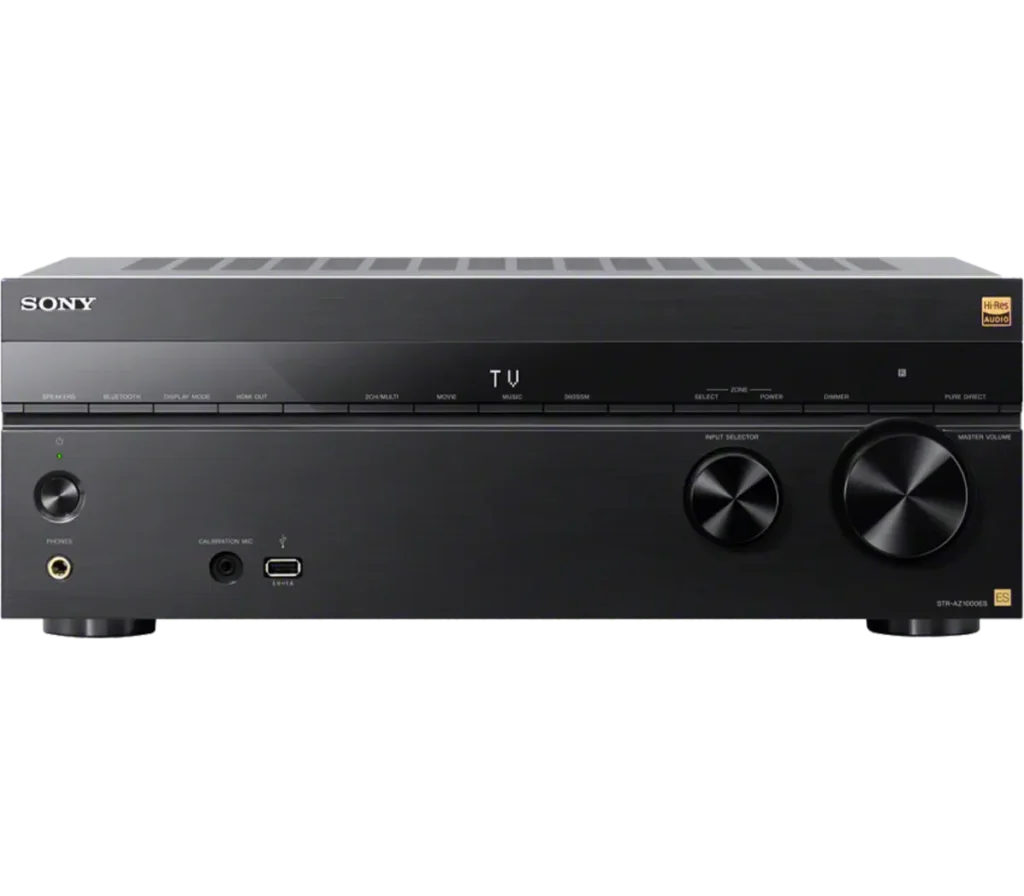
Sony STR-AZ1000ES is the seven-channel entry to the North American ES receiver family. It combines ordinary surround decoding with Sony’s calibration, spatial processing and installer-oriented control. That makes it an interesting option for a clearly planned system, but the ES badge should not distract from the real channel and HDMI limits. This review concerns the named regional model, with electrical compatibility and local support to be checked before purchase. It does not transfer specifications from the European TA-AN1000 or a larger ES receiver.
Research-based review. This assessment draws on manufacturer documentation and the original published evaluations linked below. Audio Review has not performed a hands-on test of this model.
The original sound assessment is positive with a software caveat
ecoustics’ original evaluation finds convincing immersive playback and capable stereo sound. It also reports an early casting-related problem when spatial mapping is engaged, affecting bass on the tested path. That is evidence to check current behaviour, not proof that every current unit fails or that a later update has fixed it.
Audition the sources and modes that will actually be used. Include a film passage with dialogue and a busy effect sequence, then ordinary two-channel music. Compare processing at similar levels and keep the speaker setup constant. A wider presentation can be enjoyable while a simpler mode better preserves intimacy on another recording. Verify the subwoofer’s contribution rather than assuming a successful menu selection proves the full path works. The most useful recommendation is conditional on the intended setup behaving correctly. A buyer satisfied with HDMI film playback may have different priorities from someone purchasing primarily for a particular casting service and processing combination.
Seven channels require a realistic speaker plan
The internal amplification supports a defined seven-channel arrangement, including a conventional five-speaker bed with two height channels. Spatial processing does not create extra physical amplifier channels or turn the model into a larger receiver.
Sketch the room and label the speakers before comparing prices. Decide whether a surround-back pair or height pair is the more useful addition to a basic five-channel bed. Check the supported assignment in the manual rather than trying to count every binding post as a separate simultaneous channel. If the intended destination is four physical height speakers, choose a receiver designed for that layout from the outset. A well-placed smaller system can be a better purchase than more equipment squeezed into unsuitable positions. However, a clear expansion plan should not be ignored simply to secure a discount today. The right model fits both the room and the expected period of ownership without requiring unsupported workarounds.
Two high-bandwidth HDMI inputs are the practical gaming limit
Sony’s help guide distinguishes GAME and MEDIA BOX from the remaining four inputs. The former support the high-bandwidth 4K120/8K route; the others are limited to 4K60. A general HDMI version label therefore does not mean every socket handles the same signal.
List the actual consoles, computer and video player, then assign each to a suitable input. Test the display and source settings as well as the cable route. A successful ordinary video picture does not establish that the desired frame rate, variable refresh behaviour and audio format are active together. If the system contains several demanding gaming sources, consider whether the available inputs are sufficient without an extra switch. Allow time to verify waking from standby and changing sources, since those are daily actions rather than rare technical demonstrations. A clear connection plan can make the receiver easy to live with. Guessing from the total input count can leave an owner disappointed even though the product is operating exactly within its documented limits.
Calibration and spatial mapping serve different decisions
DCAC IX establishes a measured setup, while 360 Spatial Sound Mapping is a selectable processing feature. Sony requires calibration for the mapping route. Neither facility removes the need for sensible speaker placement or proves every listener will prefer the same effect.
Follow the supplied microphone procedure carefully and check that the resulting speaker configuration matches the installation. Listen to familiar material before making multiple changes. Compare the processing from the normal seat and consider whether dialogue stays focused as the surrounding scene becomes more expansive. A more spacious result is useful when it supports the film rather than drawing attention to itself. If different sources use different sound modes, note that before attributing a tonal change to the source hardware. Save a known working baseline and change one relevant setting at a time. The benefit is a repeatable system suited to the actual room, with the processing chosen by preference rather than permanently enabled because it sounds more advanced in a feature list.
Sony and Sonos connections have specific conditions
The receiver supports listed Sony wireless rear and subwoofer models, with configuration restrictions documented in the guide. Works with Sonos requires separate compatible Sonos hardware; the logo does not mean every Sonos function is built into the receiver itself.
Identify the exact existing devices before ordering additional equipment. Confirm the desired speaker role, connection mode and volume behaviour rather than assuming brand membership establishes unrestricted pairing. Include mains access for wireless speakers, since removing an audio cable does not eliminate power needs. For a Sonos plan, price the complete route and test switching, wake-up and ordinary volume control. A system used by several people should have a clear everyday routine that does not require repeated troubleshooting. These integration features can be valuable when they solve an existing requirement. They add less value for an owner using only conventional wired speakers and HDMI sources. Buy the arrangement that can be demonstrated with the intended equipment rather than a promise of universal ecosystem compatibility.
Regional support and missing phono need to be priced honestly
This assessment concerns the North American STR-AZ1000ES. Electrical rating, warranty and service should be verified for the actual location. Its analogue inputs also do not include a cartridge-level phono input, so a turntable needs an appropriate line-level route.
For an imported offer, obtain clear confirmation of compatibility and support before buying. A low overseas price may be less attractive once the practical ownership arrangement is understood. Do not assume a plug adapter settles electrical suitability. For vinyl, check whether the turntable already supplies a line output or requires a separate phono stage, then include that cost and cable space. Compare the ES model with a supported local alternative using the complete installation price. Custom-control facilities are useful when they are actually part of the project, but need not justify a premium for a basic living-room setup. The strongest purchase is a properly supported regional example that already fits the speaker, source and daily-control requirements.
Alternatives to consider
Sony STR-AN1000 / TA-AN1000: The AN1000 family is a useful comparison for buyers who do not need the ES model’s installation features. Identify the exact regional version, warranty and connection list before assuming the packages are interchangeable.
Denon AVC-X3800H: AVC-X3800H is relevant when a broader speaker or external-amplifier plan matters. Compare the complete channel layout, calibration and regional support rather than choosing from a simple power-number contest.
Sony STR-AZ1000ES key specifications
- Market
- North American ES model; verify local electrical rating and support
- Amplified channels
- Seven
- Speaker examples
- 7.2 or 5.2.2 within supported assignments
- HDMI
- Six inputs / two outputs
- High-bandwidth inputs
- GAME and MEDIA BOX support 4K120/8K; other four up to 4K60
- TV audio
- eARC / ARC on designated output
- Surround
- Dolby Atmos and DTS:X
- Calibration
- DCAC IX
- Spatial processing
- 360 Spatial Sound Mapping after calibration
- Sony wireless
- Listed compatible rear/subwoofer models only
- Phono input
- None
- Sonos
- Works with Sonos integration requires separate compatible Sonos equipment
- Rated power
- 100 W/ch into 8 ohms, 1 kHz, 0.9% THD, two channels driven
Verdict
STR-AZ1000ES is a capable seven-channel option for a supported regional installation. Its original sound evidence and Sony integration are appealing, with meaningful limits in channel growth and high-bandwidth HDMI inputs. Confirm current casting behaviour, electrical suitability and any required Sonos or phono equipment. Buy for a defined working system rather than assuming the ES badge guarantees every connection or expansion possibility.
Documentation and original reviews
Sony official North American STR-AZ1000ES product information · Sony official STR-AZ1000ES help guide and HDMI port limits · ecoustics original STR-AZ1000ES listening and operation evaluation
Editorial record
Sources and updates
Product specifications and factual claims were checked against Official Sony STR-AZ1000ES product page ↗. Scores and buying advice follow our category-specific editorial methodology.
- Published
- November 17, 2026
- Last updated
- November 17, 2026