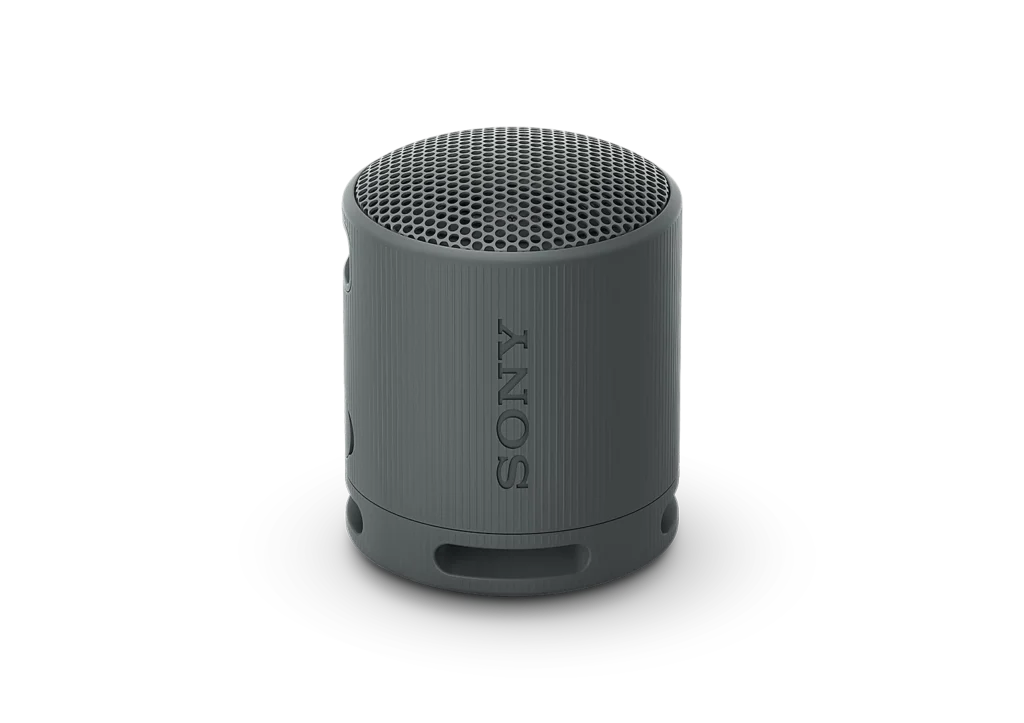
Sony SRS-XB100 is a small Bluetooth speaker designed to make personal music playback easy to carry. It weighs approximately two hundred and seventy-four grams, includes a strap and offers useful protection against dust and water. It is most convincing close to one or a few listeners. The compact size is the attraction and the constraint: this is not a room-filling party speaker, and the XB name should not be interpreted as a promise of deep bass on the scale of a much larger cabinet.
Research-based review. This assessment draws on manufacturer documentation and the original independent evaluations linked below. Audio Review has not performed a hands-on test of this model.
Why the small format can be the right choice
A speaker that adds little weight to a bag can accompany trips on which a larger model would be left behind. The cylindrical body is easy to place on a nearby stable surface, and the included strap adds another carrying option. Check that it is attached securely before relying on it while moving.
For podcasts at a small table, quiet music beside a chair or background listening during a short break, proximity can be more useful than maximum output. Place it within easy hearing distance instead of asking it to project across an open area. If the actual plan involves entertaining a larger group, start the comparison with a larger cabinet. Buying the smallest speaker and repeatedly running it at its limit is rarely the most satisfying compromise.
Sound: enjoyable at the intended scale
SoundGuys’ original evaluation finds the XB100 pleasing for its size but insufficiently loud for a medium-sized room or backyard gathering. It also notes useful bass relative to another very small speaker. Those findings support a personal-listening recommendation rather than a claim that a miniature model replaces a full portable system.
Listen with familiar speech and music at the level you normally need. Check whether vocals remain understandable without raising volume excessively, and accept that the lowest bass may be absent. If a recording relies on deep bass for much of its effect, audition it before choosing. A portable can be an excellent companion for one listener while remaining the wrong tool for a larger social space; the two judgments are entirely compatible.
Simple controls and limited software
The official support specification describes Sony Music Center support for firmware updating rather than a full sound-customisation platform. Do not assume that using the same app name as a more expensive Sony speaker provides the same equaliser and effects. The original independent review also criticises the limited companion-app features.
That simplicity can be welcome for someone who wants to pair a phone and press play. It is less attractive if the buyer routinely adjusts bass and treble for different positions or recordings. Decide whether those controls are a genuine requirement before purchase. Trying to obtain them through several phone applications may be less convenient than selecting a speaker with a documented onboard or companion-app adjustment system from the start.
Battery claims with the conditions included
Sony specifies approximately sixteen hours at volume setting thirty-six and approximately five hours at its maximum setting of fifty, using its stated test music. Including those conditions is more useful than repeating one headline number. Neither figure is a new Audio Review endurance measurement.
This matters for planning an outing. A small speaker used near its maximum level can have a very different charging schedule from the same unit playing quietly beside a listener. Allow a margin for temperature, material and battery ageing, and charge before a long trip. If extended high-volume use is essential, a larger speaker may provide a better combination of output and endurance than stretching a miniature model beyond its comfortable role.
Charging is straightforward but not fast
The official charging guide gives approximately four and a half hours for a full charge under the stated power conditions. The USB-C connection is for charging, not wired music playback. A familiar connector shape should not be mistaken for a promise that a laptop can send audio through the cable.
Keep a suitable cable and power source available, and check the charge before leaving rather than expecting a very short top-up to solve an empty battery. If several devices share the travel charger, plan the order in which they will be replenished. The XB100 works best as a simple speaker that is charged routinely, not as equipment whose longest possible session depends on an unverified charging arrangement at the destination.
Stereo pairing and the microphone
Two matching SRS-XB100 speakers can form a stereo pair. That is a specific expansion option, not a claim that every Sony Bluetooth speaker or generic wireless model can join it. Consider the total price and carrying volume of two units before choosing that path over one larger speaker.
The built-in microphone provides a hands-free function, but SoundGuys’ review is less enthusiastic about call clarity than about portability. If calls matter, test one with the device and app you use and be ready to return to the phone. A microphone in a compact music speaker is a convenience, not evidence of conference-system performance. Background noise, position and distance can make a substantial difference to what the other person hears.
Protection and long-term ownership
IP67 protection is useful for travel, but the charging port still needs appropriate care. Sony’s charging guide stresses closing the cap and avoiding charging where water may splash. Dry and inspect the port before reconnecting power, and follow the care instructions rather than treating the protection rating as immunity to every liquid or impact.
For an older or used example, check battery behaviour, the port cover, buttons and strap condition. A low purchase price is less attractive if the speaker no longer lasts through the session for which it is intended. Compare current prices with Clip 5 and Micro 2, including the attachment method and controls. The best value is the small companion whose practical compromises remain acceptable after the initial novelty has passed.
Alternatives to consider
JBL Clip 5: Clip 5 is worth comparing when the attachment method matters as much as the sound. Try the actual bag or support you intend to use and compare controls and carrying convenience, rather than choosing from the speaker size alone.
Tribit StormBox Micro 2: Micro 2 offers another compact approach. Compare current prices, strap handling, normal listening level and the need for sound adjustment; a tiny speaker should be selected for its complete practical role rather than a bass-related model name.
Sony SRS-XB100 key specifications
- Design
- Miniature Bluetooth speaker
- Driver
- One approximately 46 mm full-range unit
- Enclosure
- Passive radiator design
- Bluetooth
- 5.3, SBC and AAC
- Protection
- IP67
- Weight
- Approximately 274 g
- Dimensions
- Approximately 76 mm diameter × 95 mm high
- Battery claim
- Approximately 16 hours at Sony volume setting 36
- Maximum-volume claim
- Approximately 5 hours at setting 50
- Connection
- USB-C charging only; no wired audio
- Expansion
- Two SRS-XB100 units for stereo pairing
- Microphone
- Built in
Verdict
SRS-XB100 is an appealing simple speaker for personal listening, light bags and close-range use. Its protection and compact format are the main strengths, supported by a positive original assessment within those limits.
Choose a larger speaker for group volume or stronger bass, and another compact option if EQ or a different attachment method is essential. Include the conditional battery figures and full recharge time in the decision. The XB100 makes sense when the aim is easy everyday music nearby, rather than the output and features of a bigger portable.
Primary documentation and independent reviews
Sony official SRS-XB100 specifications · Sony SRS-XB100 speaker and power specifications · Sony SRS-XB100 battery and charging conditions · SoundGuys original SRS-XB100 evaluation
Editorial record
Sources and updates
Product specifications and factual claims were checked against Official Sony SRS-XB100 product page ↗. Scores and buying advice follow our category-specific editorial methodology.
- Published
- November 17, 2026
- Last updated
- November 17, 2026