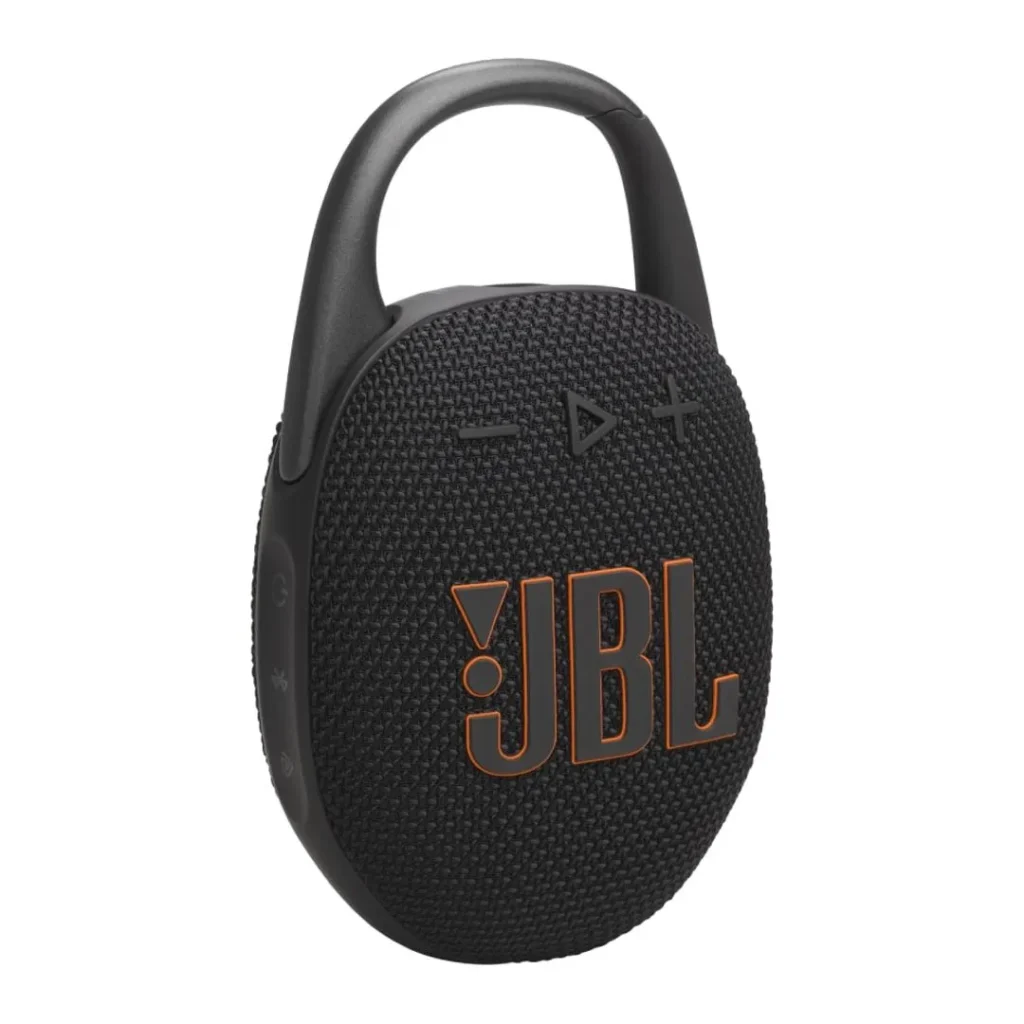
The JBL Clip 5 has a more specific purpose than most portable speakers: its integrated carabiner makes attachment part of the design. That can be more useful on a day bag than adding another loose item to a pocket. Its small driver and enclosure still require realistic expectations, so the buying decision should start with carrying convenience and listening distance.
JBL Clip 5 — The carabiner is the main reason to choose it
JBL describes a redesigned integrated carabiner with a wider opening. Check it against the strap or loop you intend to use, since attachment convenience depends on the actual bag. It is an equipment-carrying feature, not climbing or personal-safety hardware.
Attaching a speaker also changes how it faces the listener and what surrounds it. A bag can partly obstruct the grille, and movement can change perceived balance. Try a clear orientation before raising the volume or assuming the EQ needs major correction. For public paths and shared transport, consider whether open playback is appropriate around other people.
Understand the scale of the acoustic system
The specification lists a 45 mm transducer, 7 W RMS and approximately 285 g weight. These figures describe a very small portable system. A higher wattage than another pocket speaker does not independently establish loudness, clean bass or better tonal balance.
JBL quotes a 95 Hz to 20 kHz response range without providing a complete response curve in the specification sheet. Do not read that as deep sub-bass capability or a guarantee of flat reproduction. For podcasts and nearby casual music, size may be a fair compromise; for full-range outdoor listening, enclosure capacity becomes more important.
Sound quality for nearby listening
RTINGS’ original testing finds clear speech and useful coverage around the speaker, while identifying limited deep bass and restricted output. That is a more informative description of its role than the power rating alone. The Clip 5 is a small mono speaker: it combines the left and right channels rather than creating a stereo image from one enclosure. Its strengths are easier to appreciate with a podcast or a familiar vocal recording than with music whose impact depends on the lowest bass notes.
For an audition, start at the distance where you will actually use it. Compare quiet passages and busier arrangements without moving the speaker or changing the phone volume between tracks. If you need to raise the level substantially just to overcome the surroundings, a larger speaker is the more practical answer. Adding bass in an app can adjust the balance, but it cannot give a small driver the displacement or headroom of a much larger system.
Stereo pairing and app control
Two Clip 5 units can be paired for stereo, while Auracast allows connection with compatible JBL Auracast-enabled speakers. Check exact compatibility before buying a second unit. Older proprietary pairing systems should not be assumed to join simply because the manufacturer is the same.
The JBL Portable app provides EQ adjustment and updates. For a stereo pair, give the units enough separation to create distinct left and right positions and keep them reasonably balanced relative to the listener. Two speakers clipped together on one bag do not deliver the same spatial benefit as a deliberately placed pair.
Daily use with phones and shared playback
SoundGuys’ original review confirms multipoint connection, allowing two source devices to remain connected. This is useful when a phone and another device share the speaker, but it is different from mixing two audio streams. Pause playback on one source before starting the other. Pairing two phones should also be kept separate from pairing two speakers: the first concerns control and source selection, while the second concerns the playback system.
The same review reports that custom EQ is unavailable during its Auracast group-playback setup, with the speaker returning to the standard JBL tuning. Check the actual app and firmware combination if personalised EQ matters to you. Set up a group before leaving home, make sure every speaker has enough charge, and confirm that reconnection works after switching the units off. These checks are particularly useful when the speakers will be shared between people rather than kept as one permanent pair.
Battery expectations and outdoor care
The stated playtime is up to 12 hours, plus up to three additional hours with Playtime Boost. JBL explains that this mode changes tuning and performance. The 15-hour total is therefore not a promise of standard operation at every volume. Charging is specified at approximately three hours using a suitable 5 V, 1 A supply.
IP67 protection addresses dust and specified water-exposure conditions, but does not mean the product is indestructible or should be charged wet. Rinse or clean only as instructed and allow charging areas to dry. Its compact battery also makes regular top-ups more realistic than treating the maximum playback figure as a guarantee after months of mixed use.
RTINGS reports roughly six hours at its higher test level, illustrating why JBL’s maximum runtime should not be used as a fixed itinerary. A quiet background session and louder outdoor playback place different demands on the same battery. For a long day away, leave a useful reserve rather than planning around the final advertised hour. Playtime Boost is an option to compare before the trip, especially if changing the sound balance would reduce your enjoyment.
What to expect in a real setup
Can two Clip 5 speakers play stereo? Yes. JBL documents pairing two Clip 5 units for stereo. That is distinct from linking multiple compatible speakers for broader coverage.
Does Playtime Boost preserve identical tuning? JBL describes it as tuning and optimising performance to extend playtime. Treat it as a separate operating mode rather than free battery capacity.
Value and choosing the right size
The Clip 5 belongs on a shortlist when its attachment system will be used regularly. Consider how often the speaker will hang from a bag, how close it will be to the listener and whether there is already another speaker at home. Paying for the clip makes less sense when the product will spend almost all its time on a desk. In that situation, compare the available space and the sound required before choosing the smallest enclosure.
Likewise, buying a second Clip 5 primarily for more output deserves a complete cost comparison. A pair gives different placement possibilities, but it also means charging and carrying two units. For a single listener on short walks, one Clip 5 may be the more coherent purchase. For repeated group listening at a fixed outdoor spot, a larger single speaker can be easier to manage. Choose the arrangement that fits the routine rather than collecting features that will rarely be used.
Alternatives to consider
JBL Flip 7: Consider the larger design if carrying it inside a bag is acceptable and acoustic capability takes priority over the integrated clip.
Sonos Roam 2: A different compact option to research when home-system integration is more important than carabiner attachment.
JBL Clip 5 key specifications
- Driver
- 45 mm
- Rated output
- 7 W RMS
- Bluetooth
- 5.3
- Protection
- IP67
- Weight
- 285 g
- Dimensions W × H × D
- 86.3 × 134.5 × 46 mm
- Claimed runtime
- Up to 12 h; +3 h with Playtime Boost
- Claimed charge time
- 3 h at 5 V / 1 A
- Multi-speaker connection
- Compatible Auracast products
- Carrying feature
- Integrated carabiner
Verdict
The Clip 5 is a focused purchase for people who will actually use its attachment design. A nearby listening position, sensible volume and correct expectations make more sense than chasing room-filling claims. Published testing supports its usefulness for nearby speech and casual music while reinforcing the limits of bass, maximum level and louder-playback endurance.
Primary documentation and independent reviews
JBL official European product information · JBL official specification sheet · RTINGS original JBL Clip 5 testing · SoundGuys original JBL Clip 5 review
Editorial record
Sources and updates
Product specifications and factual claims were checked against Official JBL Clip 5 product page ↗. Scores and buying advice follow our category-specific editorial methodology.
- Published
- November 8, 2026
- Last updated
- November 8, 2026