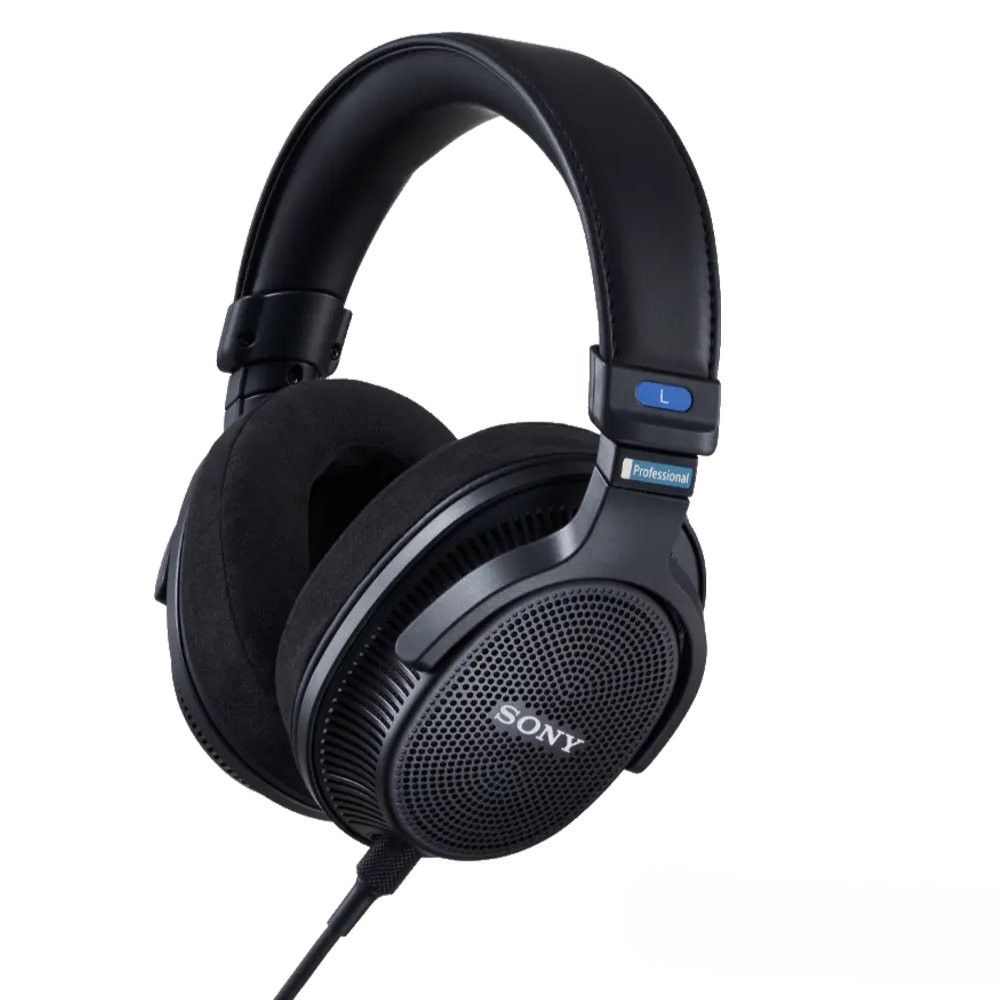
Sony MDR-MV1 is an open-back wired headphone aimed at creators, but its light construction also makes it interesting for home listening. The central question is tuning rather than connectivity: published tests find an unusually full low end for an open model, alongside a spacious presentation. That can be enjoyable, yet it complicates the assumption that a studio label guarantees a neutral reference for every task.
Research-based review. This assessment draws on manufacturer documentation and the original published evaluations linked below. Audio Review has not performed a hands-on test of this model.
Low weight with a desk-oriented connection
Sony specifies approximately 223 grams without the cable, 40-millimetre drivers and a detachable 2.5-metre lead. The normal source plug is 6.3 millimetres, with an included adapter lead for smaller headphone sockets. The weight excludes the cable, which matters when comparing figures.
At a desk, plan where the lead will rest so it does not pull across a keyboard or catch a chair. Confirm the locking connection is fully seated before diagnosing a channel problem. A removable cable is useful for service, but the replacement must have the correct physical fit; a similar-looking plug is not enough. The connector arrangement is suited to audio interfaces and amplifiers. A phone without a headphone socket still needs an appropriate output adapter, and the headphone does not become wireless simply because the source is a mobile device.
Comfort is promising, but personal
Both SoundGuys and What Hi-Fi find the MDR-MV1 comfortable over extended use. Sony’s light construction and breathable pad approach are relevant strengths. Published comfort impressions still cannot establish that the ear opening, pressure and headband shape will fit every person.
Try the headphones with the glasses normally worn, and leave them on while doing the activity for which they are intended. Check pressure at the top of the head and whether either ear touches the pad interior. Comfort also includes the cable routine: a light headphone can become distracting if a heavy lead continually drags on one side. Replacement pad availability is worth asking about for a product expected to serve through long working sessions. Keep pad condition consistent when comparing sound, since heavily worn or alternative pads can change the acoustic result as well as the fit.
Spacious sound with a qualified tonal balance
What Hi-Fi reports clear detail, openness and substantial bass, but finds the bass can impede agility and the upper range can be uneven. SoundGuys is more critical of the elevated low end and recommends adjustment for many applications. Neither account supports describing the default sound as universally flat.
For listening, compare the headphone on a voice-led recording, a dense rhythm section and music with sustained low notes. Decide whether the extra weight remains enjoyable once the initial impression has passed. For editing, keep familiar commercial references nearby and verify important decisions on another playback system. If the headphone consistently encourages a leaner mix elsewhere, that is information to incorporate into the workflow. An appealing presentation and a useful production tool are not mutually exclusive, but both depend on learning the actual balance rather than accepting marketing terms as a substitute for experience.
Open-back means sound travels both ways
The open construction is explicit in Sony’s specification. External sound remains audible and playback can escape into the room. That is a basic design characteristic, not a defect that an app setting will remove.
Choose the listening location before buying. A quiet editing desk can be a good fit; a shared office, loud transport or a microphone recording booth may not be. During tracking, playback leaking from the headphones can reach a sensitive microphone, so a closed alternative is usually the more practical starting point. Also consider other people in the room, especially during late listening. Openness should not be treated as a guarantee of a particular soundstage for every recording. The benefit is best assessed with familiar material in the intended space, where environmental noise does not force the user to increase volume merely to recover detail.
Source matching without an automatic amplifier purchase
Sony gives a 24-ohm impedance and sensitivity of 100 dB per milliwatt. Those are useful source-matching figures, but they do not identify the noise, output behaviour or volume range of every phone adapter and interface. The headphone uses an ordinary analogue signal path without a battery.
Begin with a known competent headphone output and check for sufficient clean level on quieter recordings. Listen for hiss during silence and make sure the volume control offers sensible adjustment. A low impedance alone does not prove that every source is ideal, just as a professional label does not mandate an expensive amplifier. If the existing output already works cleanly and comfortably, spend time learning the headphone before adding another box. A replacement source should solve an identified connection or performance problem rather than serving as an assumed entrance fee for enjoying the MDR-MV1.
Spatial production claims and practical value
Sony positions this model for stereo and spatial production. The headphone itself remains a wired stereo transducer; rendering software, content format and production tools determine the wider workflow. Buying it does not automatically supply every plug-in or calibration service a studio might need.
List those requirements separately before comparing costs. Check software compatibility, licensing and the actual delivery format for a project. For ordinary music listening, those production claims need not be the main reason to buy at all. Current European price, comfort, cable serviceability and preferred tonal balance are more direct considerations. It is reasonable to choose the MDR-MV1 because it is enjoyable and easy to wear. It is less convincing to pay for it solely because the word monitor suggests that every mix will translate without cross-checks. The value case becomes clearer once its specific role is defined.
Alternatives to consider
Beyerdynamic DT 900 Pro X: DT 900 Pro X is an appropriate open studio comparison. Try both with familiar material and the same source, paying attention to tonal balance, pad fit and how confidently work translates to other playback systems.
Sennheiser HD 560S: HD 560S is relevant when a more reference-oriented home-listening shortlist is the starting point. Compare present prices and comfort as well as the amount of bass each listener prefers.
Sennheiser HD 600: HD 600 offers an established alternative for quiet-room listening. Check the complete source match rather than assuming that different impedance numbers by themselves predict quality or the need for an expensive amplifier.
Sony MDR-MV1 key specifications
- Design
- Open-back dynamic
- Driver
- 40 mm
- Impedance
- 24 ohms at 1 kHz
- Sensitivity
- 100 dB/mW
- Weight without cable
- Approximately 223 g
- Cable
- Detachable, approximately 2.5 m
- Source plug
- 6.3 mm stereo
- Included adapter
- 3.5 mm connection lead
- Bluetooth
- No
- ANC
- No
- Built-in microphone
- No
- Intended environment
- Quiet listening or production space
Verdict
Sony MDR-MV1 deserves consideration for a quiet-room listener or creator who values low weight, an open presentation and a replaceable cable. The published evidence also makes its bass emphasis a central part of the decision rather than a small footnote.
Try the default balance and any preferred correction with familiar recordings, then verify the intended workflow. It is not a commuting headphone or a convenient tracking choice near microphones. As a comfortable listening and production tool whose character the owner understands, it has a clear role; as a promise of automatic tonal neutrality, it is much less straightforward.
Documentation and original reviews
Sony Pro official MDR-MV1 product and connections · Sony Pro official MDR-MV1 technical sheet · What Hi-Fi original MDR-MV1 listening and comfort evaluation · SoundGuys original MDR-MV1 tuning and production-use evaluation
Editorial record
Sources and updates
Product specifications and factual claims were checked against Official Sony MDR-MV1 product page ↗. Scores and buying advice follow our category-specific editorial methodology.
- Published
- November 17, 2026
- Last updated
- November 17, 2026