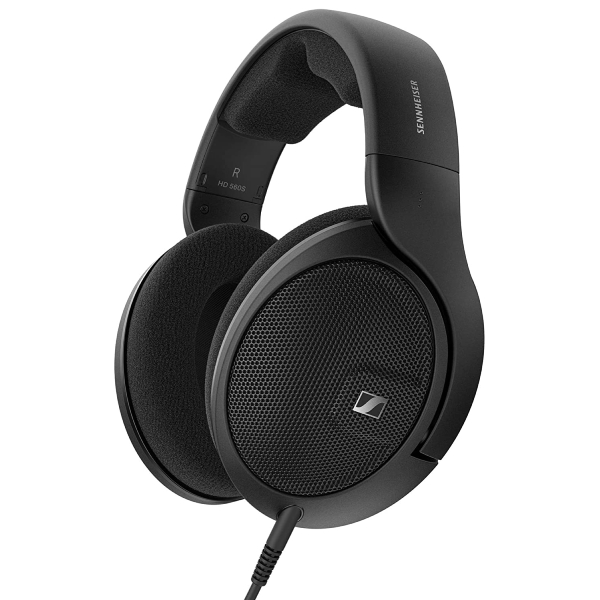
The Sennheiser HD 560S remains an interesting route into dedicated wired listening because it puts its resources into a focused job. This is an open headphone for a quiet room, not a travel model trying to combine calls, noise cancellation and music. Its strongest buying argument is a reference-oriented presentation in a relatively straightforward package. The main question is whether that presentation and its practical compromises fit the system you actually use.
Sennheiser HD 560S — A headphone built around a listening position
The HD 560S belongs beside a computer, audio interface or hi-fi headphone output. Its open earcups let environmental sound in and allow music to escape. That is useful information before considering any discussion of detail or imaging: the best listening position is one where the room is already quiet and nearby people will not be disturbed. Buying it for isolation would undermine the point of the purchase.
Its conventional construction also changes the ownership calculation. There is no charging schedule or wireless pairing routine. You connect the cable, set an appropriate level and listen. For someone who already uses a wired source at a desk, removing those extra dependencies can be attractive. For someone who regularly switches between trains, offices and phone calls, the same simplicity becomes a limitation rather than an advantage.
Build should be judged in that context. The largely plastic structure is functional and keeps the design manageable, but it is not a luxury object or a rough-use field tool. Support it properly when not in use, avoid pulling it by the cable and check the headband adjustment during an audition. Physical suitability is a separate issue from whether an enthusiastic review likes its sound.
The sound evidence and the right expectations
SoundGuys describes the HD 560S as a credible entry into higher-quality wired listening, with sound quality central to its appeal. Its review also identifies the practical drawbacks of the original long cable and plastic construction. Those findings make a balanced starting point: the headphone deserves attention for listening, while its everyday handling should not be dismissed as irrelevant.
RTINGS includes the HD 560S in its measured headphone coverage and compares its open presentation with other Sennheiser models. Such evidence is more useful than treating the word reference as a universal guarantee. A recorded vocal, an electronic bass line and a close-miked cymbal ask different questions of a headphone. Use recordings you know well and listen for the balance between them, rather than simply for newly noticeable high-frequency details.
Our reading of the evidence supports a serious shortlist position for listeners who prefer clarity over a deliberately heavy, enveloping presentation. That does not mean every listener should prefer it to a warmer headphone. If your current model has a substantial bass emphasis, allow time for a controlled comparison at similar loudness before deciding that a leaner balance is either more accurate or less enjoyable.
Why source matching is less dramatic than the impedance suggests
The HD 560S is commonly specified at 120 ohms, with Sennheiser documenting sensitivity of 110 dB at 1 V and 1 kHz. Taken together, those figures do not justify a blanket claim that a costly amplifier is mandatory. They tell you to evaluate voltage capability and usable level at the source. The headphone output already available on a computer or interface may be enough for the intended listening situation.
An external amplifier becomes a practical question if the existing output cannot reach a suitable level cleanly, provides awkward volume steps or leaves insufficient headroom after equalisation. Check those shortcomings before purchasing another box. More output power on a specification sheet is not by itself a reason to replace a source that already performs the required job.
Equalisation can change that calculation because raising one frequency region may require reducing the overall digital level to avoid clipping. A listener applying a substantial bass adjustment may therefore need more source headroom than a listener using the stock response. Make that comparison at sensible listening levels. A system that only appears inadequate when played excessively loudly is not necessarily a system that needs a stronger amplifier.
Check the cable package before ordering
Cable details deserve particular care with this model. Older reviews, including the SoundGuys evaluation, discuss a very long lead and a large default jack arrangement. Current Sennheiser support information describes 3.5 mm and 6.3 mm connectivity. Stock can span different production periods, so use the retailer’s description and the exact supplied package to establish what is included in the unit you will receive.
That is a more useful approach than calling every listing with a different cable a different acoustic model. It also avoids a preventable inconvenience: a long lead may suit a listening chair but become untidy at a laptop. Confirm length, plug size and the appropriate earcup connector if planning to buy a shorter replacement. A visually similar cable is not proof of compatibility.
An analogue connection also needs an actual analogue output. USB-C, optical and HDMI sockets do not become headphone outputs through a passive change of plug shape. Where an adapter is required, identify whether it contains the necessary conversion and amplification. This matters with phones, televisions and small computers that may have very different audio facilities despite looking equally modern.
Comfort and maintenance over time
Comfort should be tested over a meaningful part of a normal session. The first few minutes establish that the cups sit around the ears; they do not necessarily reveal pressure from glasses, a headband contact point or a fit that changes when looking down at a keyboard. A return policy or an in-store audition is especially valuable if the headphone will be used for several hours at a time.
A replaceable cable is helpful, but pads are also part of long-term ownership. Their condition affects the fit and can change how the headphone couples to the ear. Use replacements intended for the model and treat an unfamiliar aftermarket material as a potential acoustic change. Maintenance is not only about keeping the product looking tidy.
The HD 560S is not a complete communications headset in its ordinary supplied form. A separate microphone and suitable input arrangement are needed for calls or collaborative games. That can work well at a permanent desk, but it adds equipment to the overall system. Include those requirements when comparing the total package with a headset that already incorporates chat facilities.
Value is strongest when its limitations suit the room
The HD 560S makes most sense as a purposeful purchase rather than an automatic step up from every inexpensive headphone. A quiet location, a suitable existing output and a preference for its tonal approach remove many reasons to spend more. If those conditions are absent, an apparently good headphone price can be followed by additional expenditure without solving the original problem.
Compare current local prices rather than historic launch figures or isolated overseas discounts. Established models can sit unusually close to newer products during promotions. Include the warranty route, replacement parts and any cable or source accessory actually needed. The better purchase is the complete system that suits the listener, not the headphone with the longest specification list.
Alternatives to consider
Sennheiser HD 650: A home-listening alternative to audition if you want to compare a different balance and chassis before choosing the HD 560S.
Sennheiser HD 600: A useful comparison when a familiar vocal presentation and a dedicated home system are the priorities.
Beyerdynamic DT 900 Pro X: Compare its physical fit and studio-oriented package if daily desk use matters as much as the sound balance.
Sennheiser HD 560S key specifications
- Design
- Dynamic, open-back, over-ear
- Nominal impedance
- 120 ohms
- Sensitivity
- 110 dB at 1 kHz / 1 V
- Connectivity
- Analogue; verify the supplied 3.5 / 6.3 mm package
- Wireless
- None
- Frequency response
- 6 Hz–38 kHz (manufacturer specification)
- Total harmonic distortion
- <0.05% at 1 kHz and 90 dB SPL
Verdict
The HD 560S is a strong specialist choice for a quiet wired listening setup. Its appeal lies in the documented source requirements, the positive independent sound assessments and a focused ownership experience. Check cable revisions, comfort and your preference for its tonal balance. It is worth shortlisting for the job it was designed to do, while isolation, wireless convenience and integrated calls remain reasons to choose a different type of headphone.
Primary documentation and independent reviews
Sennheiser official HD 560S information · Sennheiser HD 560S support specifications · SoundGuys original review · RTINGS original review
Editorial record
Sources and updates
Product specifications and factual claims were checked against Official Sennheiser HD 560S product page ↗. Scores and buying advice follow our category-specific editorial methodology.
- Published
- November 7, 2026
- Last updated
- November 17, 2026