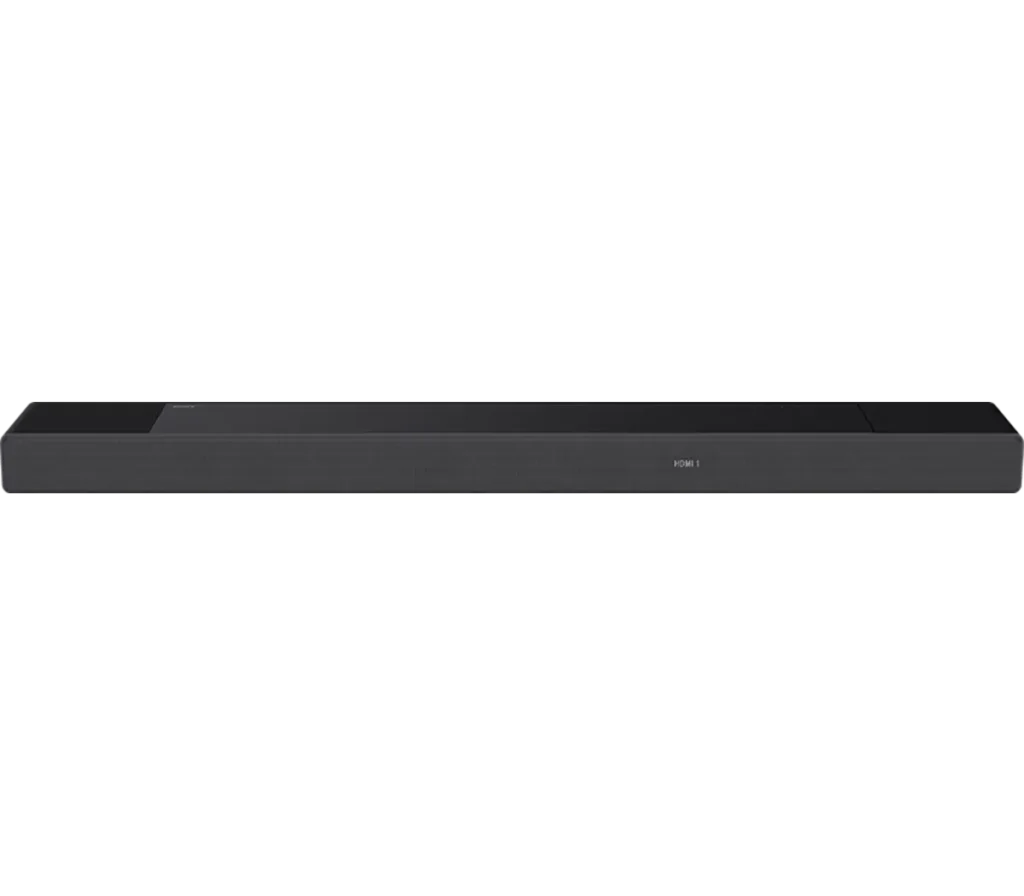
Sony HT-A7000 is a large 7.1.2 soundbar from an earlier premium generation, with physical height drivers, built-in bass and two HDMI source inputs. Its extensive connection set remains relevant, particularly after software additions such as VRR and ALLM passthrough. Original listening evidence supports a spacious front presentation, but the bar alone does not place physical speakers behind the seats or provide the deepest bass of an expanded package. This research-based review considers those boundaries alongside practical room fit, music playback and the complete ownership cost.
Research-based review. This assessment draws on manufacturer documentation and the original published evaluations linked below. Audio Review has not performed a hands-on test of this model.
A strong front presentation with an obvious rear boundary
AVForums’ original evaluation describes an energetic, detailed and broadly balanced performance, with clear dialogue, useful stereo width and effective front height effects. It also finds the standalone stage front-heavy and recognises that the built-in bass cannot match a separate subwoofer’s depth. Those qualifications help explain what the substantial enclosure can and cannot achieve by itself.
Listen to speech, a complex film sequence and ordinary music from the same seats. Check whether the front image remains coherent for people sitting off-centre, and whether dialogue stays intelligible without needing excessive level. A strong frontal presentation can be very satisfying where rear placement is impractical. It should still be assessed as that particular compromise rather than a substitute for speakers physically behind the listener. Compare normal television at the usual household volume as well as a demonstration soundtrack. The most persuasive premium upgrade is one that improves daily listening, not merely the brief moments when an effect makes the room sound larger.
Installation matters for height and width
The HT-A7000 uses up-firing drivers and side-directed beam tweeters as part of its spatial approach. Their effectiveness depends on the installation and reflecting surfaces. The documented physical arrangement is more informative than assuming the 7.1.2 label means a complete set of separately positioned speakers around the room.
Avoid enclosing the bar inside furniture that blocks the upward and sideways sound paths. Follow the official positioning and setup instructions, with the main seats in their normal locations. Use a suitable soundtrack to decide whether height effects add useful involvement under the actual ceiling. An unusually high, sloping or acoustically open space deserves an audition rather than a promise of identical results to a review room. Optional compatible rears can change the surround arrangement, but their positions and power sockets should be planned in advance. Choose the feasible layout first. A well-installed single bar may be preferable to an expanded system with rear units placed wherever a spare surface happens to be available, while a buyer seeking precise rear localisation should budget accordingly.
Two source inputs provide useful flexibility
Sony’s specification lists two HDMI inputs and one eARC/ARC output, plus optical, stereo mini analogue and USB music connections. Its software history confirms added VRR and ALLM passthrough, making early descriptions of those features as absent or merely promised outdated. The model also supports a 4K/120 video route with appropriate equipment and settings.
Decide which sources should connect directly to the bar and which can use the television’s return channel reliably. Check each required audio and video mode with the actual console or player. A successful picture does not establish that the expected soundtrack is being decoded, and ordinary stereo sound does not establish correct multichannel configuration. Keep the working settings documented for future source changes. Two inputs are convenient where the television has limited audio passthrough, but they are not unlimited switching capacity. Avoid purchasing extra adapters before establishing which route already works. The connection advantage is strongest when it solves a specific installation problem rather than simply adding sockets to a feature checklist.
A music system as well as a television upgrade
AirPlay 2, Chromecast built-in and Spotify Connect sit alongside local and Bluetooth sources. Sony documents SBC, AAC and LDAC for Bluetooth reception, with a separate transmission function supporting SBC and LDAC. A particular phone or headphone still needs to support the relevant route and codec.
Use the music service and devices that will actually remain in the room. Check the process of starting playback, changing volume and handing control to another person. Compare the preferred ordinary music setting with film processing rather than leaving every enhancement engaged automatically. A broad soundstage is welcome, but the ability to follow voices and instruments comfortably matters more over a complete album. Do not assume that a service mentioned in an older review still offers the same special-format catalogue. Network convenience should be judged from today’s application and account arrangement. The analogue input can also be useful for an existing source with a suitable line-level output; a turntable still needs the correct phono amplification somewhere in its signal path.
Optional bass and rears require a complete-system comparison
The base product contains its own bass drivers but does not include a separate subwoofer or physical rear speakers. Sony provides an optional-speaker route, with exact compatibility and firmware requirements that should be checked against current support rather than an old accessory list. Spatial mapping options also need the appropriate supported hardware.
Add every intended component to the price before comparing rivals. Include stands, mounting and practical placement rather than calculating only the box prices. A wireless signal connection still requires power for active components, and a subwoofer should be positioned for integration rather than hidden automatically in the nearest corner. Check that bass supports dialogue and music at ordinary levels as well as adding film impact. It can be reasonable to expand gradually if the starting system is already enjoyable. It is less sensible to buy a bar that does not suit the listener on the assumption that an unspecified later addition will repair its character. Compare the actual final system with packages that include rears and bass from the outset.
Its size and age belong in the value judgement
At approximately 1300 mm wide, 80 mm high and 142 mm deep, and weighing around 8.7 kg, the HT-A7000 needs deliberate furniture or mounting provision. Its substantial height may affect screen or remote-sensor clearance. This is an earlier premium platform, so neither an old launch price nor a current discount alone determines value.
Measure the available space with connectors attached, check the intended mounting support and confirm the normal control routine. Use the generation’s official remote, on-screen and Sony Music Center instructions rather than assuming that newer BRAVIA Connect guidance applies. For a second-hand or remaining-stock purchase, verify included accessories, condition, local support and warranty terms. Confirm current software before judging advanced HDMI or accessory operation. The premium case remains credible when the enclosure fits, the source connections are useful and the sound suits the listener. A smaller or newer system may be better value when those strengths are unused or when the total expanded price approaches a more appropriate complete installation.
Alternatives to consider
Sonos Arc Ultra: Compare the app platform, dialogue and musical presentation, allowing for the different source connections and total price of the intended speaker system.
Sennheiser AMBEO Soundbar Max: Another substantial premium bar to audition where furniture space is available. Compare its room presentation and connections rather than treating all large all-in-one systems as equivalent.
Sony HT-A7000 key specifications
- Base layout
- 7.1.2; built-in bass; physical height drivers
- Separate subwoofer / rears
- Optional, not included in basic bar package
- HDMI
- Two source inputs; one eARC/ARC output
- Video support
- 4K/120; VRR and ALLM with appropriate software
- Other audio inputs
- Optical; stereo mini analogue; USB music
- Network music
- AirPlay 2; Chromecast built-in; Spotify Connect
- Bluetooth reception
- SBC, AAC, LDAC
- Bluetooth transmission
- SBC, LDAC
- Dimensions
- 1300 × 80 × 142 mm
- Weight
- Approximately 8.7 kg
- Expansion
- Exact compatible Sony accessories and firmware required
- Control
- Remote; television interface; Sony Music Center
- HDMI audio formats
- Includes Dolby Atmos, Dolby TrueHD, DTS:X, DTS-HD Master Audio and LPCM
Verdict
The HT-A7000 remains a serious soundbar to consider for a large screen and a demanding source arrangement. Original evidence supports clarity, width and front height presentation, while physical rear coverage and deeper bass remain expansion questions. Check current software, room fit and the complete price. Choose the exact system that will be installed, without treating its earlier flagship status as a substitute for comparison.
Documentation and original reviews
Sony official HT-A7000 specifications and dimensions · Sony official HT-A7000 operating guide · Sony official HT-A7000 current software history · AVForums original HT-A7000 soundbar evaluation
Editorial record
Sources and updates
Product specifications and factual claims were checked against Official Sony HT-A7000 product page ↗. Scores and buying advice follow our category-specific editorial methodology.
- Published
- November 17, 2026
- Last updated
- November 17, 2026