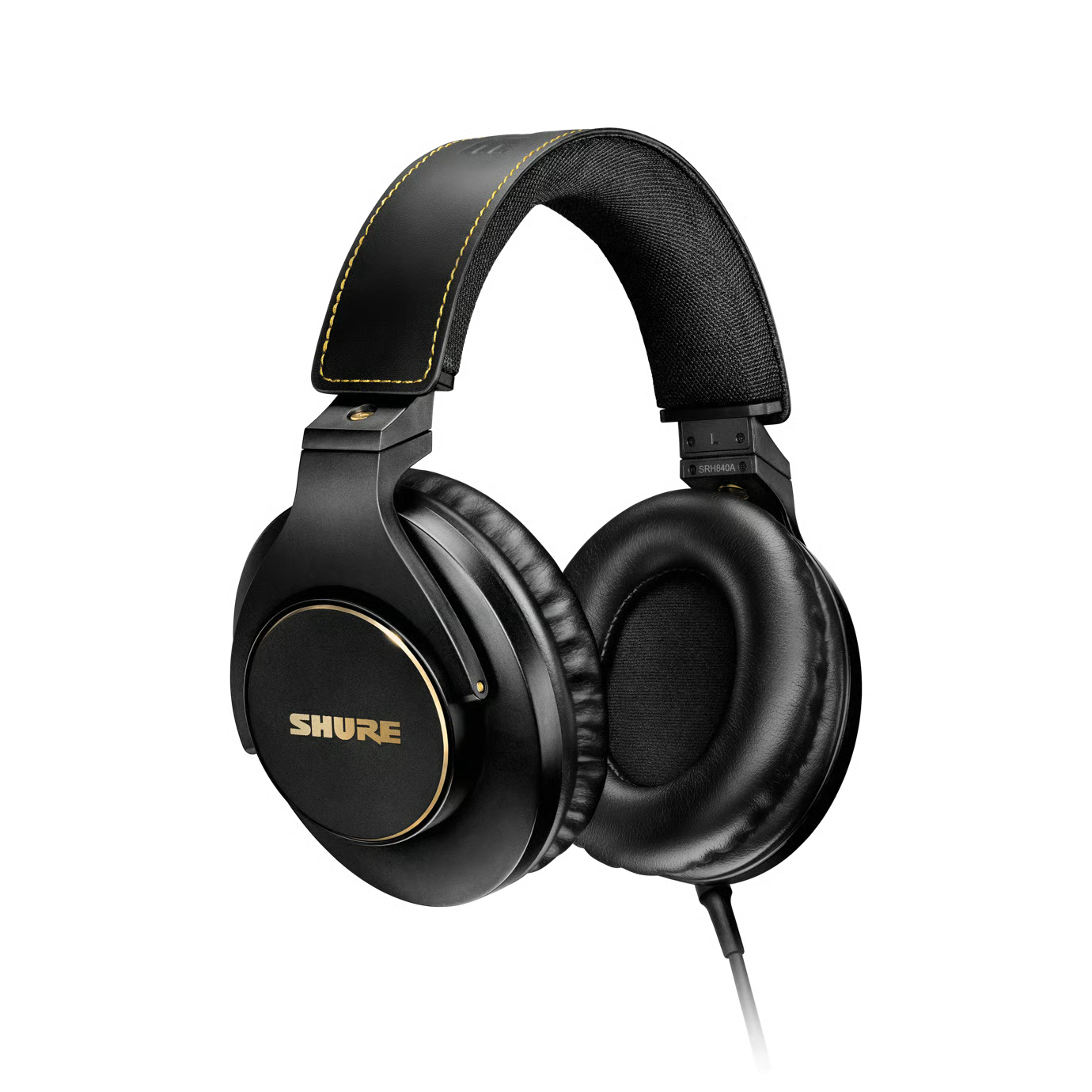
Shure SRH840A is a passive closed headphone aimed at recording and content creation, but its appeal is not restricted to a studio. The original published evaluation finds it enjoyable for ordinary music as well as useful for general monitoring. That makes it an all-round proposition rather than proof of perfectly flat response. The practical details are equally important: a long locking cable, replaceable pads and a fit that should be tried through a realistic session.
Research-based review. This assessment draws on manufacturer documentation and the original published evaluations linked below. Audio Review has not performed a hands-on test of this model.
The A model should be identified correctly
The SRH840A is the revised model, not simply another spelling of the older SRH840. Shure’s current guide specifies a closed design with 40-millimetre dynamic drivers, a 40-ohm impedance and a 273-gram weight. Those figures should be kept separate from information about its predecessor.
Check the model marking on the actual product when buying older stock or a used example. Ask which cable and accessories are included, since a photograph of a complete new package does not establish the condition of a second-hand offer. Also decide what the headphone is expected to do. This is a straightforward analogue listening device, not a USB interface, Bluetooth headset or ANC model. It can simplify a recording desk precisely because there is no charging or wireless profile to manage. That benefit is strongest when the source and microphone arrangement are already understood.
An agreeable presentation, with a monitoring qualification
MusicRadar’s original test finds the SRH840A detailed and enjoyable, but does not regard it as completely flat or the ideal sole reference for finalising a mix. It places the headphone more naturally in an all-round recording and content role. That is a useful distinction rather than a reason to dismiss it.
For listening, try a familiar voice, a bass-led track and a dense arrangement at an ordinary level. Decide whether the balance stays comfortable through a full session. For production, keep known reference tracks nearby and check important tonal decisions on another system. A headphone can make detail easy to hear without making every frequency judgement automatically correct. If the intended job is dialogue editing or monitoring a recording, a comfortable coherent presentation may be more useful than an analytical first impression. Choose the role first, then decide whether the sound helps complete it reliably.
Fit and warmth matter during real work
MusicRadar reports comfortable cushions and a well-padded headband, while Shure provides replaceable ear cushions in its parts list. Those are encouraging ownership details, but the fit still depends on the listener and the condition of the pads.
Wear the headphone with normal glasses and through the kind of session for which it is being bought. Check pressure at the jaw and temples, ear clearance and warmth after some time. A short demonstration rarely reveals whether a cushion becomes distracting during a long edit. With a used pair, compressed or deteriorating pads can change both the seal and comfort. Select replacements for the correct model and remember that different materials may also change the sound. A known repeatable fitting arrangement is especially useful when the headphone is used to compare recordings across days rather than simply play background music.
The three-metre lead is a desk feature
Shure supplies a straight detachable locking cable, with a small stereo source plug and a larger threaded adapter. The official guide shows the cable-lock procedure. Its length is helpful around equipment but can be cumbersome when the source is close or carried in a pocket.
Plan where the spare lead will rest and keep it clear of chair wheels. Disconnect using the intended release and plug rather than pulling on the wire. A replacement cable should have the correct fit; not every similar-looking connector will lock properly. The standard stereo lead does not include a microphone. Shure lists a separate communication-cable option, so confirm that accessory and source compatibility if calls are part of the plan. Do not assume a larger plug adapter adds a microphone channel or turns the connection into balanced wiring. The ordinary package is designed first for listening and monitoring.
Closed monitoring does not eliminate the room
The closed cups provide passive isolation, and MusicRadar finds that useful for recording work. There is no active cancellation circuit. Actual isolation and leakage still depend on fit, programme level and the surrounding sound.
If tracking near a sensitive microphone, record a short sample and listen for headphone spill before beginning a complete session. If working in transport noise, compare an ANC model rather than expecting a passive studio headphone to suppress every low rumble. For a normal content desk, the available reduction may be entirely adequate. Keep the aim practical: hear the material clearly at a comfortable level without contaminating a recording or disturbing someone nearby. A closed design is a useful tool, but a blanket claim of perfect isolation can lead to the wrong buying decision and an avoidable problem once the microphone is open.
Source and long-term value
The official sensitivity is 97 dB per milliwatt. Alongside the impedance, it helps assess a source, but it does not specify the noise or clean output of every interface and adapter. Begin with a competent headphone socket and test quieter material as well as loud recordings.
Check that the volume control provides useful adjustment and that there is no distracting hiss in pauses. An extra amplifier should solve an observed limitation rather than be assumed mandatory. For the current buying decision, include cable needs, replacement pads, local warranty and return conditions. On a used pair, inspect the headband, locking connection and both channels before judging a discount worthwhile. The SRH840A earns its place when its combination of comfort, sound and simple maintenance fits the daily task. A different headphone may be better value if the main requirement is a smaller portable lead, stronger environmental reduction or a different tonal reference.
Alternatives to consider
Audio-Technica ATH-M50x: ATH-M50x is an appropriate closed wired comparison when everyday monitoring and detachable cables matter. Try the pressure and sound directly rather than choosing from driver size or a similar studio description.
Sennheiser HD 560S: HD 560S is relevant if the work happens in a quiet room and an open design is acceptable. Consider leakage near microphones before replacing a closed tracking headphone with an open listening reference.
Beyerdynamic DT 900 Pro X: DT 900 Pro X offers another reference-oriented option for quiet work. Compare long-session comfort and translation to other systems, not merely the first impression of extra detail.
Shure SRH840A key specifications
- Design
- Closed circumaural dynamic
- Driver
- 40 mm neodymium
- Impedance
- 40 ohms at 1 kHz
- Sensitivity
- 97 dB/mW at 1 kHz
- Weight
- 273 g
- Cable
- Detachable locking, 3 m straight
- Source plug
- 3.5 mm stereo with threaded 6.3 mm adapter
- Pads
- Replaceable
- Storage
- Folds flat; carry pouch supplied
- Battery
- None
- ANC and Bluetooth
- Neither
- Standard cable microphone
- None
Verdict
Shure SRH840A is a credible wired all-rounder for recording, content work and music listening at a desk. The original evaluation supports its detail and agreeable presentation while leaving a sensible qualification around final mix judgement.
Try the fit, route the long cable properly and confirm the source and microphone arrangement. It can form a straightforward dependable listening setup without wireless complexity. Choose another design when ANC, compact portable handling or a particular reference balance is more important than the strengths offered here.
Documentation and original reviews
Shure official SRH840A guide · Shure official SRH840A specification, cable and replacement-parts manual · MusicRadar original SRH840A sound and comfort evaluation
Editorial record
Sources and updates
Product specifications and factual claims were checked against Official Shure SRH840A product page ↗. Scores and buying advice follow our category-specific editorial methodology.
- Published
- November 17, 2026
- Last updated
- November 17, 2026