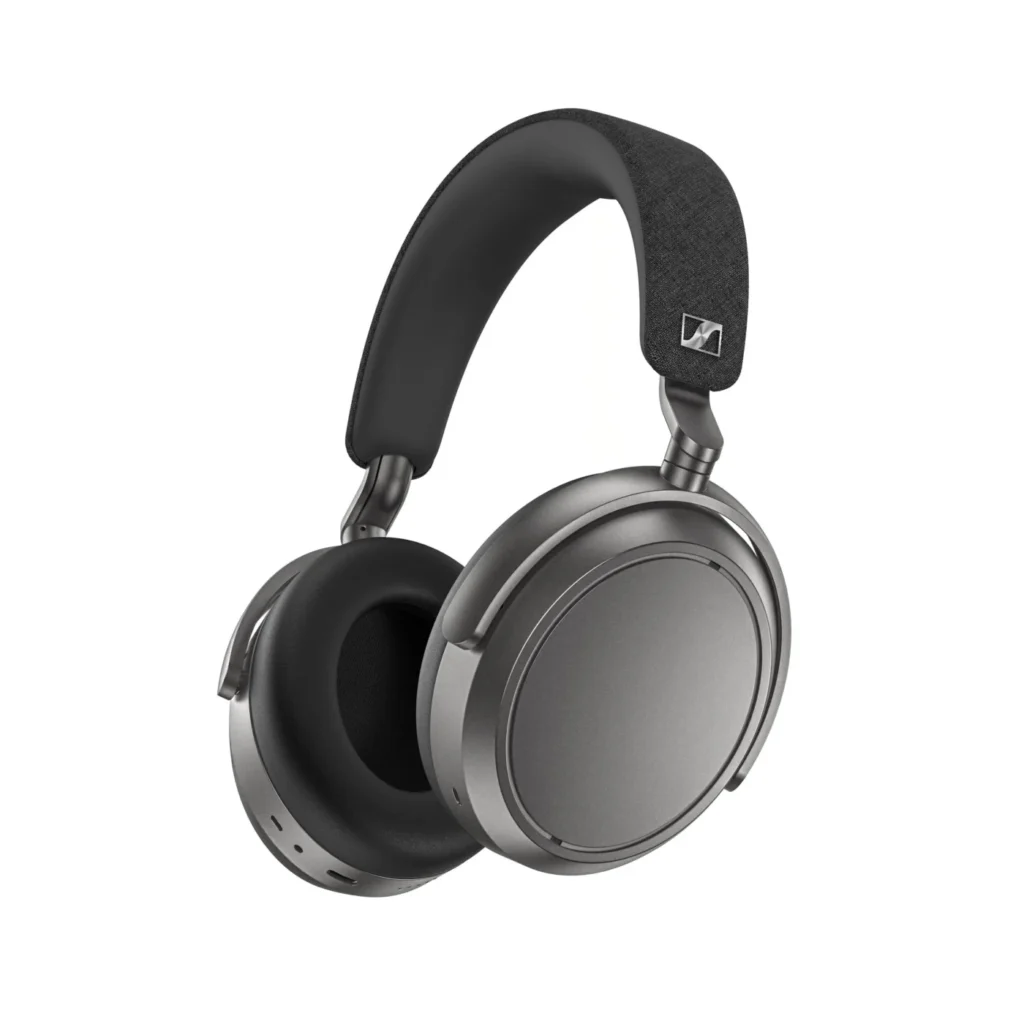
Sennheiser Momentum 4 Wireless is a particularly useful shortlist candidate when long trips and a phone-and-laptop routine matter as much as noise cancellation. It combines Bluetooth with analogue and USB listening, but the three connections do different jobs. Choosing it successfully means understanding those differences before relying on it for a journey or a working day.
Research note: This assessment uses manufacturer documentation and practical setup analysis. We have not performed hands-on listening, battery tests or independent measurements. Published performance figures are manufacturer claims.
Sennheiser Momentum 4 Wireless: weight, battery and connections
- Weight: approximately 293 g.
- Battery: up to 60 hours of Bluetooth music with ANC under Sennheiser’s stated test conditions.
- Multipoint: connections to two Bluetooth devices, with music from one source at a time.
- USB: a documented route for playback and microphone recording on a compatible source.
- Analogue: the supplied 2.5-to-3.5 mm cable offers a different listening route; it is not the same calling workflow.
Use Sennheiser’s official specification table and instruction manual for the conditions behind these headline answers.
What the 60-hour battery claim means for travel
The specification states Bluetooth playback with ANC, using an iPhone at mid volume. It is not a promise that a week of calls, loud listening and repeated device changes will produce the same total. Decide how much charging margin the actual itinerary needs rather than dividing 60 hours by the length of the commute and assuming the result is guaranteed.
Sennheiser lists approximately two hours for a full charge and up to four hours of playback from five minutes of charging; it also notes that temperatures above 30°C can extend charging time. Those details are more useful when preparing for a flight than the battery capacity alone. Check the remaining charge before departure and pack the cable needed for the intended source.
When comparing another headphone’s battery figure, keep its conditions alongside the number. ANC mode, codec, volume and the manufacturer’s test method can differ. A larger advertised maximum is a useful buying consideration, but it does not establish the result of a controlled comparison between the two products.
293 g does not settle the comfort question
The listed mass helps with packing, not with predicting pressure on an individual head. Try the pads and headband for a realistic session, including with glasses if normally worn. Check whether the cups remain seated when looking down at a laptop and whether the controls suit the way the headphones are adjusted during use.
For travel, assess the complete carrying routine as well: the case, the cable and the space left in the bag. A headphone that is comfortable at a desk can still be inconvenient to pack. The European product page describes the supplied package and current app features; regional availability and prices should be checked locally.
How two-device multipoint works
Momentum 4 attempts to reconnect to the last two connected Bluetooth devices and stores up to six pairing profiles. Playback comes from one device at a time. The distinction is important: multipoint is a convenience for moving between a phone and computer, not a way to mix two independent music streams.
For a working-day check, pair the phone and laptop, start a short piece of music, pause it and start playback on the other source. Then test a call in the application actually used for work. Select the intended microphone and output explicitly. If an app keeps the wrong audio device selected, repeatedly pairing the headphones may not address the real cause.
Keep the first test simple. Disconnect an unused third device while confirming the basic two-device workflow. Once that behaves as expected, add the rest of the routine. This separates a source or app setting from a genuine connection problem and makes the purchase decision more useful than relying on a feature badge.
USB audio and microphone: a practical computer setup
The manual documents playback and microphone recording over USB while the headphones charge. Its setup starts by disconnecting Bluetooth and selecting Momentum 4 as the source device’s audio input and output. A charging light alone is not evidence that the computer or meeting application has selected the headset.
- Connect a suitable data-capable USB cable to the intended computer or compatible mobile device.
- Select Momentum 4 as output in the system’s audio settings.
- Select the appropriate input separately, then check the meeting or recording application’s own device settings.
- Make a short test recording and listen back before the first important call.
This route is useful for someone who wants a cable at a desk and Bluetooth away from it. It still deserves a trial with the actual operating system, adapter and software. Successful music playback does not prove that the microphone is selected, and a working microphone does not demonstrate how background noise will sound to another caller.
What changes with the analogue cable?
Inserting the supplied analogue cable disables Bluetooth. The manual describes listening from a non-Bluetooth source or with an empty battery, but ANC requires power. Phone-call, voice-assistant and playback-control functions are not available in the same way through this route. Treat it as wired listening rather than a replacement for the documented USB headset connection.
That difference matters for an aircraft entertainment system, a desktop audio output and a phone adapter. Before travelling, identify the required socket and cable. Before choosing it for daily meetings, establish whether the intended route provides the microphone and controls needed for that job.
Alternatives and the buying decision
Compare our Sony WH-1000XM6 review if the fold-and-pack routine and Sony’s controls are the main attraction. Its documented wired-listening route differs from Momentum 4’s USB workflow. Read both connection sections rather than assuming all premium Bluetooth headphones do the same job when plugged in.
For a less expensive Sennheiser option, use the ACCENTUM Plus review to compare the features that would actually be used. A price saving is worthwhile when the missing functions are irrelevant; a cheaper model is less useful if it forces an unwanted change to calls or commuting.
Sennheiser Momentum 4 Wireless key specifications
- Design
- Closed-back circumaural wireless headphones
- Driver
- 42 mm dynamic driver
- Wireless
- Bluetooth 5.2 Class 1
- Bluetooth codecs
- SBC, AAC, aptX and aptX Adaptive
- Frequency response
- 6 Hz–22 kHz
- Noise control
- Hybrid adaptive ANC
- Microphones
- Four MEMS microphones with beamforming
- Battery life
- Up to 60 hours via Bluetooth with ANC; iPhone at mid volume (manufacturer test)
- Charging
- USB-C; about 2 hours full charge, 5 minutes for up to 4 hours playback
- Weight
- Approximately 293 g
- Wired listening
- 2.5 mm to 3.5 mm audio cable included
- USB audio
- Playback and microphone input while charging; select input/output on source
- Analogue mode
- Disables Bluetooth; call, assistant and playback-control functions unavailable
- Passive listening
- Analogue playback with empty battery; ANC requires charge
View the official Sennheiser Momentum 4 Wireless product page
Verdict
Sennheiser Momentum 4 Wireless offers a documented combination of a long ANC battery claim, two-device Bluetooth use and a flexible USB connection. That makes it worth considering for someone whose headphones move between work and travel. Its 293 g specification and feature list cannot settle comfort or call quality for every wearer, so confirm the fit and daily connection routine before buying. Explore our headphone reviews and comparison tool for the broader shortlist.
When is the Momentum 4 Wireless the smarter choice?
Momentum 4 Wireless stands out when battery life and sound priorities carry more weight than having the most aggressive noise cancellation. Its 60-hour claim, aptX Adaptive and multipoint support make it especially relevant for listeners who use one headphone across work, travel and home listening.
Best fit
Listeners who want long battery endurance, flexible Bluetooth support and a sound-first alternative to the most ANC-focused flagships.
Look elsewhere if
Buyers who want the strongest possible isolation, the most compact travel design or deeper Apple-specific integration.
Compare before buying
Compare this product with Sony WH-1000XM6 and Bose QuietComfort Ultra Headphones 2, then see our Best Headphones ranking for the wider category.
Review method: This is a research-based evaluation built from manufacturer documentation, established test findings, long-term owner patterns and current alternatives. It is not presented as a hands-on laboratory test.
Editorial record
Sources and updates
Product specifications and factual claims were checked against Official Sennheiser Momentum 4 Wireless product page ↗. Scores and buying advice follow our category-specific editorial methodology.
- Published
- July 1, 2026
- Last updated
- November 8, 2026