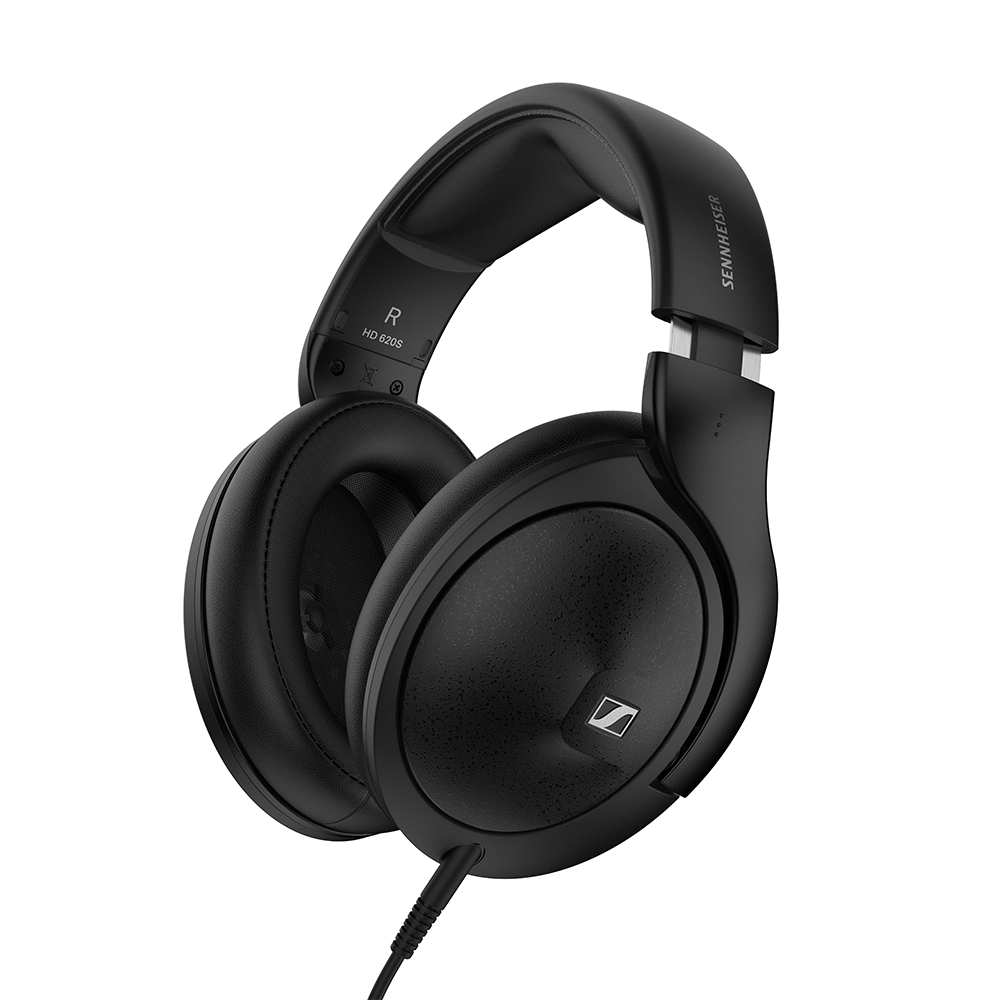
The Sennheiser HD 620S gives the familiar wired home headphone a useful change of direction: closed earcups. It addresses a practical problem for listeners who enjoy a quiet, detailed presentation but cannot let music spill freely into a shared room. Its appeal is more specific than a general claim that closed headphones have finally become indistinguishable from open ones. The HD 620S should be judged as a complete listening arrangement, including the fit, the headphone output and the room in which it will actually be used.
Research-based review. This assessment draws on manufacturer documentation and the original independent evaluations linked below. Audio Review has not performed a hands-on test of this model.
Closed-back design and intended use
Sennheiser places the HD 620S within its enthusiast range while using a chassis that is visibly related to its more accessible home headphones. The closed cups are the important change. They put a barrier between the rear of the drivers and the room, which makes the design relevant when another person is reading, working or sleeping nearby. That barrier does not turn the headphone into an electronic noise-cancelling travel model.
The distinction matters when deciding where to spend money. A desk shared with another person presents a different problem from a bus engine or aircraft cabin. For the former, reducing outward leakage may be enough. For the latter, an ANC headphone can be a much more practical purchase. The HD 620S makes most sense when the cable and physical size are acceptable and home listening remains the main activity.
Fit, build and long sessions
The official construction includes steel reinforcement in the sliders and earcup covers. A detachable cable also avoids making a damaged lead the end of the headphone’s useful life. These are sensible ownership details, although neither a metal component nor a replaceable lead can tell you whether the pads will sit comfortably around your own ears.
What Hi-Fi?’s reviewers were divided over the clamping pressure, with some finding it too firm during longer sessions. Treat that as a reason to try the headphone, rather than as a guarantee that it will be uncomfortable. Check it while wearing your usual glasses and moving your head naturally. A fit that feels secure during a brief demonstration can become tiring later. Pad contact also affects the seal, so comfort and sound should be assessed together instead of as unrelated checklist items.
Sound quality and the published evidence
What Hi-Fi? describes a relatively relaxed, spacious and detailed presentation for a closed-back design, while also stopping short of presenting it as a precision monitoring reference. That supports a recommendation for attentive home music listening. It does not justify promising that every recording will have the same apparent width or that the headphone will reproduce the physical placement of loudspeakers.
For a useful audition, include a familiar voice, a dense arrangement and a bass part whose notes you can follow. Listen for whether the vocal remains easy to understand without raising the level, and whether individual low notes remain distinct. Then repeat at an ordinary daily volume. An exciting demonstration played unusually loudly is a poor substitute for finding a balance you want to live with. Personal response to treble and pad fit can matter more than a broad description such as detailed or smooth.
Amplification and source matching
The HD 620S is a 150-ohm wired headphone. Impedance is relevant to the electrical load, but it is not a complete measure of how much output a headphone needs. The source’s available voltage, its noise and the sensitivity of the headphone also matter. There is therefore no sound basis for declaring that every phone needs a large amplifier, or that every laptop headphone socket will give identical results.
Start with the source you already own. It should reach your normal listening level cleanly, with useful adjustment left on the volume control. If it cannot, consider a suitable DAC and headphone amplifier. If it can, spend time on fit and familiar music before buying more hardware. The optional use of a different cable does not automatically improve the acoustic performance; connector compatibility and safe levels come first.
Isolation, leakage and shared spaces
The closed enclosure is a practical advantage over an unrestricted open back, but passive isolation varies with frequency and fit. It should not be described as silence. Voices can remain audible, and a poor pad seal can undermine both isolation and low-frequency consistency. Check the real environment rather than relying only on the product category.
If privacy is the main reason for choosing the HD 620S, ask another person to sit at the distance they would normally occupy while you play music at a reasonable level. This simple check answers a different question from whether you can hear outside noise. It also avoids assuming that raising the volume is the correct response to a noisy room. For calls, the supplied listening cable has no microphone, so plan a separate input device.
Everyday handling and portability
The headphone’s wired operation removes pairing, charging and firmware management from the listening routine. That simplicity can be attractive for a permanent chair or desktop system. It also leaves the cable as a physical object that has to be routed around a keyboard, chair arm or equipment rack. Choose the connection and cable length for the actual layout of the system.
The bulky, non-folding form is less appealing for a small travel bag. A carrying pouch provides basic separation from other objects, but should not be confused with a rigid protective case. There are no onboard wireless controls or battery features to rescue a mismatched use case. If frequent travel and quick phone calls occupy most of your listening time, a different product format is likely to provide more useful value.
Value and the complete system
Value depends on the job the HD 620S solves. Paying more than a basic closed headphone can be reasonable if its fit and sound make it the one you use every day. Paying for an additional amplifier before establishing that your existing output is inadequate can make an otherwise sensible purchase unnecessarily expensive.
Compare local prices with the cost of any genuinely required accessories, then include a return policy in the decision. A comfortable lower-priced headphone can be better value than a technically interesting model whose clamp makes you shorten every session. Equally, an open headphone that measures attractively is not a bargain if it cannot be used in your shared room. The useful comparison is the complete, usable arrangement, rather than the headphone price in isolation.
Alternatives to consider
Sennheiser HD 600: The HD 600 is the more traditional open-back comparison for a genuinely quiet room. Choose between them by leakage and isolation requirements before debating small tonal preferences; they are different acoustic arrangements, rather than successive versions of the same headphone.
FiiO FT1: The FT1 offers another closed-back route at a lower market position. Compare the current local package, comfort and tuning rather than treating the Sennheiser name or the higher nominal impedance as proof of better sound.
Sennheiser HD 620S key specifications
- Design
- Closed-back, over-ear
- Driver
- Angled 42 mm dynamic transducer
- Nominal impedance
- 150 ohms
- Connection
- Wired, detachable single-sided cable
- Supplied cable
- 1.8 m; 3.5 mm plug and 6.35 mm adapter
- Noise control
- Passive isolation; no active noise cancellation
- Microphone
- None in the supplied cable
- Weight
- Approximately 350 g without cable
- Frequency response
- 6 Hz–30 kHz (manufacturer specification)
Verdict
The HD 620S is a sensible candidate for listeners who want a conventional wired music headphone with better containment than an open design. Its published listening assessments, detachable cable and practical construction support that role. The firm fit reported by some reviewers remains the most immediate qualification, and an audition is particularly worthwhile for glasses wearers.
Choose it for a home setup where passive isolation and reduced leakage solve a real problem. Check your existing headphone output before adding an amplifier, and compare a less expensive closed model at the same listening level. If the environment is quiet enough for open headphones, the HD 600 and HD 560S remain relevant alternatives; if travel noise is the problem, look towards a suitable ANC design. The HD 620S earns its place through a clear use case, not through a promise to replace every other headphone.
Primary documentation and independent reviews
Sennheiser official HD 620S product information · What Hi-Fi? original HD 620S review · RTINGS original HD 620S test
Editorial record
Sources and updates
Product specifications and factual claims were checked against Official Sennheiser HD 620S product page ↗. Scores and buying advice follow our category-specific editorial methodology.
- Published
- November 17, 2026
- Last updated
- November 17, 2026