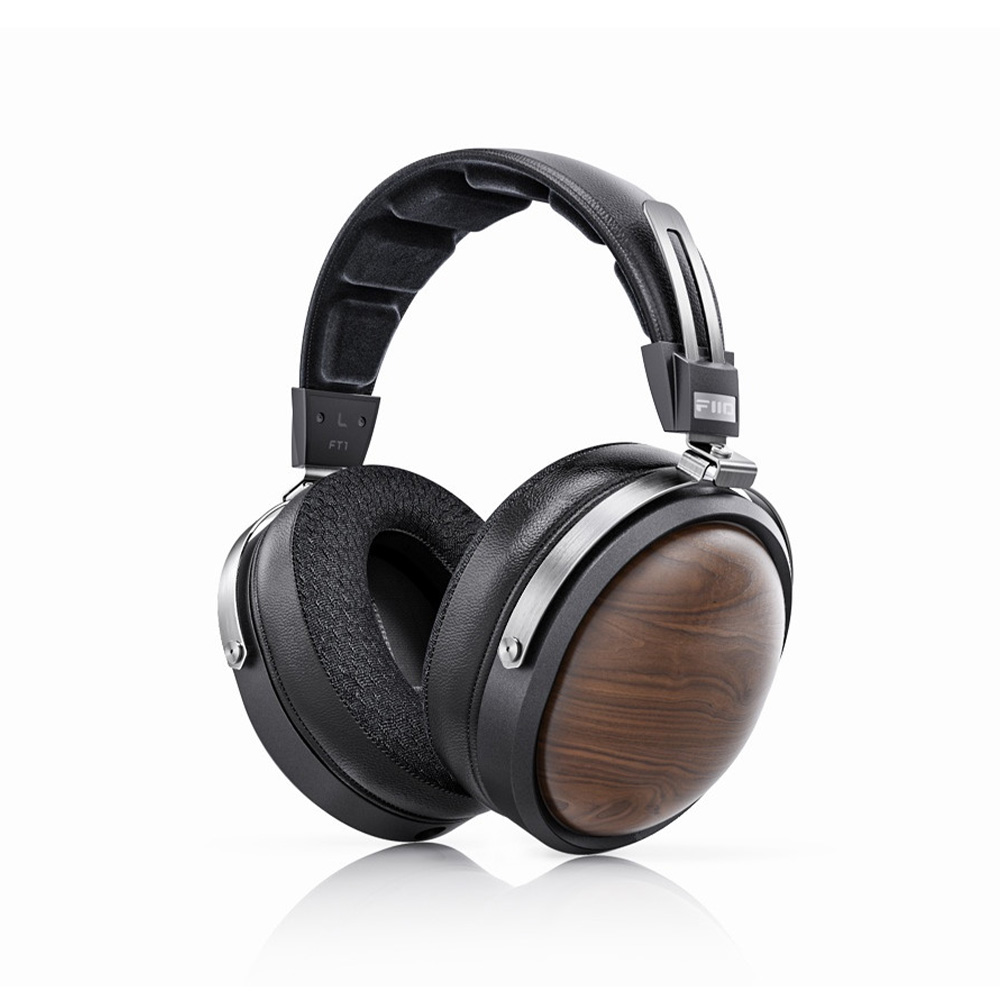
The FiiO FT1 targets one of the most useful parts of the headphone market: an affordable wired model that can deliver enjoyable music without demanding a silent private room. Its wooden cups and generous accessories make it look ambitious, but the more important question is whether the complete package solves a real listening problem better than similarly priced open headphones or wireless alternatives.
FiiO FT1 — What the FT1 actually is
The FT1 is a closed-back dynamic headphone with a 60 mm driver. It is not the open planar FT1 Pro, despite the closely related name. That distinction changes isolation, leakage, fit expectations and the kind of system in which it makes sense. Choose the original FT1 because its particular construction suits the listening environment, rather than treating Pro as an automatic upgrade path.
FiiO lists 32-ohm impedance and sensitivity of 98 dB per milliwatt at 1 kHz, equivalent to its stated 113 dB per volt. The specification indicates a relatively accessible load for a competent headphone output. It does not mean that every device with a socket behaves identically or that the source cannot introduce noise.
The wooden exterior is a welcome alternative to plain plastic designs. It should be evaluated as part of the product’s construction and appearance rather than a promise that wood creates a particular musical character. The tuning depends on the complete acoustic system, including the pads and the space enclosed around the ear.
Sound quality and published evidence
Headfonics’ original review describes a rich, enjoyable balance with substantial bass, while noting that strong bass lines can crowd the presentation. It also criticises the stiffness of the cables. Headphones.com independently presents the FT1 as a particularly strong budget closed-back contender. Together, those accounts support a positive value assessment without establishing that every listener will prefer its balance.
The most relevant audition question is whether bass weight leaves voices sufficiently clear on your own recordings. Try a dense rock mix, a lightly accompanied singer and a track with sustained electronic bass. A headphone can sound engaging with one arrangement but make another feel crowded. This is a preference decision rather than something resolved by the size of the driver.
A fuller presentation can be a benefit for relaxed listening at modest levels. It can also be less useful for someone seeking a strictly neutral monitoring reference. If the goal is mixing, compare the result on established speakers or another familiar headphone before making major tonal decisions from the FT1 alone.
For acoustic music, pay attention to the shape of low notes rather than only their quantity. The attack of a plucked bass and the resonance that follows should remain distinguishable. With bright recordings, check whether percussion stays comfortable over several songs. These comparisons reveal more than turning up one impressive demonstration track.
Comfort and isolation
The official listed weight is approximately 340 g without the cable. That is not exceptionally light compared with basic studio headphones, so the headband and pad shape deserve attention. A comfortable fit for one reviewer cannot predict whether the lower cup edge presses on a different jaw or whether ears touch the inside.
Closed construction is helpful when some separation from the room is needed, but the FT1 has no active noise cancellation. It should not be bought with the expectation of matching good travel headphones against a train or aircraft’s low-frequency noise. Its larger wired form also makes it more naturally a home or desk product than a commuting companion.
The seal is important. Glasses, thick hair or an uneven pad position can change bass response and isolation. When auditioning, use your usual glasses and try moving your head as you would during normal work. A balance that depends on holding perfectly still may be less satisfactory in everyday use.
For recording, reduced leakage compared with an open headphone can be useful, but it does not guarantee silence at a nearby microphone. Check the actual microphone position and monitoring level. Lowering unnecessary headphone volume is often more effective than assuming a closed cup cannot leak.
Cables and source matching
FiiO supplies separate 3.5 mm single-ended and 4.4 mm balanced cables, with a 6.35 mm adapter for the single-ended connection. Both cables connect to the earcups through dual 3.5 mm plugs. This is a useful package because the owner can connect to common portable and desktop outputs without immediately shopping for another cable.
Use the cable that matches the amplifier’s intended output. A balanced socket may offer more power on a particular device, but it is not intrinsically a guarantee of audible improvement. Avoid improvised adapters that short the active channels of a balanced output. A straightforward single-ended connection is entirely appropriate when it supplies enough clean level.
The included cables’ handling matters at a desk. If the lead drags across clothing or pushes against a chair arm, route it differently before deciding that the headphone itself is uncomfortable. A future replacement can improve flexibility, but spending heavily on cable materials would be difficult to justify ahead of fit or a better source connection.
Start with a sensible low gain setting. The desired result is a wide useful volume range with no hiss and sufficient reserve on quiet recordings. If a laptop or compact DAC already provides that, the FT1 does not automatically need an expensive amplifier. Allocate the budget according to a demonstrated limitation.
Ownership and buying advice
The FT1 is most persuasive as a practical listening tool with an unusually appealing package for the money. It serves someone who wants wired operation, some room separation and a fuller musical balance without entering a high-end system. It is less suitable if the priority is wireless calls, a tiny travel bag or strong active noise cancellation.
Before ordering in Europe, compare the authorised warranty, return policy and exact wood finish or package. Availability and discounts change, so a historical launch price should not be treated as the price you will necessarily pay. A local offer with reliable support can be worth more than a small saving from a difficult return route.
Replacement pads are an ownership consideration because their condition affects both fit and sound. Keep the originals in good condition and be cautious about unverified aftermarket substitutions. A different pad can change the tuning enough that an old review no longer describes the resulting headphone.
The strongest value comparison is the cost of a complete usable setup. If the FT1 works from the source already owned and includes the required cables, that simplicity is a genuine advantage. If it requires changes to accommodate a poor personal fit, a different headphone may be the better purchase despite a less generous box.
Alternatives to consider
Audio-Technica ATH-M50x: A familiar closed-back alternative with a different fit and tonal balance; compare comfort and everyday handling as well as sound.
Beyerdynamic DT 770 Pro: An established closed studio design with several impedance versions; check the exact version and source requirements before comparing.
HiFiMAN Sundara: An open planar alternative for a quiet private room, rather than a direct replacement when leakage is the reason for choosing the FT1.
FiiO FT1 key specifications
- Driver
- 60 mm dynamic
- Design
- Closed-back
- Impedance
- 32 ohms
- Sensitivity
- 98 dB/mW or 113 dB/V at 1 kHz
- Weight
- Approximately 340 g without cable
- Cables
- 3.5 mm single-ended and 4.4 mm balanced
Verdict
The FiiO FT1 is a strong-value closed-back headphone with an engaging balance, appealing construction and useful included cables. Its bass character and fit should suit the buyer before the accessories decide the purchase. It is especially convincing for affordable home listening, provided passive isolation is enough and wireless features are unnecessary.
Primary documentation and independent reviews
FiiO FT1 official product information · FiiO FT1 basic specifications · Headfonics original FT1 review · Headphones.com original FT1 review
Editorial record
Sources and updates
Product specifications and factual claims were checked against Official FiiO FT1 product page ↗. Scores and buying advice follow our category-specific editorial methodology.
- Published
- November 7, 2026
- Last updated
- November 8, 2026