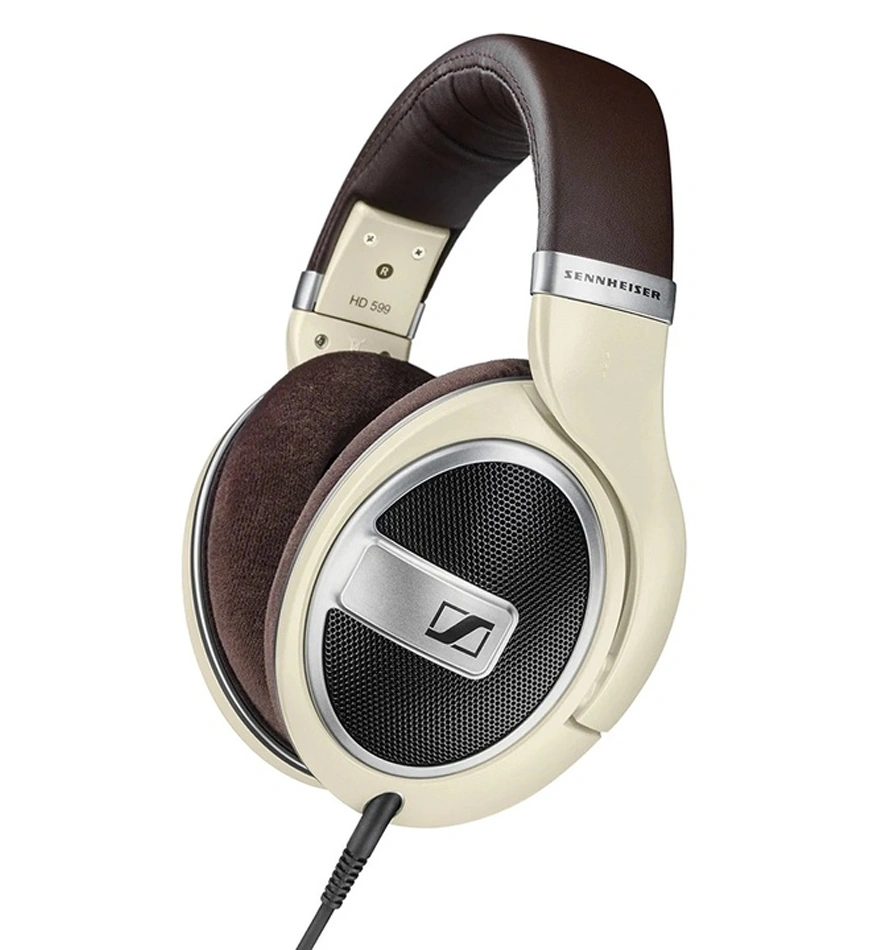
Sennheiser HD 599 is an open-back wired headphone with a strong emphasis on comfortable home listening. It supplies two removable leads and uses a light over-ear structure, making it easy to understand as a quiet-room companion. Its warm tonal character is part of the decision rather than a universal advantage. The buyer should want that balance and have a suitable private space, because this is neither an isolating travel headphone nor a guarantee of neutral studio monitoring.
Research-based review. This assessment draws on manufacturer documentation and the original independent evaluations linked below. Audio Review has not performed a hands-on test of this model.
A home headphone before a portable one
The open cups let outside sound in and music out. That makes the HD 599 suitable for a quiet private room, but less appropriate beside someone trying to work or sleep. The shorter supplied lead does not turn an open headphone into a discreet commuting design.
Check the room as well as the source. Traffic, a loud computer fan or conversation can mask quieter details and tempt the listener to increase volume. A closed headphone may be the better purchase if those conditions are routine. An open design is worthwhile when its physical and listening qualities can be enjoyed without fighting the environment. Choosing the right setting is more important than assuming open construction is automatically superior in every use.
Comfort is a central strength
SoundGuys’ original evaluation is particularly positive about long-session comfort. The official weight is two hundred and fifty grams, and the over-ear design uses replaceable pads. Those are encouraging details, but individual ear clearance, pressure and headband fit still need a personal check.
Try the headphone with glasses if normally worn and include the posture used for reading or working. A fit that is comfortable upright may change when leaning back or looking down. The benefit of a comfortable headphone is not merely luxury: it can make ordinary listening easier and less distracting. If the cups require continual adjustment, compare another shape before deciding that a favourable review must apply identically to you.
The warm balance and its trade-off
SoundGuys’ measurements and listening assessment identify an emphasis where bass meets the lower midrange, with reduced energy at the lowest and highest extremes. Its review finds the result enjoyable with some material but less suitable as a universal accuracy reference. That is a more useful description than assuming an open headphone must sound lean or perfectly neutral.
Try dense arrangements as well as simple vocals. Listen for whether bass warmth gives a pleasing sense of body or makes instruments harder to separate. A preference for warmth is legitimate, but the same balance need not suit every recording. If clarity through complicated passages is the main priority, compare HD 560S rather than attempting to infer the result from the size of the driver or the claimed frequency range.
What the frequency specification does not establish
The manufacturer’s wide frequency-range figure describes an advertised operating range, not a flatness guarantee across that range. It does not mean the owner hears every stated extreme or that the headphone reveals more useful detail than a model with a narrower headline specification.
For a buying decision, the balance through voices and instruments is more relevant. Compare using familiar material at a comfortable level and avoid turning up simply to make a quieter presentation sound more impressive. If EQ is available from the source, modest adjustment can be worth trying, but it is sensible to choose a headphone whose basic character you already enjoy. A specification should clarify compatibility and design, not replace listening preference.
Cables and everyday source connection
The official package lists a long lead with a larger plug and a shorter lead with a three-and-a-half-millimetre plug, plus an adapter. That covers different home arrangements without forcing every owner to manage excess cable. Choose the lead appropriate to the listening position and keep adapters from putting unnecessary leverage on a small source socket.
The removable connection is useful for replacement, but check the matching connector and locking arrangement. A similar-looking plug is not necessarily a compatible substitute. There is no microphone or wireless connection, so calls and walking around the room require a different plan. A simple wired headphone can be exactly right for a chair and a music source, provided those are the activities for which it is being purchased.
Does it require a separate amplifier?
The nominal impedance is fifty ohms. That figure alone cannot determine whether a particular phone adapter, computer or headphone amplifier is suitable. Try the existing source first and check that it provides a comfortable level, quiet background and usable volume range.
An additional amplifier can solve a specific output limitation or make physical control more convenient. It should not be treated as a mandatory accessory before establishing that limitation. If the existing source is already clean and sufficient, spending the same money on a different headphone balance may produce a more meaningful change. Compare with similar perceived level so that a louder output does not masquerade as a better match. System simplicity can be a strength when every component already does its job.
Construction, maintenance and current value
The mostly plastic structure is light, and the original review considers the build ordinary for the price rather than unusually luxurious. Replaceable pads and cables are practical ownership advantages. Check that the correct parts remain available locally and include them in a used-purchase calculation if wear is visible.
The HD 599 has been sold for many years, so compare the current price with HD 560S and other open models rather than relying on its launch positioning. Different finishes or special-edition names should not become a reason to buy duplicate headphones for an assumed new listening experience without evidence. The value case is strongest when the comfortable fit and warm balance are the qualities you actually want, at a price competitive with the alternatives on sale.
Alternatives to consider
Sennheiser HD 560S: HD 560S is the first comparison if a more analytical listening preference is important. Use the same source and similar perceived level, and compare current prices rather than treating the higher HD 599 number as proof of a better match.
Sennheiser HD 600: HD 600 offers another open-back route at a different price and drive requirement. Try its fit and source pairing before paying more; the useful choice is the complete listening experience rather than a progression through model names.
Sennheiser HD 599 key specifications
- Design
- Open-back, over-ear, dynamic
- Driver
- 38 mm
- Impedance
- 50 ohms
- Weight
- 250 g
- Cables
- Removable 3 m and 1.2 m leads
- Source plugs
- 6.3 mm and 3.5 mm cable options; adapter included
- Pads
- Replaceable
- Wireless / ANC / microphone
- None
- Intended environment
- Quiet private listening
- Frequency response
- 12 Hz–38.5 kHz (manufacturer specification)
Verdict
HD 599 is a comfortable and approachable open headphone for private home listening, especially for someone who enjoys a warmer presentation. The removable leads and pads support sensible ownership, while the original evaluation gives clear context for the tonal compromises.
Compare HD 560S if accuracy or a different balance is the priority, and choose a closed design where leakage is a problem. The HD 599 is best bought for its fit and sound at the current price, rather than for its styling, wide frequency headline or position in the model-number sequence.
Primary documentation and independent reviews
Sennheiser official HD 599 product and technical information · SoundGuys original HD 599 evaluation
Editorial record
Sources and updates
Product specifications and factual claims were checked against Official Sennheiser HD 599 product page ↗. Scores and buying advice follow our category-specific editorial methodology.
- Published
- November 17, 2026
- Last updated
- November 17, 2026