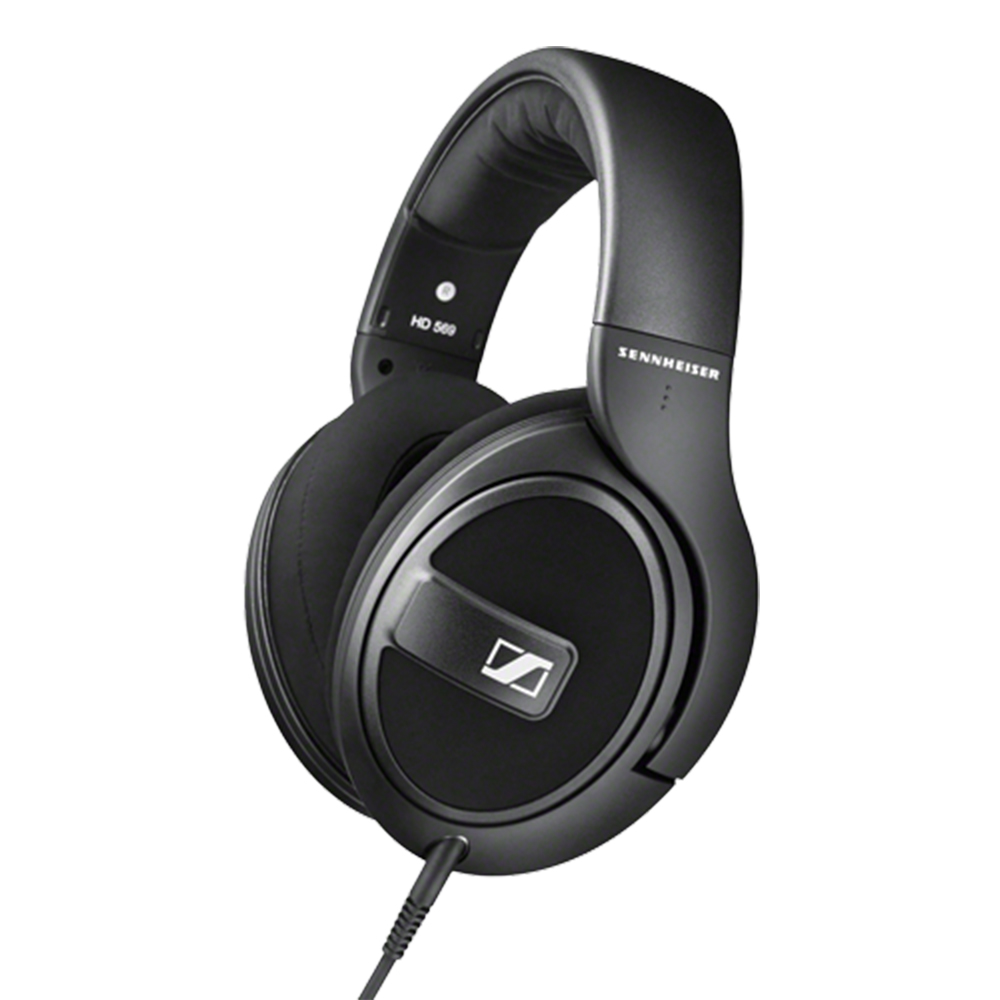
Sennheiser HD 569 is a closed-back wired headphone for listeners who want a straightforward home connection and an occasional call option. Two detachable cables give it more flexibility than a fixed long lead, while the passive design avoids charging and wireless pairing. It is an established model rather than a new release. Its appeal is practical, but the original listening review raises enough questions about treble sharpness and bass control to make a personal audition important.
Research-based review. This assessment draws on manufacturer documentation and the original published evaluations linked below. Audio Review has not performed a hands-on test of this model.
Where a closed wired design makes sense
The closed cups reduce the direct exchange of sound with the room compared with an open headphone. This is passive isolation, not electronic noise cancellation. It should not be treated as silence in every environment or a guarantee that nearby people can never hear playback.
For shared home listening, first decide how much isolation is required. A headphone that sounds appealing in a quiet demonstration may need a different volume setting beside a television or household conversation. Test at a comfortable level and check whether it allows the intended activity without competing with the room. If the main use is commuting with strong low-frequency noise, compare a suitable ANC model as well. If the room is already quiet, an open alternative becomes a reasonable option rather than a missing feature.
A lively presentation with specific reservations
Headphonecheck’s original evaluation finds strong perceived clarity and useful speech intelligibility, but warns that treble can become sharp with some recordings. It also identifies bass resonance and reduced control at higher levels. That is more nuanced than calling the HD 569 universally neutral or especially suitable for every film effect.
Use familiar recordings with vocals, cymbals and sustained bass to assess the balance. Keep the volume moderate and compare at similar perceived level with another candidate. A bright presentation can make detail obvious during a quick demonstration while becoming less comfortable over a longer session. Conversely, a listener who enjoys that energy may find it appealing. The useful decision is whether the character suits the actual material and listening duration, not whether a single favourable adjective appears in a review.
Two cables and a useful microphone option
The documented cable arrangement includes a longer home lead and a shorter lead with an inline microphone and one-button remote. A detachable connection also makes a cable fault less consequential than it would be with a permanently attached lead.
Check the source socket and adapter before assuming both sound and microphone will work. A computer with separate microphone and headphone sockets may need an appropriate splitter, while a phone without an analogue socket needs a compatible adapter. A connector that passes stereo audio does not establish that it passes the microphone correctly. Try a real call or recording in the intended application. The short lead can make the HD 569 more convenient at a desk, but it is not the same arrangement as a dedicated boom microphone positioned near the mouth.
Comfort should be checked over time
The over-ear design uses replaceable soft pads, but the right fit still depends on head width, ear position and any glasses being worn. A manufacturer’s comfort description cannot establish that the seal and pressure suit every listener.
Try the headphone for long enough to notice pressure and warmth, with the headband adjusted rather than simply stretched. Move the cups slightly and listen for a change in bass, which can help reveal an inconsistent seal. Do not judge a used example only by the condition of the outer shell. Compressed pads may change fit and the acoustic relationship around the ears. Include the cost of appropriate replacements when comparing an older pair with new stock, and confirm that replacement parts suit the exact model.
Source matching without an unnecessary amplifier purchase
The nominal impedance is low, but that number alone does not describe every source’s performance or the listening level someone will prefer. Begin with a competent headphone output or compatible adapter rather than assuming a separate desktop amplifier is required.
Check for clean playback, useful volume adjustment and the absence of obvious hiss or distortion at normal levels. If an output struggles, compare another known source before changing several parts of the system. Buying extra amplification solely because a headphone is described as hi-fi can consume the budget that might otherwise buy a more suitable headphone. The HD 569’s practical advantage is its simple analogue role. Preserve that simplicity unless there is a specific source problem or connection requirement that an additional device would solve.
Value in an older wired model
Current price, condition and support matter more than the original launch positioning. Compare the complete purchase, including any adapter and replacement pads, with alternatives that satisfy the same isolation need. A discounted older model is attractive only when its particular compromises remain acceptable.
For games and films, try dialogue as well as effects and confirm that the cable reaches the seat safely. For music, prioritise the tonal balance and sustained comfort over extra maximum volume. There is no battery to age or application to keep running, which can make ownership straightforward. That benefit does not compensate for a sound signature the listener dislikes. The sensible purchase is one that combines an appropriate connection, acceptable fit and a presentation that remains enjoyable beyond the first few tracks.
Alternatives to consider
Audio-Technica ATH-M50x: ATH-M50x is another closed wired option worth trying with the same source. Compare tonal balance, fit and cable practicality rather than assuming a studio label makes one model automatically more accurate.
Sennheiser HD 560S: HD 560S is relevant if the listening room is quiet and an open design is acceptable. It answers a different isolation requirement, so the decision should begin with the environment before comparing tonal preferences.
Sennheiser HD 569 key specifications
- Design
- Closed-back over-ear
- Transducer
- Dynamic, 38 mm
- Nominal impedance
- 23 ohms
- Connection
- Wired analogue
- Cables
- Detachable 3 m and 1.2 m options
- Home cable plug
- 6.3 mm
- Short cable plug
- 3.5 mm with inline remote and microphone
- ANC
- No
- Bluetooth
- No
- Battery
- Not required
- Weight
- 300 g
- Frequency response
- 10 Hz–28 kHz (manufacturer specification)
Verdict
HD 569 offers a useful mixture of closed-back listening, detachable cables and a short-lead microphone. It can make sense for a desk or home system where those features are more valuable than wireless operation.
The original review’s treble and bass reservations deserve an audition with familiar material. Compare the M50x for another closed approach and HD 560S when isolation is unnecessary. Choose the Sennheiser for a combination of fit, sound and practical connections at a sensible current price, rather than for an assumption that every model in the HD family has the same tuning or intended role.
Documentation and original reviews
Sennheiser official HD 569 product and specifications · Headphonecheck original HD 569 listening and handling test
Editorial record
Sources and updates
Product specifications and factual claims were checked against Official Sennheiser HD 569 product page ↗. Scores and buying advice follow our category-specific editorial methodology.
- Published
- November 17, 2026
- Last updated
- November 17, 2026