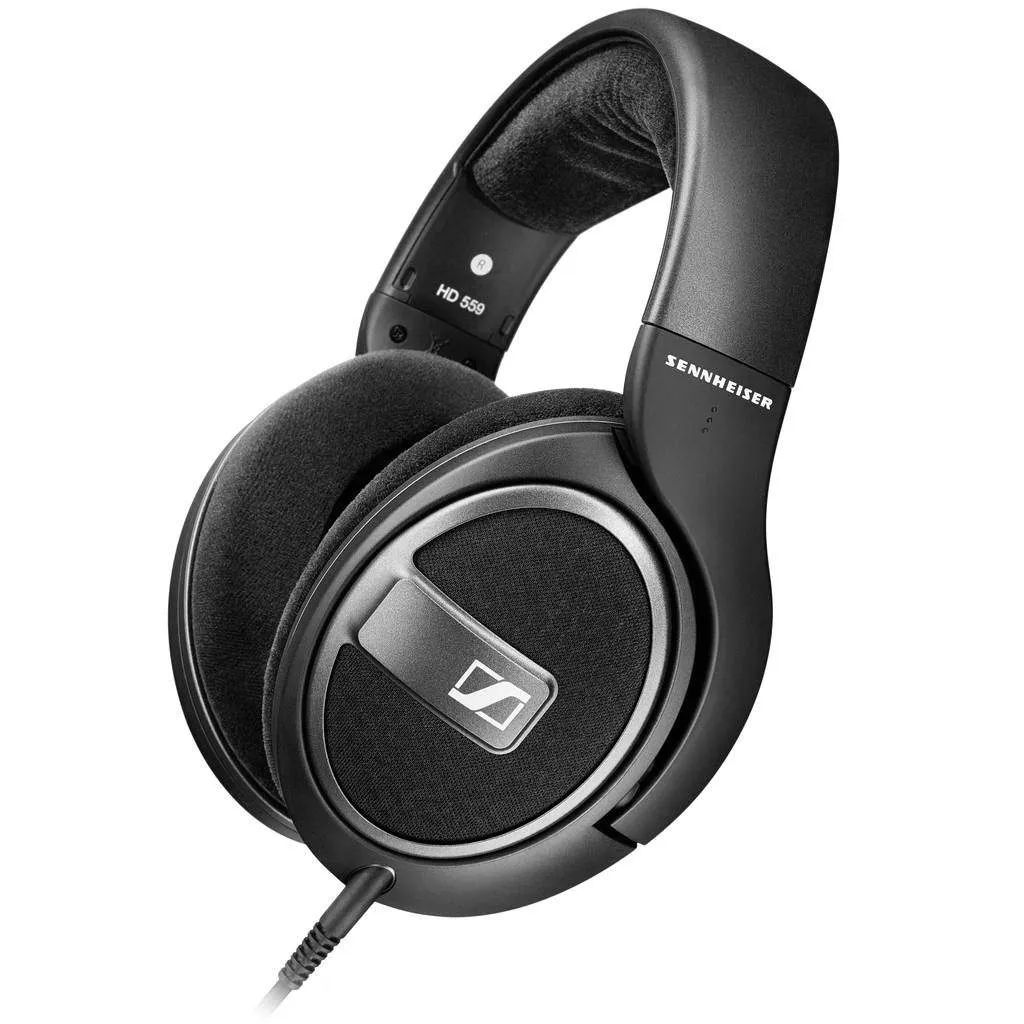
Sennheiser HD 559 is an established open-back headphone designed around wired home listening. It offers large padded cups, a detachable long cable and a straightforward connection to suitable audio equipment. It does not try to replace a commuter ANC headphone or a microphone-equipped gaming headset. The attraction is an affordable, comfortable route into open listening, with a sound that the original test finds enjoyable but less defined and revealing than more ambitious alternatives.
Research-based review. This assessment draws on manufacturer documentation and the original published evaluations linked below. Audio Review has not performed a hands-on test of this model.
Begin with the room rather than the model number
An open headphone exchanges sound with the surrounding space. Household conversation can remain audible, while the music may be heard by someone nearby. This is part of the design decision, not a pairing fault or a missing application setting.
Choose the HD 559 for a place where that behaviour is acceptable. A quiet desk, reading chair or private room is a more natural setting than a shared office or noisy commute. If isolation is necessary, compare a closed model before deciding that the open presentation is worth the compromise. Do not raise volume merely to overpower an unsuitable environment. A headphone that fits the room can be more useful than a higher-ranked model whose basic acoustic design conflicts with the way it will be used.
An enjoyable balance with limits to definition
Headphonecheck’s original review praises comfort and a pleasing overall presentation at the price, while finding the bass rather heavy and less clearly defined. It also wants more brilliance and fine articulation in the upper range, and regards HD 560S as a more capable all-round performer.
This supports an audition focused on the difference between fullness and clarity. Use a busy arrangement, a natural voice and a recording with a clearly followed bass line. Decide whether the warmer impression makes listening inviting or obscures information you want to hear. A relaxed music headphone need not be selected by the same priorities as a tool for checking a mix. What matters is recognising that preference instead of describing the HD 559 as an automatically neutral reference merely because it uses an open enclosure.
Comfort, adjustment and the state of the pads
The official design provides broad padding and replaceable ear pads. The original test also finds the fit comfortable. That is encouraging evidence, but a personal trial remains useful because ears, glasses and head shape change the experience.
Adjust the headband and allow time to notice pressure rather than deciding from a momentary fit. A long home session may reveal warmth or contact that was not obvious at first. With used stock, examine whether the pads have flattened or become uneven. Replacement parts should suit the model and preserve the intended fit, rather than being chosen only by appearance. Comfort and condition affect how often the headphone will actually be used. A small initial saving can disappear if the pair needs immediate restoration before it feels pleasant to wear.
The long cable and the source connection
The documented package has a detachable three-metre cable ending in a 6.3 mm plug. That is convenient beside a conventional amplifier or audio interface with the appropriate socket. It is less tidy beside a phone or laptop using a small adapter.
Plan the cable route so it does not pull against the headphone or create a loop across a walkway. If an adapter is required, use an appropriate one and consider the mechanical load on a small source socket. There is no inline microphone in the supplied arrangement. For calls or online games, budget for a separate microphone if needed rather than assuming the headphone becomes a headset through a plug change. The simple connection is a strength when it matches the system already in place.
Listening and production require different expectations
The HD 559 can be connected to suitable recording equipment, but that does not make its tuning an unquestioned guide for every production decision. The original evaluation’s reservations about definition and fine detail are relevant when the task is judging a mix rather than enjoying a finished recording.
For creative work, learn familiar reference material and cross-check important decisions on another trusted playback system. If tracking near an open microphone, consider whether sound leaking from the open cups will be picked up. A closed monitoring headphone may be the more practical tool for that part of the job. The distinction is about the task rather than prestige. A comfortable music headphone can be good value without being the strongest solution for quiet vocal recording or detailed tonal correction.
Assess the price gap before choosing the entry model
An older budget design needs to be judged against what is available now. Compare the HD 559 with HD 560S at their actual offered prices, including any source adapter or replacement pads. Historical list prices are not a reliable description of today’s difference.
If the gap is small and the more defined presentation is preferred, moving up may be worthwhile. If the HD 559 is substantially cheaper and already sounds enjoyable, there is no requirement to spend more for a specification-led upgrade. For second-hand buying, check both channels, connector security, headband adjustment and pad condition. Avoid treating a cosmetic resemblance to another Sennheiser as proof of identical performance. The value case rests on this model’s comfort and enjoyable home use at the right price, with its limits understood.
Alternatives to consider
Sennheiser HD 560S: HD 560S is the direct step-up comparison if greater tonal definition and detail matter. Listen at matched level and consider the actual current price difference, rather than relying on the historical launch gap.
Sennheiser HD 600: HD 600 belongs on a higher-budget home-listening shortlist. Include a suitable source in the cost and decide whether the gain in the qualities you value justifies moving beyond the HD 559 budget class.
Sennheiser HD 559 key specifications
- Design
- Open-back over-ear
- Transducer principle
- Dynamic
- Connection
- Wired analogue
- Cable
- Detachable, 3 m
- Supplied plug
- 6.3 mm straight
- Pads
- Replaceable
- Microphone
- No
- ANC
- No
- Bluetooth
- No
- Battery
- Not required
- Frequency response
- 14 Hz–26 kHz (manufacturer specification)
Verdict
HD 559 is a straightforward open headphone for relaxed listening in a quiet room. Its replaceable wear parts and detachable long cable suit a conventional home setup, while the original test supports its comfort and price-relative appeal.
Expect a full presentation with limits in bass definition and upper detail, and compare HD 560S before buying if the current price gap is modest. It is a more coherent choice as an affordable listening companion than as a universal studio reference. Confirm the room, fit and connector arrangement, then decide whether its particular balance makes familiar music enjoyable over a full session.
Documentation and original reviews
Sennheiser official HD 559 design, cable and package information · Headphonecheck original HD 559 listening comparison
Editorial record
Sources and updates
Product specifications and factual claims were checked against Official Sennheiser HD 559 product page ↗. Scores and buying advice follow our category-specific editorial methodology.
- Published
- November 17, 2026
- Last updated
- November 17, 2026