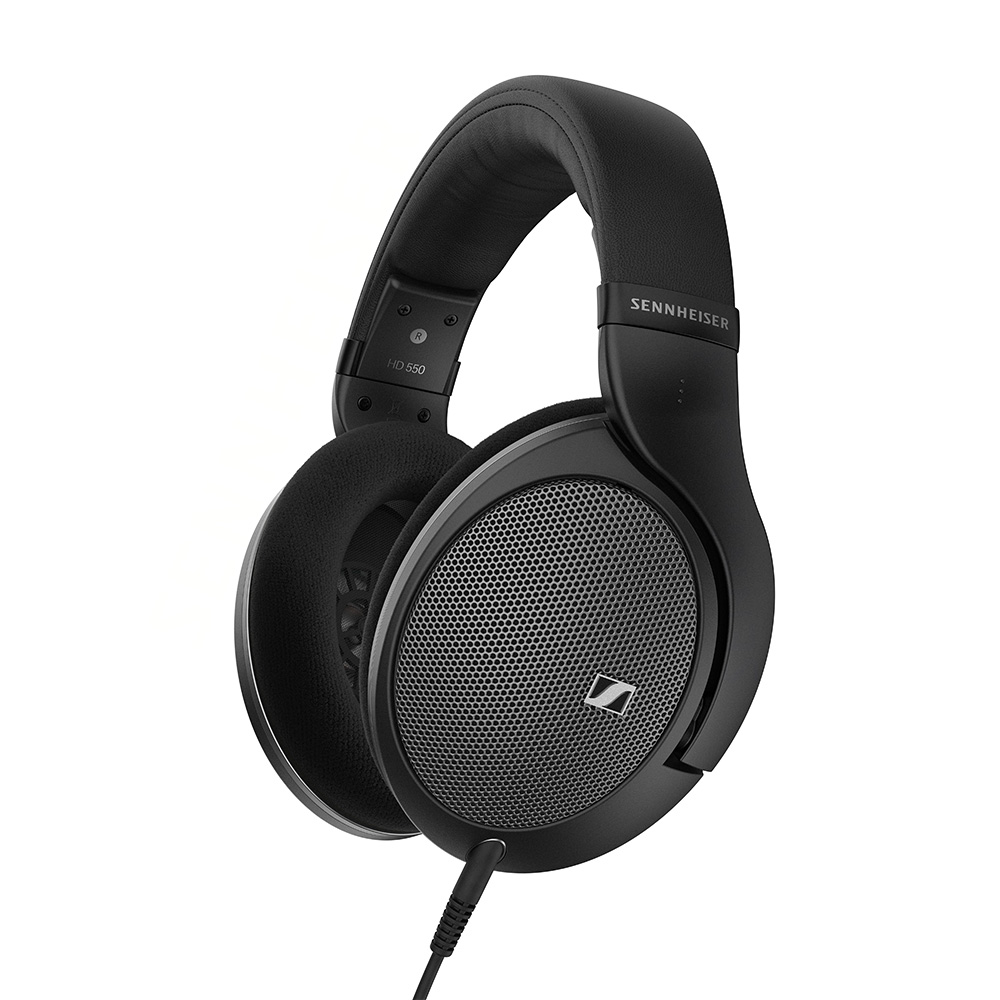
The Sennheiser HD 550 makes a persuasive case for a dedicated home headphone: a light, open construction, a replaceable analogue cable and no dependence on batteries or software. Its appeal is not a long feature list. It is the possibility of an uncluttered listening system that puts comfort and a carefully judged presentation ahead of wireless convenience. The important buying question is whether that focused role suits your room, source and musical preferences.
Sennheiser HD 550 — Design and comfort for longer sessions
The HD 550 uses an over-ear, open-back design with synthetic velour pads. That combination deserves consideration if sealed earcups tend to become uncomfortable during long listening sessions. Ventilation and a relatively undemanding physical format can be more useful at a desk than folding hinges or elaborate transport accessories. Fit still varies with head shape, glasses and the condition of the pads, so comfort should remain something to check during an audition rather than an absolute promise.
SoundGuys lists a weight of 237 g and describes comfort as a strength in its original review. Those observations support treating the HD 550 as a serious candidate for extended computer use. They do not establish that every listener will prefer its fit to a different Sennheiser chassis. A lighter headphone with the wrong pad contact can still become distracting; an individual fit check is more valuable than judging comfort from photographs alone.
The finish is practical rather than a demonstration of luxury materials. That is a reasonable trade if the headphone will remain beside a computer or amplifier. The supplied drawstring bag is useful for keeping dust away, but it is not a substitute for a rigid protective case when packing a bag with other equipment. Budget for suitable protection if the HD 550 will regularly travel between locations.
What published listening tests establish
The independent evidence is broadly encouraging, but it is not unanimous about the exact balance. Headphones.com praises the tuning and midrange performance while identifying a lower-treble emphasis that can add an edge to certain recordings. The useful conclusion is that the HD 550 deserves consideration for tonal balance, with particular attention to cymbals, vocal consonants and other energy in that part of the spectrum during an audition.
T3 offers a more reserved assessment of its musical engagement. That distinction matters: a headphone can reveal information clearly and still leave a listener wanting a different sense of impact or momentum. We would therefore avoid describing the HD 550 as an automatic upgrade for everyone who owns a warmer or more energetic headphone. Compare familiar tracks at matched listening levels, especially material that sometimes sounds sharp on other equipment.
SoundGuys positions the HD 550 as a comfortable platform for music listening and equalisation. Taken together, these reviews support its place on a home-listening shortlist, while leaving room for disagreement about taste. Our assessment draws on those published tests and the manufacturer’s documentation; it is not an account of an Audio Review listening session or laboratory measurement.
Open-back operation sets the limits
The open construction is a defining requirement, not an incidental detail. It gives sound a route out into the room and allows environmental sound to reach the listener. A quiet private desk or listening chair is therefore the natural setting. An office with nearby colleagues, a shared bedroom or public transport places very different demands on a headphone. A closed-back alternative is the more sensible starting point when isolation is essential.
This also limits its usefulness beside a live microphone. A boom microphone or desk microphone does not make the headphone acoustically sealed. If a recording setup is sensitive to spill, judge leakage at the actual monitoring level and microphone position before choosing it for tracking. Music listening, editing and occasional voice calls are different jobs; a headphone that works well for one need not be the best choice for all three.
Open-back construction alone does not guarantee accurate positioning or a particular soundstage size. Those experiences depend on the recording, fit and individual hearing as well as the headphone. The sensible expectation is a product intended for an unisolated listening environment, rather than an immersive-room simulation or a replacement for properly positioned loudspeakers.
Source matching and sensible amplification
Sennheiser specifies a nominal impedance of 150 ohms and sensitivity of 106.7 dB for 1 V RMS. The combination is more informative than impedance alone. A source needs adequate clean voltage for the required listening level and recording, but the specification is not an instruction to buy an unusually powerful amplifier. Begin with the output you already own and establish whether it has sufficient level and usable volume adjustment.
A computer headphone socket, a USB dongle and a desktop headphone amplifier can have different output capabilities. The HD 550’s analogue plug cannot establish that any one of them is suitable in every circumstance. Check the source documentation, listen at a conservative level and leave enough headroom for quieter recordings. A poor match is a reason to investigate the source, not proof that an expensive converter is automatically necessary.
The included 1.8 m cable terminates in a 3.5 mm plug, with a screw-on 6.35 mm adapter supplied. That accommodates many everyday headphone outputs without changing the signal into a different format. A phone without an analogue socket needs a compatible USB audio adapter or another suitable source. The larger screw-on adapter is a mechanical connection accessory, not an amplifier or a balanced-output conversion.
Ownership, maintenance and feature trade-offs
The replaceable cable is valuable for a headphone intended to remain useful over several years. Check the connector and locking arrangement when buying a spare; a random cable with a superficially similar plug is not enough to establish compatibility. The same principle applies to pads. Replacements can affect fit and the acoustic relationship around the ear, so choose parts intended for the model rather than assuming every similarly shaped pad will preserve its balance.
There is no battery to charge, pair or gradually wear out through charge cycles. In return, the HD 550 does not supply Bluetooth operation or active noise cancellation. Its included cable is not an integrated call-control system. Listeners who need one headphone for flights, meetings, commuting and music may find a wireless model more practical, even if a dedicated open headphone remains attractive for a separate home system.
For games and media, check the complete connection route. A device with a suitable analogue headphone output is different from a television that only provides optical or HDMI audio. The headphone does not decode those digital connections directly. A microphone, chat controls and any virtual-surround processing also depend on other equipment; none follows automatically from the open-back design.
Alternatives to consider
The Sennheiser HD 600 is an obvious reference point for a home-listening comparison. Auditioning the two is more useful than assuming the higher model number must suit every listener better. Compare vocal tone, high-frequency comfort and physical fit, then consider the complete purchase price with any source equipment you actually need.
The Sennheiser HD 490 PRO addresses a more explicitly studio-oriented use case. Its different package and intended workflow deserve attention if production work is central to the purchase. For broader convenience, the Momentum 4 Wireless belongs in a different comparison: it answers portable and wireless requirements that the HD 550 deliberately leaves to other equipment.
Value depends on the current European asking price and on what is already in your system. Compare final local prices, warranty arrangements and replacement-part availability. A discount is useful only if the headphone is right for the listening environment; buying an open model for a noisy commute is not made sensible by a lower price.
Sennheiser HD 550 key specifications
- Acoustic design
- Dynamic, open-back
- Impedance
- 150 ohms
- Sensitivity
- 106.7 dB / 1 V RMS
- Cable
- 1.8 m
- Connector
- 3.5 mm, supplied 6.35 mm adapter
- Ear pads
- Synthetic velour
- Wireless connectivity
- None
- Frequency response
- 6 Hz–39.5 kHz (manufacturer specification)
- Weight without cable
- 237 g
- Included storage
- Drawstring bag
Verdict
The HD 550 is a convincing option for listeners building a straightforward wired system in a quiet space. Its documented connections and published evaluations make a stronger case for focused home use than for an all-purpose role. Comfort, serviceable accessories and a generally well-regarded tuning are the central reasons to investigate it.
The reservations are equally clear: isolation is absent, portable conveniences are limited, and published reviewers differ over its treble character and sense of engagement. Our recommendation is to shortlist it for a private desk or listening area, check the fit and source pairing, and compare familiar music before committing. It is a considered specialist choice rather than a universal headphone solution.
Primary documentation and independent reviews
Sennheiser EU HD 550 product information · Sennheiser HD 550 specifications · Headphones.com original HD 550 review · SoundGuys original HD 550 review · T3 original HD 550 review
Editorial record
Sources and updates
Product specifications and factual claims were checked against Official Sennheiser HD 550 product page ↗. Scores and buying advice follow our category-specific editorial methodology.
- Published
- November 7, 2026
- Last updated
- November 17, 2026