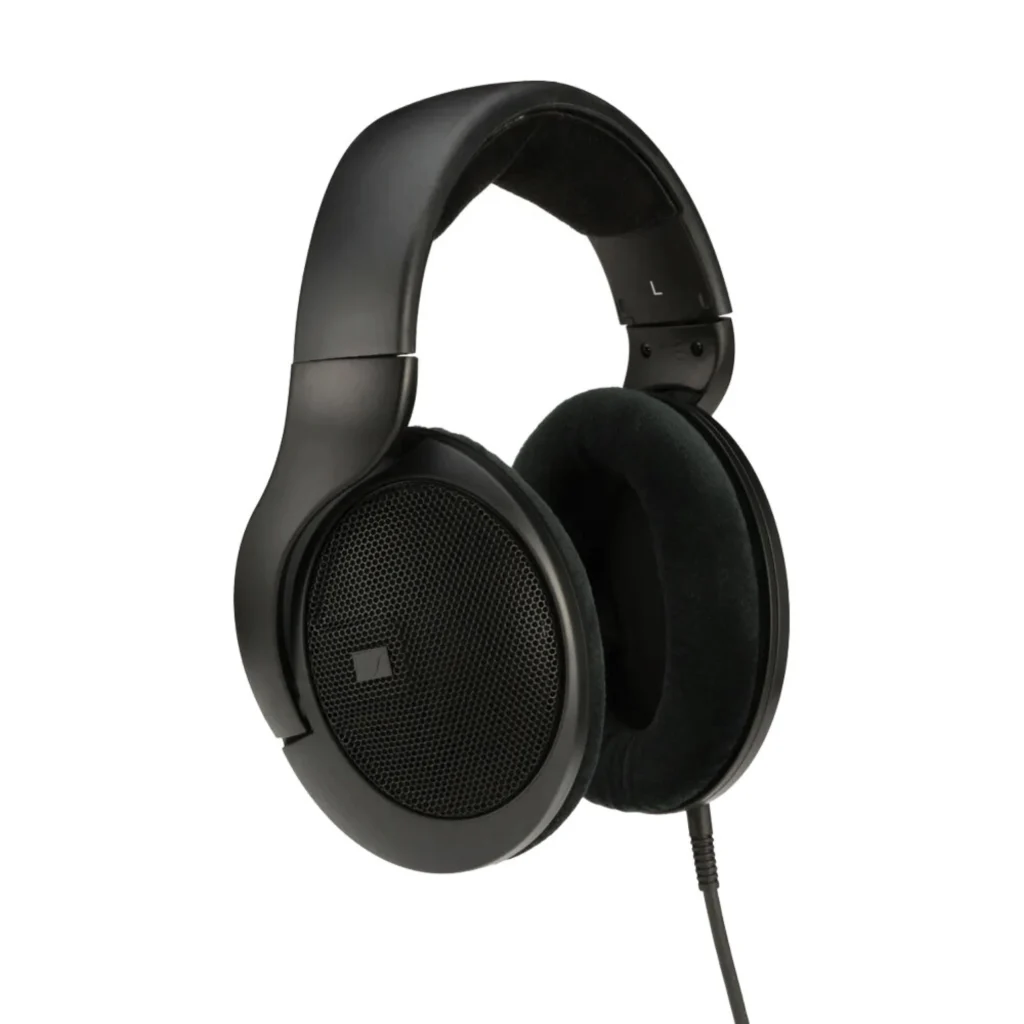
Sennheiser HD 400 PRO is a wired open-back headphone aimed at a quiet editing and mixing workspace. Its lightweight construction, velour pads and choice of supplied cables are practical features for someone spending long periods at a desk. The important qualification comes before any sound description: an open headphone lets outside noise in and playback out. It is therefore a different tool from a closed tracking headphone, even when both are sold for studio use.
Research-based review. This assessment draws on manufacturer documentation and the original independent evaluations linked below. Audio Review has not performed a hands-on test of this model.
A studio role that depends on the room
For editing, checking balances and working through a mix without loudspeakers, the HD 400 PRO is a plausible choice. A quiet private space lets its open design make sense. In a shared office or beside an active recording microphone, leakage may become a practical obstacle before any tonal advantage can matter.
Think about the tasks that occupy most of the session. Mixing an existing recording and tracking a quiet vocal are different requirements. One headphone need not do both. If only one pair can be purchased initially, decide whether isolation or a more open listening experience is the immediate priority. Buying the correct tool for the dominant task is more useful than expecting the word studio to describe a universal design.
Sound evidence and mix confidence
MusicRadar’s original review describes a clear, balanced and rich presentation, with a spacious quality that helps reveal detail. It is also positive about comfort. These findings support the HD 400 PRO as an audition candidate for analytical work; they do not establish that every mix made on it will translate perfectly.
Learn the headphone with recordings you know across other systems. Pay attention to how much bass and vocal presence those references have, then compare your own work at a similar level. A new headphone is not an instant calibration of the listener’s judgment. For important decisions, use another familiar playback reference where possible. Confidence comes from understanding the headphone’s behaviour rather than assuming an advertised reference role removes every uncertainty.
Comfort is part of the working performance
The official specification gives a weight of two hundred and forty grams without the cable. Velour pads and the over-ear shape are intended for extended use, but fit still depends on the listener. Try them with glasses if worn, and allow more than a brief shop demonstration to assess pressure and ear clearance.
A comfortable headphone can make careful low-level work easier because the listener is less distracted by heat or a pressure point. It does not justify working indefinitely without breaks. If adjustment is needed repeatedly to maintain comfort or a stable position, compare another shape before buying. The most technically appealing specification is less useful when physical discomfort continually interrupts the session or encourages the owner to avoid using the headphone.
Two cable styles and a fixed desk
The supplied coiled and straight leads let the owner choose a routing style. A coiled cable can help keep excess length from lying across a work surface, while a straight lead may pull less when the listener moves. Try the actual cable path from the interface or headphone amplifier to the chair.
Keep the lead from passing under chair wheels or pulling against a small desktop device. Confirm the removable connector is properly seated and use a compatible replacement rather than assuming any similar-looking plug fits. The headphone is a wired listening tool without Bluetooth or a call microphone. That simplicity suits a fixed workstation, but someone expecting frequent phone calls or walking around a room should compare a different feature set.
Driving the 120-ohm load
Impedance is only one part of source matching. Check that the intended interface, computer or headphone amplifier provides a comfortable level with some usable range left in the control. Start low, and do not use the final few steps of a volume slider as a reason to raise listening level beyond comfort.
An external amplifier is useful when the existing output has a real limitation, such as insufficient level, noise or inconvenient control. It should not be assumed necessary solely because the headphone has a three-digit impedance figure. If the present source already works cleanly at a suitable level, compare before spending on an additional box. The most useful upgrade may instead be a better work position, less room noise or more familiar reference material.
Open-back does not mean ideal for every recording
The lack of isolation lets nearby sounds compete with quieter details. A fan, conversation or traffic can make the listener raise volume unnecessarily or misjudge low-level material. Improving the environment is often a better solution than trying to overpower it.
For tracking, check leakage into the actual microphone at the intended cue level. An open headphone may be acceptable for some situations, but it is a poor default for a quiet performance recorded with a sensitive nearby microphone. Keep a closed pair available when isolation matters. That division of roles also prevents a false upgrade comparison: a comfortable open headphone and a practical closed tracking headphone can both be good purchases without one making the other obsolete.
Value beside other Sennheiser models
HD 560S deserves a direct comparison because of the closely related open-back format and potential price difference. Look at the actual package and support rather than assuming that a professional suffix alone establishes better sound. HD 490 PRO offers another studio-focused route when its physical and practical differences matter.
If buying used, inspect pads, headband adjustment and the removable cable connection. Worn pads can alter fit and the listening result, so include replacement costs when comparing a low asking price. For a new purchase, a reliable return option can be valuable because comfort is personal. The HD 400 PRO is strongest as a complete working package that suits a quiet desk, not as a badge chosen independently of the rest of the setup.
Alternatives to consider
Sennheiser HD 560S: HD 560S is an essential value comparison for this open-back Sennheiser format. Compare the actual cable package, support and current price, and audition if possible rather than assuming the professional label guarantees a different class of listening result.
Sennheiser HD 490 PRO: HD 490 PRO is worth considering when its fit, pad options and studio package justify the extra outlay. The useful upgrade is one that improves your actual working routine or listening confidence, not simply a higher model number.
Sennheiser HD 400 PRO key specifications
- Design
- Open-back, over-ear, dynamic
- Connection
- Wired, detachable single-sided cable
- Impedance
- 120 ohms
- Weight
- 240 g without cable
- Pads
- Velour
- Supplied cables
- 3 m coiled and 1.8 m straight
- Source connector
- 3.5 mm with 6.3 mm adapter
- Wireless / ANC
- Neither
- Microphone
- None
- Transducer type
- Dynamic
Verdict
HD 400 PRO is a credible open-back option for quiet editing and mix evaluation, with a positive original review for balance, detail and comfort. Its light construction and cable choice make the practical proposition easy to understand.
Choose it with the leakage limitations in mind and compare HD 560S pricing before committing. For recording beside sensitive microphones, retain a closed alternative. The HD 400 PRO makes most sense when its fit and working package support consistent decisions in a suitable room, rather than when the professional label is expected to solve every monitoring task.
Primary documentation and independent reviews
Sennheiser official HD 400 PRO information · Sennheiser HD 400 PRO official technical sheet · MusicRadar original HD 400 PRO review
Editorial record
Sources and updates
Product specifications and factual claims were checked against Official Sennheiser HD 400 PRO product page ↗. Scores and buying advice follow our category-specific editorial methodology.
- Published
- November 17, 2026
- Last updated
- November 17, 2026