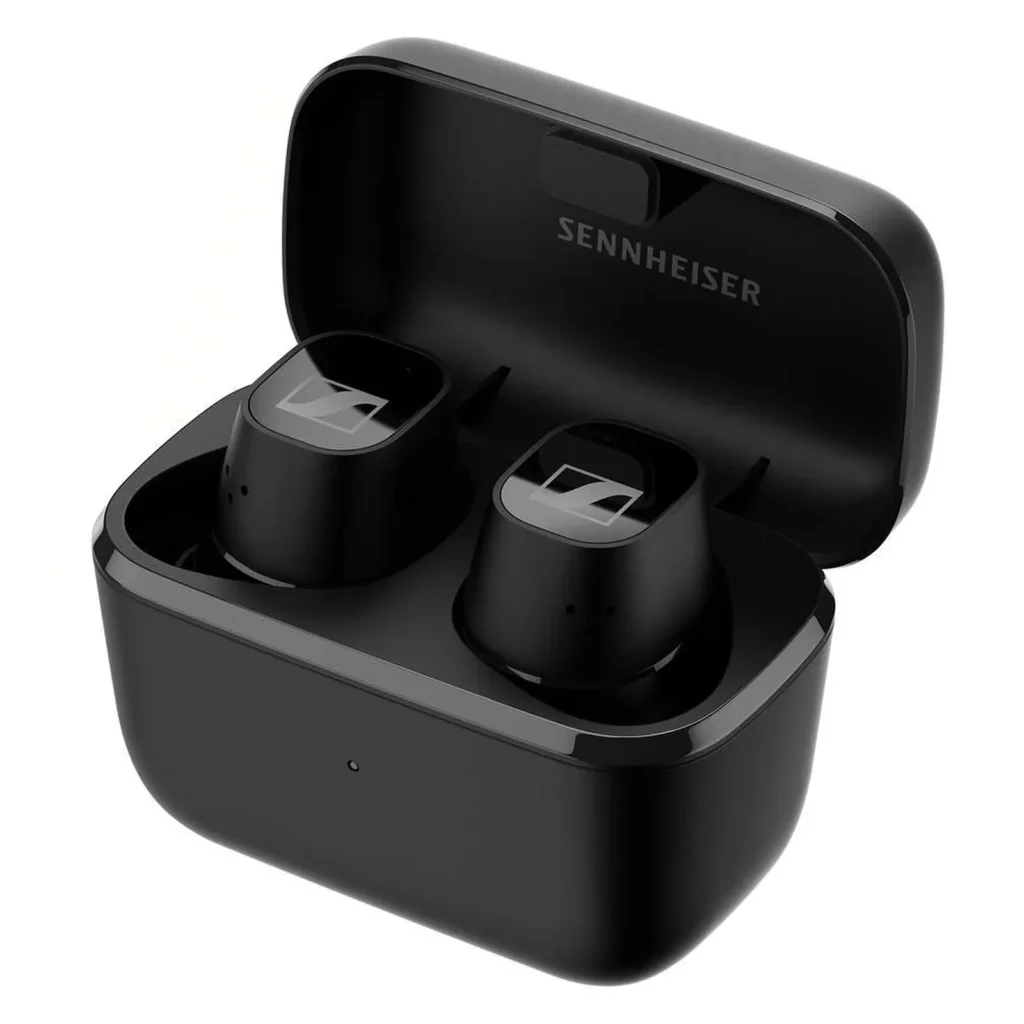
The Sennheiser CX Plus True Wireless adds noise cancellation to a straightforward sealed-earbud design. Its strongest appeal is musical competence without the cost of a flagship package, especially when sold at a sensible discount. As an older model, it needs to be assessed against current alternatives rather than the market and launch price that framed its earliest reviews.
Sennheiser CX Plus True Wireless — Design and fit
The CX Plus has a relatively boxy housing with touch-sensitive outer surfaces. It is not the same product as the ordinary CX True Wireless: the Plus adds active noise cancellation and Transparent Hearing. The similarly named SE version is also worth identifying accurately when comparing finishes and retail offers.
SoundGuys’ original review finds the design straightforward to use and broadly similar to the earlier CX. Its familiar shape does not remove the need to check fit. A sealed earbud must stay comfortable and maintain its seal while talking or walking, not merely sit securely for a short demonstration.
Try the supplied tips systematically. If low notes disappear when you move your jaw, the seal needs attention before any sound judgement is reliable. A larger tip can help, but excess pressure is not a desirable trade for a more stable bass response. Persistent discomfort is a reason to choose another housing shape.
The relatively uncomplicated case suits someone who wants a place to charge and store the earbuds rather than an additional screen or transmitter. That simplicity is an advantage only if the omitted conveniences are genuinely unimportant to the owner.
Sound quality
SoundGuys reports an agreeable balance with some bass emphasis and a relatively restrained upper range against its reference target. Its reviewer finds voices clear and bass sufficiently controlled. That is encouraging evidence for everyday music, but it does not make the tuning a neutral studio reference or a universal preference.
A prospective buyer should check vocal presence on a familiar recording, then repeat the comparison with a busier track. A relaxed upper balance can be comfortable with bright music, while someone who prefers more forward vocals may want a different presentation. This is a question of the complete tonal balance rather than a simple ranking of driver quality.
The Smart Control app offers sound adjustment. Make changes with a stable physical fit and similar playback volume, because both variables can have a larger effect than a small equaliser movement. Keep a standard setting available for comparison instead of changing several controls without an obvious reference.
The most useful sound comparison is against an earbud you already understand. If the CX Plus improves comfort and musical balance during ordinary listening, that is a stronger reason to buy than expecting a codec or brand name to reveal previously inaccessible detail on every track.
Noise cancellation and Transparent Hearing
The Plus model’s ANC is a meaningful addition over passive isolation. SoundGuys’ testing supports useful reduction of persistent low-frequency noise, alongside good passive sealing. It should nevertheless be evaluated as an older noise-cancelling system rather than assumed to match current flagship performance.
A train commute, a quiet office and an aircraft cabin place different demands on earbuds. Consider the dominant sound in the actual routine. If the goal is reducing a steady engine rumble, ANC can be useful; if the main distraction is nearby speech, the fit and passive isolation remain especially important.
Transparent Hearing makes a brief conversation or announcement easier to follow without removing the earbuds. It is a different facility from cancellation, and its usefulness depends on music level as well as microphone processing. Pause playback when understanding the surroundings matters more than keeping the soundtrack running.
Comfortable fit is essential to the value of both modes. Constantly readjusting the earbuds can change bass and noise reduction at the same time, making an otherwise capable system frustrating in practice.
Codecs, connections and calls
The official manual lists Bluetooth 5.2 with SBC, AAC, aptX and aptX Adaptive. A compatible Android source may access the latter options, while an iPhone normally uses AAC. The presence of aptX Adaptive in the earbuds cannot add it to a phone that does not support it.
Do not confuse stored pairing information with simultaneous multipoint operation. If effortless switching between a work computer and a phone is essential, verify the supported connection behaviour before buying rather than assuming it from the Bluetooth version. Different products using the same version can offer different facilities.
For video, perceived synchronisation depends on the source and application as well as the codec. A low-latency feature should not be treated as proof of suitability for every competitive game or recording task. A wired connection remains the more predictable option when timing is critical.
SoundGuys describes the microphones as adequate for calls but somewhat muffled, with limitations in background noise. That makes occasional conversations a more natural use than treating the CX Plus as a dedicated work headset. If meetings are central to the purchase, test speech intelligibility from the receiving end in the normal room.
Battery and charging
Sennheiser’s official table claims up to eight hours from the earbuds and up to twenty-four hours with the case under defined conditions, including ANC and transparency off, AAC playback and a specified level. These are manufacturer figures, not promises of continuous noise-cancelling use.
SoundGuys measured approximately five hours and forty-four minutes from its left earbud with ANC off, with the other lasting a few minutes longer. That gap is a good reason to plan with reserve rather than treating the advertised maximum as a guaranteed minimum. Test volume and other conditions help explain why results differ.
The official manual states roughly ten minutes of charging for an hour of music and about ninety minutes for a full charge. The case uses a wired charging arrangement rather than wireless charging. Confirm the exact retail package and follow the current manual rather than relying on an old review’s accessory description.
Battery age matters when buying an older wireless model. Check that the unit is new, covered by a suitable warranty and supplied through a reliable retailer. A very low price is less attractive if replacement or return support is uncertain.
Durability and value today
The earbuds have an IPX4 splash-resistance rating. That is relevant to light rain and ordinary perspiration within the rating’s limits, but it does not approve swimming or establish protection for the charging case. Let the earbuds dry before charging and avoid leaving moisture around the contacts.
The CX Plus makes its strongest case at a price that reflects its age. Its core combination of agreeable music reproduction, ANC and broad codec support can still be useful. Newer alternatives may provide better endurance, smaller housings or more convenient device switching, so those features should be compared directly.
For an existing owner, there is little reason to replace a comfortable working pair solely because the model is older. For a new buyer, the calculation is different: the real offer, return policy and fit should decide whether an established product is a bargain or simply outdated stock beside a more suitable current option.
Alternatives to consider
Sennheiser Accentum True Wireless: Compare the newer Sennheiser alternative for fit, current features and the actual price difference.
Sony WF-C710N: A useful current ANC comparison when straightforward everyday listening is the priority.
Nothing Ear (a): An alternative with a different physical shape and app experience to audition before committing to older CX Plus stock.
Sennheiser CX Plus True Wireless key specifications
- Bluetooth
- 5.2
- Codecs
- SBC, AAC, aptX, aptX Adaptive
- Noise control
- ANC and Transparent Hearing
- Battery claim
- Up to 8 hours; up to 24 hours with case, ANC off conditions
- Fast charge claim
- Approximately 10 minutes for 1 hour playback
- Weight
- Approximately 6 g per earbud
- Resistance
- IPX4 earbuds
View the official Sennheiser CX Plus True Wireless product page
Verdict
The CX Plus True Wireless remains a capable everyday earbud when the fit works and its price reflects its age. Useful ANC and codec support strengthen the package, while modest independent battery results and call limitations deserve attention. Buy from a supported retailer and compare newer alternatives before treating a discount as decisive.
Primary documentation and independent reviews
Sennheiser CX Plus official specifications · Sennheiser official connection FAQ · SoundGuys original CX Plus review · RTINGS original CX Plus review
Editorial record
Sources and updates
Product specifications and factual claims were checked against Official Sennheiser CX Plus True Wireless product page ↗. Scores and buying advice follow our category-specific editorial methodology.
- Published
- November 7, 2026
- Last updated
- November 8, 2026