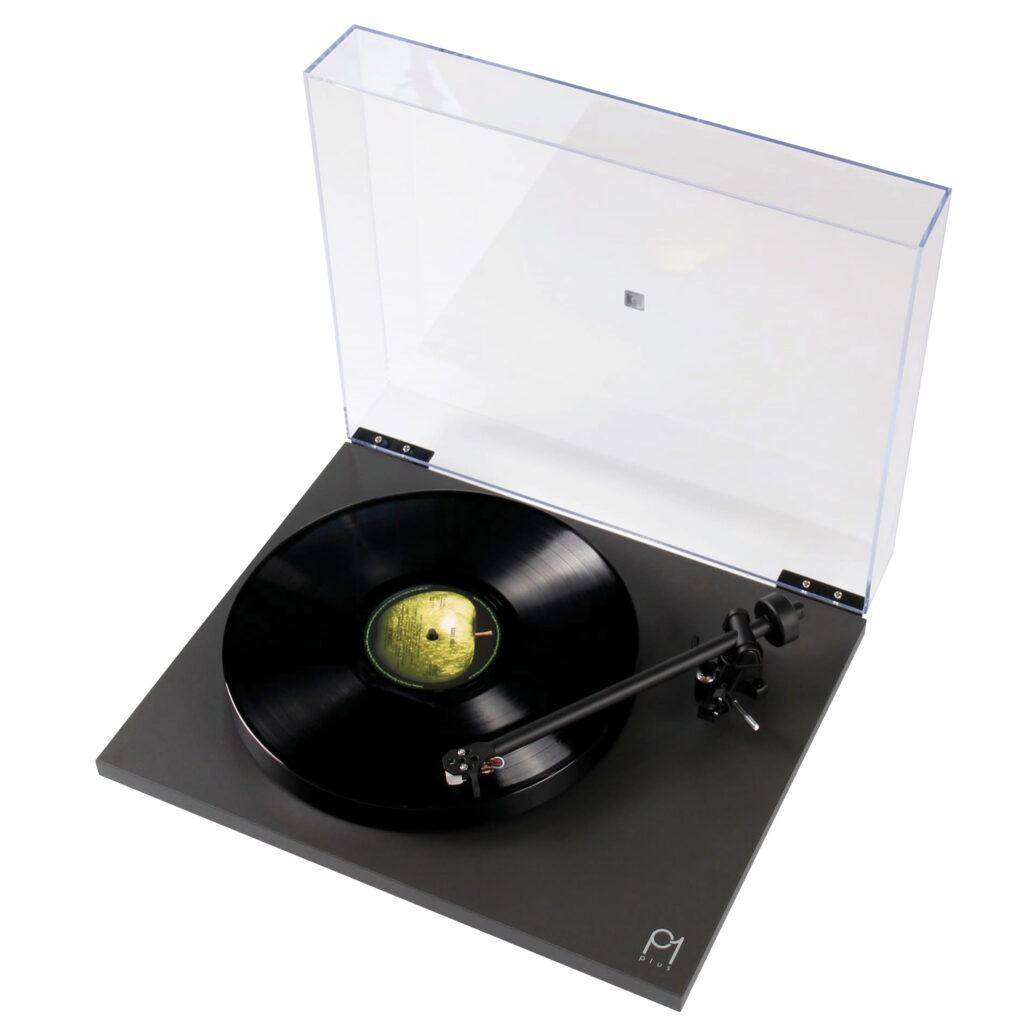
Rega Planar 1 Plus takes a familiar manual turntable formula and adds a built-in moving-magnet phono stage. The practical benefit is a line-level connection to a suitable amplifier or powered-speaker system, with one fewer separate box to choose. It remains a manual record player: the owner handles the arm and changes speed at the belt pulley. The Plus name describes a real connection difference from the standard Planar 1, rather than simply a different finish.
Research-based review. This assessment draws on manufacturer documentation and the original independent evaluations linked below. Audio Review has not performed a hands-on test of this model.
What the built-in phono stage changes
The integrated stage raises the cartridge signal to a level suitable for a line input. Rega’s instructions explicitly warn against connecting the Plus to an amplifier’s phono input. Choose an input intended for a normal line source and reduce the volume before switching the player on or off.
This makes the Plus attractive when an amplifier lacks a phono input or when compact powered speakers provide an appropriate analogue input. It does not remove the need for amplification: passive speakers cannot connect directly and play from the turntable. Draw the complete path before buying, from cartridge through phono stage and volume control to speaker amplifier. The convenience is greatest when that path is simple and every stage has an identified role.
Arm, cartridge and initial setup
The current specification includes Rega’s RB110 arm and a factory-fitted Carbon moving-magnet cartridge. Bias is preset, and the manual explains how to fit the balance weight to the designated stop. That is a more approachable start than selecting and aligning a cartridge independently.
Read the supplied instructions rather than borrowing an adjustment sequence for another Rega arm. Check the unpacking steps, belt position and stylus guard before playing a record. A dealer demonstration can be particularly useful for someone unfamiliar with handling an exposed stylus. The simplified setup reduces the initial work, but the player still needs a stable position and careful use. It is not an automatic appliance that can be operated without learning the basic arm and cueing controls.
Musical performance in the original review
What Hi-Fi’s original evaluation praises the Plus for clarity, agile rhythm and an engaging presentation. Its comparison with a separate Planar 1 and phono-stage arrangement favours the integrated model’s cleaner character while recognising a different sense of weight from the separates. Those are attributed listening findings, not measurements or a hands-on result from Audio Review.
The review dates from an earlier production period; the current manufacturer specification lists the EBLT belt. That current specification should not be presented as a component independently measured in the older test. For a purchase today, listen to the actual supplied deck with familiar records and a plausible partnering system. Judge vocal balance, bass definition and listening comfort across several records rather than expecting every pressing to have the same character.
Manual speed changes and daily handling
The official setup instructions describe moving the belt between the pulley steps for thirty-three and one-third and forty-five rpm. There is no front-panel electronic speed selector. This is unobtrusive for someone mainly playing one record format, but more relevant if a session frequently alternates albums and singles.
Handle the belt and platter as instructed and keep the stylus protected during setup. Ask for a demonstration of changing speed and cueing the arm before deciding the manual arrangement suits you. A slightly more elaborate turntable may be the better purchase if it makes those everyday actions easier. Conversely, paying for automatic operation is unnecessary when the tactile process of selecting and playing a record is part of the attraction.
Placement matters more than the finish
A turntable is a mechanical source, so the support deserves attention. Rega recommends a firm, level surface and advises against sharing the same surface with loudspeakers. A visually convenient cabinet is not automatically a good location if it moves when people walk past or receives strong vibration from nearby speakers.
Plan room for the lid and for safe access to the arm. Keep records and accessories from obstructing the player, and avoid routing cables where they pull against the sockets. If the system produces a low-frequency rumble that increases with volume, investigate the mechanical arrangement before buying a different cartridge. Better isolation and sensible placement can be a more useful first step than replacing a component that has not yet been given a fair installation.
The limits of an integrated approach
The Plus is designed around its internal phono stage and line-level connection. Treat it as that complete package, rather than assuming it provides the same phono-stage flexibility as the standard Planar 1. If selecting and upgrading an external stage is central to the plan, start by comparing the non-Plus deck.
There is also no USB recording connection or Bluetooth transmission. A wish to archive records to a computer or listen through a wireless-only speaker introduces extra equipment and a different workflow. Decide whether those are occasional experiments or core requirements. A simple analogue player can be excellent for its intended role, but it becomes poor value when the owner immediately needs adapters and additional boxes to make it behave like a more feature-focused alternative.
Ownership, consumables and value
Budget for record care, a safe stylus-cleaning routine and eventual stylus replacement. Confirm the correct replacement part and procedure with a dealer rather than assuming any visually similar stylus fits. If buying used, assess the condition of the cartridge, belt, bearings and lid as well as the price.
The Plus can save both space and a separate phono-stage purchase, which makes its price easier to understand in a complete system. If a capable external stage is already owned, that advantage largely disappears. Compare current dealer packages and support, including a demonstration and setup help where available. The strongest value is a well-installed player that encourages regular use, not a nominal saving followed by a series of avoidable compatibility purchases.
Alternatives to consider
Rega Planar 1: Choose the standard Planar 1 when a suitable phono stage is already available or when you want to choose that stage separately. Include the phono-stage cost if starting from scratch; comparing the deck prices alone misses a necessary part of the system.
Audio-Technica AT-LP5x: The AT-LP5x suits a different feature preference, including direct drive and a more flexible connection package. Compare operation and setup as well as the listening presentation, especially if changing speed or digitising records is part of the routine.
Rega Planar 1 Plus key specifications
- Drive
- Belt drive with EBLT belt on current specification
- Operation
- Manual
- Speeds
- 33⅓ and 45 rpm, manual pulley change
- Tonearm
- Rega RB110
- Cartridge
- Factory-fitted Rega Carbon moving magnet
- Phono stage
- Integrated moving-magnet preamplifier
- Output connection
- Line-level stereo RCA
- Bias
- Preset
- Motor
- 24 V synchronous
- USB / Bluetooth
- Neither
- Weight
- 4.35 kg
Verdict
Planar 1 Plus is a strong candidate for a listener who wants a straightforward manual vinyl system with a ready line-level output. The original independent assessment supports its musical appeal, and the current official documentation makes the setup and connection requirements clear.
Choose it when the built-in stage genuinely simplifies the system. Compare the standard Planar 1 if an external stage is part of the plan, and a feature-rich alternative if USB, wireless playback or quicker speed selection matters. With suitable placement and the right input connection, the Plus offers a coherent route into vinyl without demanding a large collection of separate components.
Primary documentation and independent reviews
Rega official Planar 1 Plus information · Rega Planar 1 Plus setup and connection instructions · What Hi-Fi original Planar 1 Plus evaluation
Editorial record
Sources and updates
Product specifications and factual claims were checked against Official Rega Planar 1 Plus product page ↗. Scores and buying advice follow our category-specific editorial methodology.
- Published
- November 17, 2026
- Last updated
- November 17, 2026