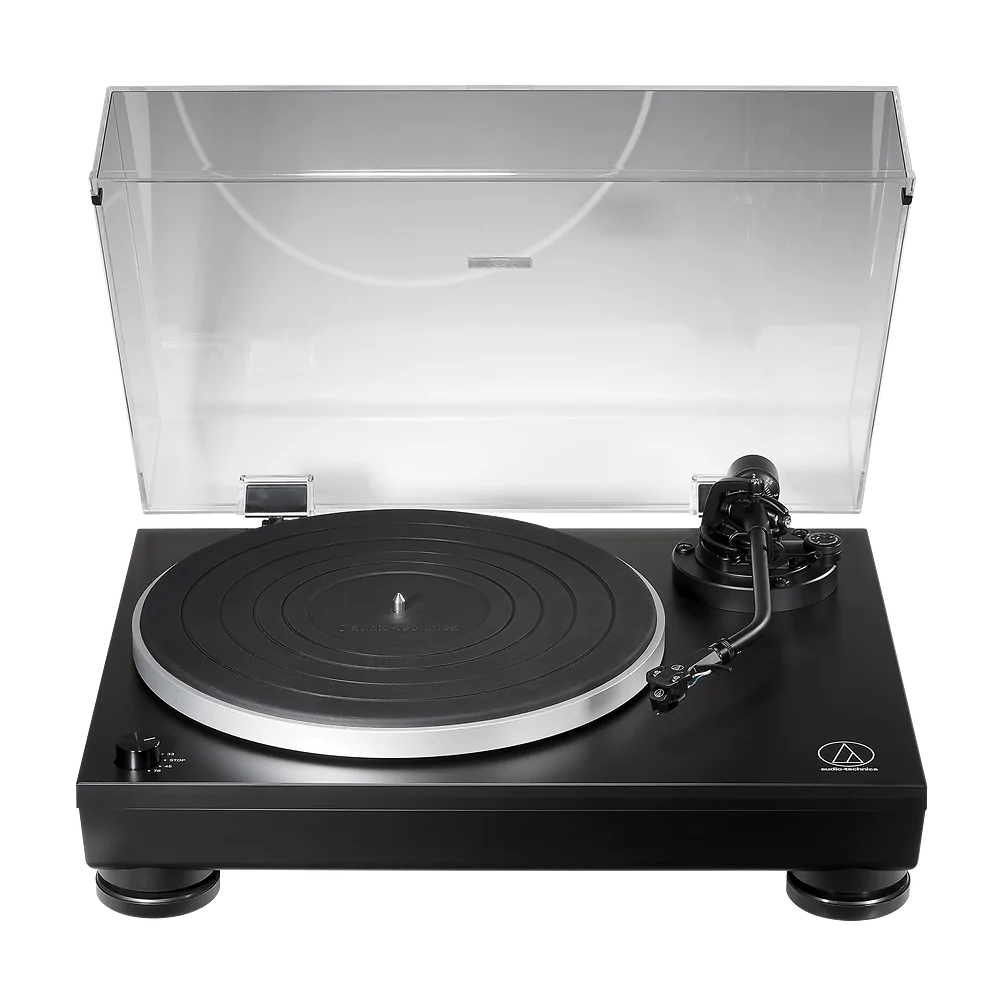
The Audio-Technica AT-LP5X combines a manual direct-drive deck with a built-in phono stage and USB recording output. That makes it more self-contained than a bare turntable platform, while still allowing cartridge and phono-system choices. Its appeal is the combination of conventional record playback and a documented route to computer capture.
Audio-Technica AT-LP5X — A manual platform with a replaceable cartridge
The official manual lists direct drive, a static-balanced J-shaped arm and an AT-VM95E cartridge mounted in an AT-HS6 headshell. The removable headshell and VM95 stylus family make maintenance and compatible changes practical, but they do not remove the need for alignment and tracking-force checks.
Manual operation means the listener cues the arm and handles the end of a side. That is appropriate for an attentive listening setup and less convenient than automatic return for some households. Try the controls and cueing routine before deciding that a more adjustable deck is necessarily the easiest one to live with.
Built-in MM/MC settings need correct use
The internal phono stage has MM and MC settings, along with PHONO and LINE output selection. The supplied VM95E uses the MM setting. If a different cartridge is installed, consult its output and loading requirements rather than assuming every MC cartridge suits one generic setting.
Use LINE into an ordinary line input, or PHONO into a suitable external or amplifier phono stage. Sending LINE output into another phono input can overload the next stage and apply equalisation twice. Conversely, feeding cartridge-level PHONO output into a line input produces an unsuitable level and response. The switch positions are part of setup, not minor optional tweaks.
USB recording is useful but not automatic restoration
The manual documents a USB output for a computer and 16-bit capture at selectable 44.1 or 48 kHz. This is a practical digitisation route, not a claim of high-resolution capture beyond those listed limits. Use suitable recording software and confirm levels before recording a full side.
A digital file preserves the playback chain’s output, including surface noise and setup problems. It does not automatically repair a worn record or remove clicks. Clean the record, check the stylus and leave headroom to avoid clipping. Keep an unprocessed capture before applying optional editing so changes can be revisited.
Three speeds do not cover every record unaided
The AT-LP5X supports 33⅓, 45 and 78 rpm. A 78-rpm record commonly requires a different stylus from the supplied LP-oriented one, and some archival material raises additional equalisation questions. Do not play valuable shellac solely because the speed switch reaches 78.
The specified dimensions are 450 by 352 by 157 mm and the weight is 7.3 kg. Provide a stable, level support with room to open the lid and handle records. Follow the manual’s grounding advice to address hum rather than improvising electrical changes.
For value, include any required 78 stylus, recording software workflow and local support in the budget. We have not measured speed stability, phono noise or USB conversion quality. Its documented connections make it versatile, but do not establish an audible advantage over another turntable in a different cartridge system.
What to expect in a real setup
What USB capture format is documented? The manual specifies 16-bit conversion at selectable 44.1 or 48 kHz. Do not advertise a higher recording resolution without a model-specific source.
Which phono setting fits the supplied VM95E? Use the MM cartridge setting. Select LINE or PHONO output according to whether the next component expects a line signal or needs phono-stage processing.
Alternatives to consider
Audio-Technica AT-LP120XUSB: Compare the different control layout and complete feature set if USB recording is a shared priority.
Technics SL-100C: A different direct-drive ownership approach to investigate when built-in USB capture and phono convenience are less important.
An analogue deck with a useful archive option
The AT-LP5X’s USB output can support a deliberate record-transfer workflow. Begin with a short stereo recording containing a louder passage, then listen to the saved file through the computer. This confirms capture settings and both channels before spending time on an entire side. Keep an unprocessed master before editing clicks or splitting tracks, and use clear file names and backups for material that matters. The USB connection captures the playback signal; it does not automatically restore a worn pressing.
Record care and cartridge setup remain important to that process. A poorly tracked or dirty record can produce a disappointing digital copy regardless of the application’s export settings. Work from a clean, correctly configured playback baseline before experimenting with restoration software. That makes any later processing easier to judge and keeps a reversible starting point available.
The MM/MC selector is a matching control
The supplied VM95E belongs with the appropriate moving-magnet setting. A future cartridge change requires checking output, recommended load and the phono-stage settings together. A switch labelled MC does not establish ideal compatibility with every moving-coil cartridge. Consult the actual documentation rather than assuming all models in a broad cartridge category need the same gain. Begin listening with receiving levels down after changing the signal path.
For an external phono stage, identify the correct output route and avoid applying phono equalisation twice. A raw cartridge signal should also not be expected to behave like an ordinary line source. These connection choices are more immediately important than comparing small headline differences between converter specifications.
A manual platform with defined priorities
Choose the AT-LP5X when adjustable manual playback, a replaceable cartridge and occasional USB transfers fit the intended use. If 78 rpm records are part of the collection, identify the appropriate stylus and format requirements before playing them; the speed setting alone is not sufficient. Someone who wants automatic return has a different priority and should compare accordingly. The strongest value comes from using the deck’s actual facilities within a well-matched system, with maintenance, a stable support and the phono path included in the purchase plan.
If recording an album for later listening, check the beginning and end of each side as well as the loudest track. Keep the source recording until the edited files have been checked and backed up; a mistaken cut is easier to repair from that master.
Audio-Technica AT-LP5X key specifications
- Drive
- Direct drive
- Operation
- Fully manual
- Speeds
- 33⅓ / 45 / 78 rpm
- Arm
- Static-balanced J-shaped
- Cartridge / headshell
- AT-VM95E / AT-HS6
- Phono stage
- Selectable MM / MC; PHONO / LINE output
- USB recording
- 16-bit, 44.1 or 48 kHz
- Dimensions W × D × H
- 450 × 352 × 157 mm
- Weight
- 7.3 kg
Verdict
The AT-LP5X is a useful wired-system candidate with a practical computer-recording route. Correct switch settings and cartridge setup are essential to getting the intended result. Choose it for the documented flexibility, and reserve sound-quality and measurement judgements for a properly configured test.
Primary documentation
Specifications and feature descriptions were checked against the following official documents on 6 November 2026. Compatibility advice is our interpretation of those documented capabilities; it does not establish measured sound quality. Regional bundles, software features and service availability can change, so verify the exact European model and current support information before purchase.
Editorial record
Sources and updates
Product specifications and factual claims were checked against Official Audio-Technica AT-LP5X product page ↗. Scores and buying advice follow our category-specific editorial methodology.
- Published
- November 7, 2026
- Last updated
- November 8, 2026