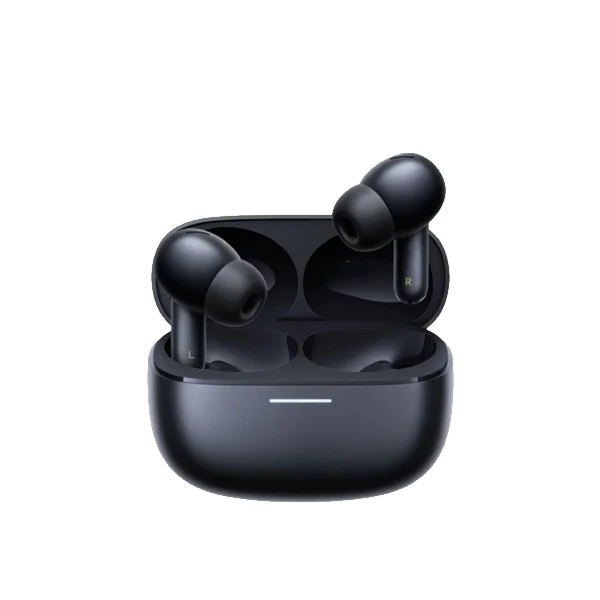
Redmi Buds 6 Pro is an established value-oriented earbud with a triple-driver arrangement, ANC and a broad app feature set. The original Scarbir evaluation is particularly enthusiastic about music, while identifying less polished multipoint behaviour and calls during movement. Regional versions also differ in app support and sound. It is therefore a strong candidate to configure and test carefully, rather than a recommendation based on assuming that every function works simultaneously or identically across imported and European offers.
Research-based review. This assessment draws on manufacturer documentation and the original published evaluations linked below. Audio Review has not performed a hands-on test of this model.
The music case is unusually strong at this position
Scarbir finds an engaging, full presentation with natural midrange and useful placement of instruments. It also describes differences between the China and global versions. Those observations support a music-focused shortlist without establishing identical balance from every regional unit.
Try a familiar voice, acoustic instruments and a dense arrangement. Check whether the fuller character remains organised and enjoyable across complete tracks. Compare at similar loudness and keep the same processing mode during a direct comparison. A listener who likes a rich presentation may value the result more than a feature-heavy alternative with a less preferred balance. Someone seeking a very restrained or sharply etched sound should audition directly. The driver count is useful background, but the listening evidence matters more than the number itself. If importing, identify the exact version before relying on another owner’s EQ advice or sound description. The best purchase is the particular unit and configuration that suits the library actually played.
Regional app compatibility matters before purchase
The original evaluation warns that the Chinese version does not use the western Xiaomi Earbuds app in the same way as the global edition. A lower imported price should therefore be compared with the complete supported package rather than treated as an identical offer.
Check the seller’s region description, model documentation and return arrangements. Confirm that the supported app is available for the intended phone and market. App access matters for updates, controls and feature selection, so it should not be dismissed as optional if those functions are central to the purchase. A product can still play ordinary Bluetooth audio while lacking the expected local management experience. Ask for clarification before ordering an ambiguous listing rather than assuming English packaging proves every regional detail. The useful comparison includes current price, support and the configuration that can actually be maintained over time. A modest saving is less attractive if the owner must continually work around a mismatched app or unclear firmware route.
LDAC and spatial processing require a choice
Xiaomi explicitly states that LDAC and dimensional audio are mutually exclusive. The original evaluation also encounters restrictions around immersive processing and multipoint. The complete feature list should not be presented as one simultaneously available operating mode.
Choose the daily priority first. For ordinary music from one compatible source, a higher-bitrate connection may be useful. For switching between a computer and phone, connection convenience may matter more. For a soundtrack, the spatial effect may be worth trying without being desirable for every album or spoken recording. Compare modes at similar loudness and keep a reference setup. LDAC remains a lossy Bluetooth format despite loose promotional language; its presence does not establish universal lossless playback. Check current firmware and the actual source support instead of assuming the same menus exist on every phone. The best configuration is the one that sounds preferred and behaves reliably, not necessarily the one with the greatest number of enabled labels.
Calls and switching deserve a current-firmware check
Scarbir reports overly eager source switching and a less consistent outgoing voice while walking or in wind. Its quiet-call experience is more reassuring. These are practical limits to assess even when the music verdict is highly favourable.
Test the actual phone and laptop together. Try unlocking the secondary device while music plays and conduct an incoming call before returning to the original source. Review the current app and firmware, because an older observation should not be declared either permanently present or resolved without evidence. For calls, ask another person about complete sentences while stationary and during normal movement. A reduction in background noise is not helpful if it also causes words to disappear. Someone listening mainly in one place may find the limitations minor. A frequent caller moving between devices all day should give them much more weight. The recommendation follows the whole routine rather than expecting musical enjoyment to compensate automatically for recurring communication friction.
Fit and cancellation work together
The original review finds a comfortable fit and useful ANC, with more limited reduction of some lighter, changing sounds. Xiaomi’s largest cancellation figures come from specified test conditions rather than every frequency at once. A stable seal remains part of the complete result.
Try the fitting parts independently for each ear and check comfort through a longer session. Listen to speech and bass after any adjustment so that a comfortable position is not simply a loose one. Compare cancellation modes in the intended environment and learn how to change them without shifting the earbud. Try volume swipes as well as playback actions while the phone is in a pocket. A reassuring fit is valuable when it remains easy to use repeatedly. If the main goal is stronger isolation than the previous pair, compare that task directly rather than ranking maximum marketing figures. Useful ANC is a practical benefit, but the final choice still needs comfortable contact, predictable controls and a presentation that suits the preferred recordings.
Runtime needs the exact feature conditions
The UK product page claims up to 9.5 hours and a 36-hour case-inclusive total with AAC and ANC off. The support FAQ gives somewhat different maxima and a shorter ANC-on claim. They should remain qualified manufacturer figures rather than a single guarantee for every setting.
Plan around the longest continuous interval required and leave room for volume, calls, codec choice and battery age. The case total requires recharging breaks. USB-C charging is provided without wireless charging, which may be a small or meaningful inconvenience depending on the desk routine. Compare the present European delivered price with the correct regional alternatives and verify the complete accessory set. Buds 6 Pro becomes especially attractive when its enjoyable music and useful cancellation serve the main role. It is less persuasive if difficult calls or unsettled source switching are central to the day. A deliberate setup and representative trial will reveal more about value than selecting the largest runtime from several published descriptions.
Alternatives to consider
Nothing Ear (2024): A useful existing comparison when considering app flexibility and a different music presentation. Check the exact generation, fit and current delivered price, then test the phone functions that will actually be used rather than choosing from driver counts.
Soundcore Liberty 4 NC: Compare this established alternative when cancellation and everyday value matter most. Judge its full review against the required connections, comfort and controls. A lower or higher launch position does not permanently determine the best present offer.
Redmi Buds 6 Pro key specifications
- Driver system
- 11 mm dynamic plus two 6.7 mm ceramic units
- Earbud weight
- Approximately 5.2 g each
- Bluetooth
- 5.3
- Codecs
- SBC, AAC, LDAC
- Connections
- Dual-device Bluetooth
- Noise control
- Adaptive ANC and transparency
- Processing
- Dimensional audio with head tracking; incompatible with LDAC
- Battery headline
- Up to 9.5 h earbuds; 36 h including case, AAC and ANC off
- ANC-on FAQ claim
- Up to 5.5 h music; actual settings vary
- Charging
- USB-C; no wireless charging
- App
- Xiaomi Earbuds; regional version matters
- Protection
- IP54 earbuds
Verdict
Redmi Buds 6 Pro has a strong music-value case with useful ANC and flexible adjustment. Choose the correct regional version, understand the mutually exclusive modes and test calls and switching on current firmware. Its strengths are substantial when those practical details fit the intended routine.
Documentation and original reviews
Xiaomi official UK Redmi Buds 6 Pro features and conditions · Xiaomi official UK Redmi Buds 6 Pro support FAQ · Scarbir original Redmi Buds 6 Pro evaluation and regional comparison
Editorial record
Sources and updates
Product specifications and factual claims were checked against Official Redmi Buds 6 Pro product page ↗. Scores and buying advice follow our category-specific editorial methodology.
- Published
- November 17, 2026
- Last updated
- November 17, 2026